 Identity Card
 National Identity Document
 Citizenship ID
 Unique Identity Document
 Personal Identification Document
 Unique Population Registry Code
 Personal Identity Card
 Civil Identity Card
 Identity and Electoral Card
 Check Plate Colombia
 Check Plate Peru
 Check Plate Mexico
 Check Plate Argentina
 Check Plate Chile
 Check Plate USA
 Check Plate Brazil


Customers now expect to open a bank account from a phone in a few minutes. For banks, that creates a harder problem: confirming every applicant is who they claim to be and meeting KYC and AML obligations, without adding so much friction that legitimate customers abandon the application.
The trade-off is sharp. Benchmarking research by Cornerstone Advisors found that for every digital checking application a bank completes, 3.36 are abandoned, and that fraud controls reject roughly one in four before approval (eMarketer). Tighten the checks and completion falls. Loosen them and fraud gets through.
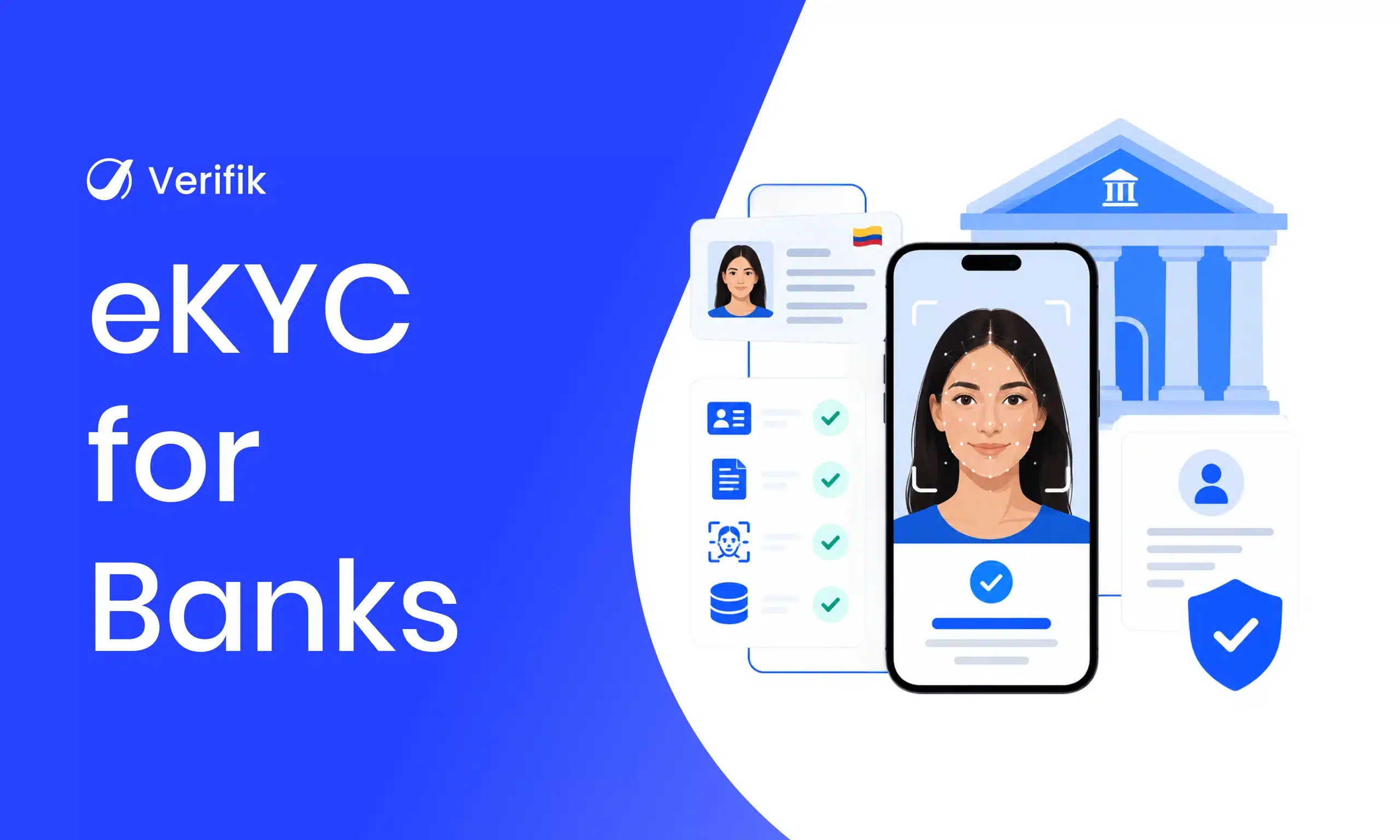
eKYC for banks closes that gap by running document, biometric, and database checks inside the onboarding flow rather than in a review queue after it. In this guide, you will learn what eKYC means in banking, the requirements it supports, how the process works step by step, the capabilities a platform should include, and what to weigh when choosing one.
What Is eKYC in Banking?
eKYC, or electronic Know Your Customer, is the digital process of verifying a customer’s identity before giving them access to banking products or services. It replaces the manual document review that traditionally happened at a branch or in a back office with automated checks that run during the application itself.
A banking eKYC flow normally combines several checks rather than relying on any single one:
- Document verification, to establish that an identity document is genuine and unaltered
- OCR, to extract the customer’s details from that document instead of asking them to type it
- Facial recognition, to compare a live selfie against the photograph on the document
- Liveness detection, to help confirm that a real person is present rather than a photo, video, or mask
- OTP verification, to confirm ownership of the phone number or email address on the application
- Database validation, to check the extracted details against available official records
The goal is not simply to approve more applicants. It is to separate genuine customers from fraudulent ones with enough confidence to support an onboarding decision, while keeping the process short enough that genuine customers actually finish it.
For this step, Verifik's option is smartENROLL: move your KYC to a digital flow with evidence for every check.
Why Banks Are Moving From Manual KYC to eKYC
Most banks did not set out to build a slow onboarding process. It accumulated. A document check here, a separate screening tool there, a manual review queue to catch what the tools missed. Each addition made sense on its own, and together they produced a journey that takes days and loses applicants at every handoff.
The contrast between the two approaches is easiest to see side by side.
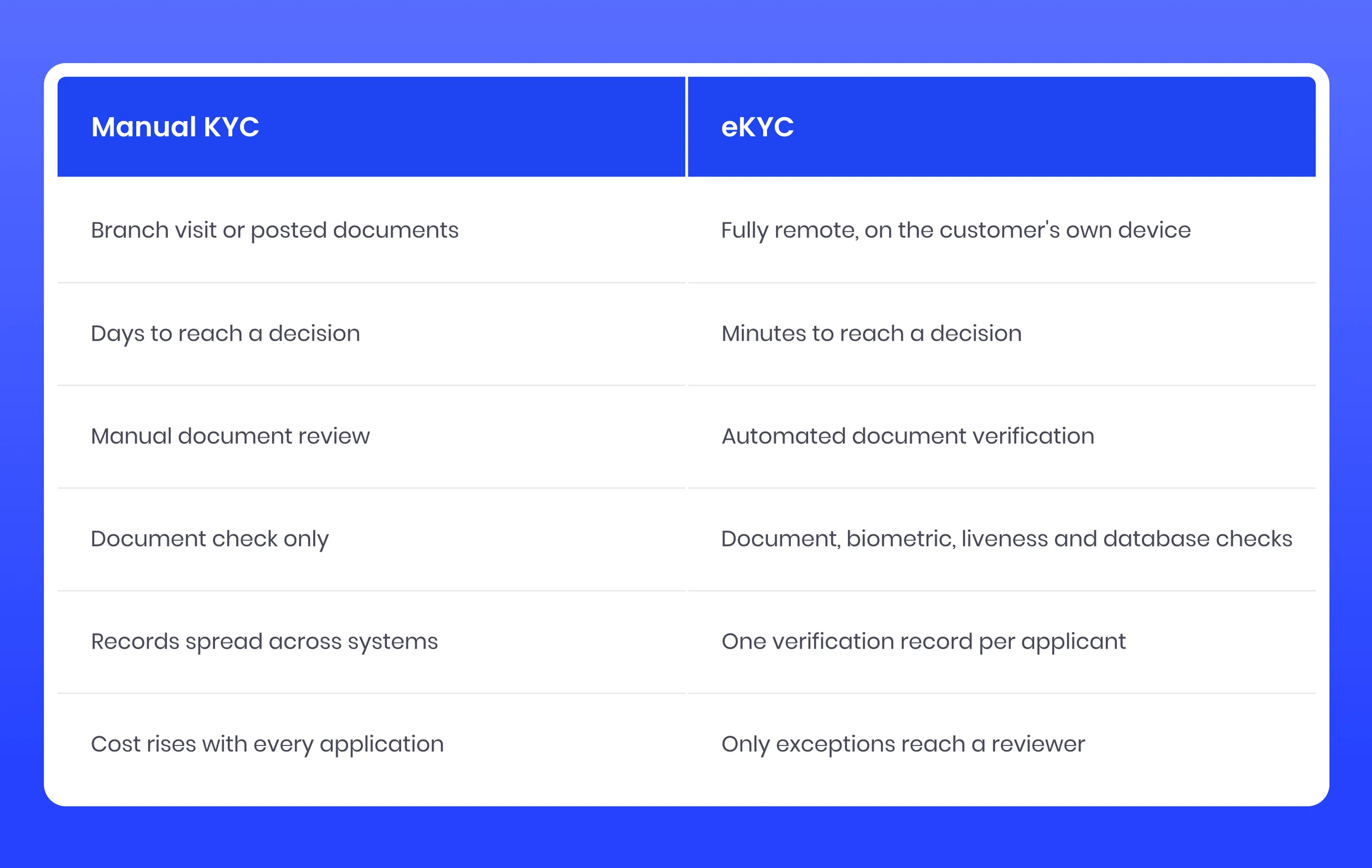
Manual KYC Does Not Scale
When applications arrived at a branch, a reviewer could handle the day’s volume. Digital channels remove that natural limit. Volumes rise, review queues lengthen, and approval times stretch at exactly the moment the customer is comparing you with a competitor who approved them this morning.
Disconnected Verification Tools
Running document checks in one system, screening in another, and biometrics in a third means no single place holds the full picture of an applicant. Two reviewers looking at the same customer can reach different conclusions, which is difficult to defend in an audit.
Document Checks Alone Are Not Enough
A genuine document in the wrong hands still passes a document check. Establishing that the person submitting the application is the rightful holder of that identity needs a biometric comparison and a liveness check, not a closer look at the document.
Compliance Cost Grows With Volume
Screening obligations, record keeping, and periodic review all expand as the customer base grows. Handling them manually means compliance cost rises in step with growth, which is the opposite of what a digital channel is supposed to deliver.
KYC and AML Requirements Banks Must Meet
Specific obligations differ by country and supervisor, but they are built on a common foundation. The FATF Recommendations, the international standard most national AML rules follow, require regulated institutions to identify their customers, understand the risk each one represents, and keep records that show how they reached that conclusion.
In practice, a bank’s eKYC process has to support five core obligations.
1. Customer Identification
Collecting and verifying identifying information from a reliable, independent source. In a digital channel this usually means a government-issued document, checked for authenticity and matched against the person presenting it.
2. Customer Due Diligence
Understanding who the customer is and what they intend to do with the account, then applying checks proportionate to the risk that profile carries. For a straightforward retail account this is light. For a higher-risk customer it is not.
3. Sanctions and PEP Screening
Checking applicants against sanctions lists, watchlists, and politically exposed person records before onboarding, and keeping that screening current afterwards.
4. Record Keeping
Retaining the verification evidence and the decision trail for the period your supervisor requires, in a form that can be produced during an audit or an investigation.
5. Ongoing Monitoring
Treating verification as something that continues after account opening rather than a one-time gate at the start of the relationship.
Each of these carries detail that deserves more room than a single section. For the full picture, including how obligations differ across supervisors and what evidence they expect, read KYC & AML Requirements for Banks: A Complete Guide.
How Banking eKYC Works, Step by Step
The sequence below is how an automated banking eKYC workflow typically runs. The customer experiences it as one continuous journey, usually completed in minutes.
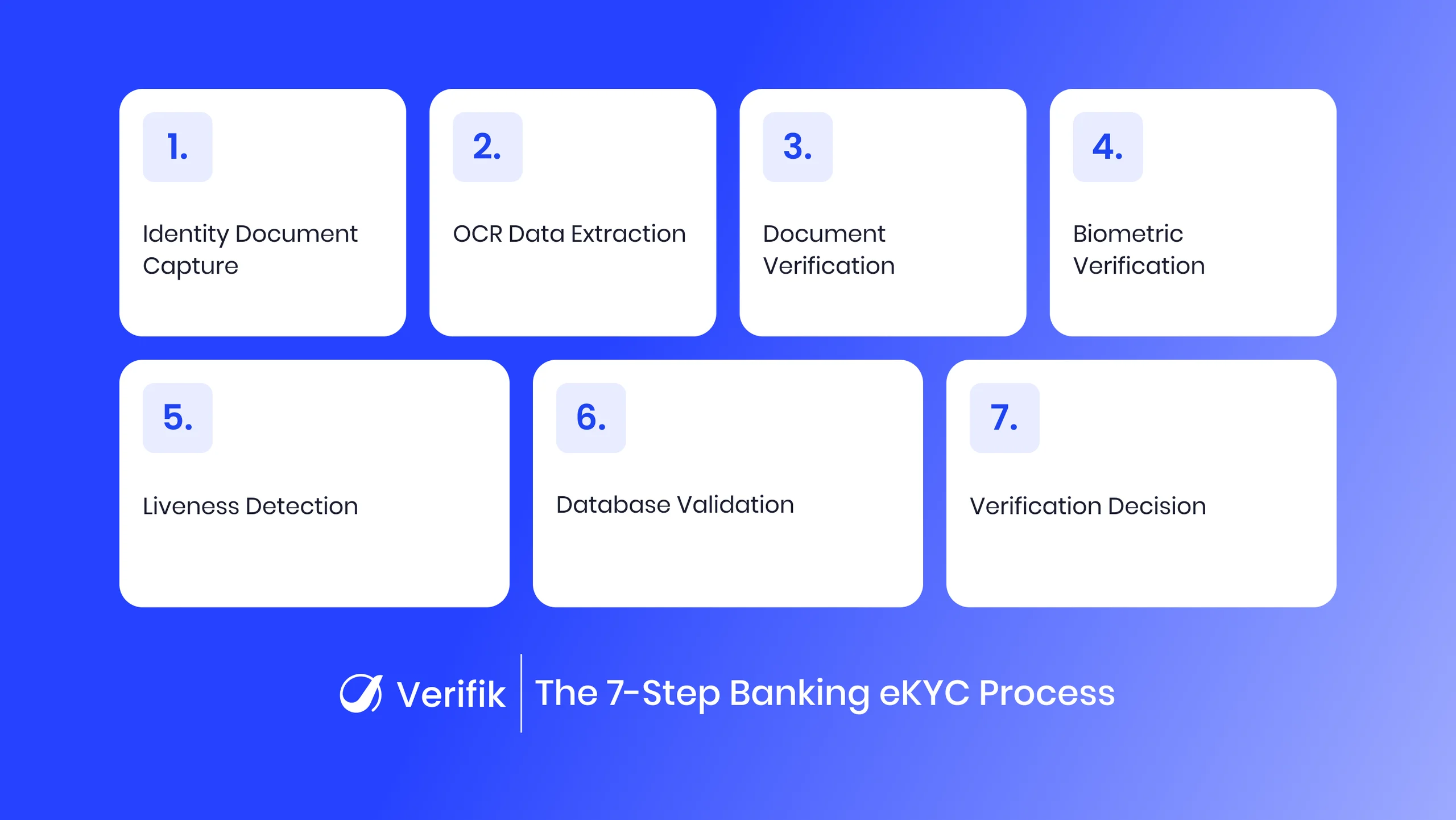
1. Identity Document Capture
The customer uploads or scans a government-issued identity document such as a national ID, passport, or driver’s license, from the device they are already applying on.
2. OCR Data Extraction
OCR reads the document and extracts the customer’s details automatically. This removes most of the typing from the application, which matters because manual entry is both a drop-off point and a source of data errors that surface later in review.
3. Document Verification
The document is checked for signs of alteration, forgery, or inconsistency. Detecting a manipulated document at this point is considerably cheaper than discovering it after an account has been opened and used.
4. Biometric Verification
The customer takes a live selfie, which is compared against the photograph on the document to establish that the two belong to the same person.
5. Liveness Detection
A liveness check helps confirm that a real person is completing the application, and helps protect against spoofing attempts using printed photos, replayed video, or masks.
6. Database Validation
The extracted details are checked against available local and international government databases, and against sanctions and watchlist sources, to add independent confirmation of the identity and surface any compliance flags.
7. Verification Decision
The signals from each step are brought together to support an onboarding decision. Clear cases pass or fail automatically. Cases that sit between the two are routed to a reviewer with the evidence already assembled, which is a very different task from starting a review from scratch.
If you want this walked through in more depth, with what happens at each handoff and where applications tend to fail, see How Banking eKYC Works: A Step-by-Step Breakdown.
Core Capabilities of a Banking eKYC Platform
Most providers advertise a similar list. What separates them is how the pieces work together and how much of the journey they cover without a second vendor.
• AI-Powered Identity Verification
Automated verification of the customer’s identity using document checks, OCR, and biometric authentication, rather than a reviewer comparing a scan against a form.
• Document Verification and OCR
Capture of identity documents, automatic extraction of the information on them, and detection of altered or suspicious documents.
• Facial Recognition and Liveness
Comparison of a live selfie with the document photograph, plus a liveness check to help confirm a real person is behind the application.
• OTP Verification
Confirmation that the customer controls the phone number or email address they supplied, which also gives you a usable channel for later authentication.
• Phone and Email Intelligence
Signals drawn from the contact details themselves, including carrier, ownership, and associated information, used as additional evidence rather than as a decision on their own.
• Database Validation
Cross-checking customer information against available local and international government databases, which is where coverage in your actual markets matters more than the length of the feature list.
• Configurable KYC and AML Workflows
The ability to shape registration steps, verification order, and escalation rules around your own onboarding process. A platform that forces its flow onto your bank tends to create the manual workarounds it was bought to remove. smartENROLL brings these capabilities into a single workflow rather than leaving you to assemble them.
For a closer look at which of these genuinely affect verification accuracy and which are table stakes, read 10 Must-Have eKYC Features for Digital Banking.
Matching KYC Check Depth to Customer Risk
Applying identical checks to every applicant is the most common way banks end up with both too much friction and too little assurance. A low-risk retail customer is put through steps that are not warranted, while a higher-risk applicant gets the same treatment and nothing more.
A risk-based approach sorts applicants into tiers and matches the depth of verification to the tier. Lower-risk customers move through a shorter path. Standard cases run the full flow. Higher-risk cases trigger additional checks, additional evidence, and usually human review before approval.
Getting these tiers right is as much a policy question as a technology one, and it is where supervisors look closely. Bank KYC Tiers Explained: CDD vs EDD vs Simplified covers how the tiers differ, what each one requires, and how to decide which applicant belongs where.
Benefits of eKYC for Banks
• Faster Account Opening
Checks that previously took days of back-and-forth run in the time the customer is already spending on the application, so approval arrives while their intent is still fresh.
• Less Manual KYC Work
Routine verification is automated, which lets onboarding and compliance teams spend their time on the cases that genuinely need judgement instead of clearing a queue of straightforward ones.
• Stronger Identity Assurance
Combining document, biometric, liveness, phone, email, and database signals produces a fuller picture of an applicant than any one check can, and makes impersonation harder to carry off.
• Fewer Abandoned Applications
Keeping verification inside a single journey, rather than sending customers to separate tools or asking them to resubmit documents, removes the points where applications are most often dropped.
• Audit-Ready Compliance
Automated checks and retained verification records give you a consistent, traceable basis for the decisions you made, which is what an audit actually asks for. eKYC for banking supports KYC and AML workflows in this way rather than replacing the judgement your compliance team applies.
• Onboarding That Scales
Volume growth stops translating directly into headcount growth, because the share of applications needing a human has fallen rather than the absolute number rising with every new channel.
Where eKYC Fits Into the Banking Customer Journey
• New Customer Onboarding
The obvious case. Identity is established before the account is opened, inside the digital journey the customer started in.
• Mobile Banking Applications
Verification built into your own web and mobile apps, so the customer never leaves the experience they recognise as yours.
• Fraudulent Application Detection
Multiple identity signals combined to surface suspicious applications before approval, which is a better position than detecting them from transaction behaviour afterwards.
• Customer Reverification
Existing customers rechecked when circumstances change, when a supervisor expects it, or when account activity warrants another look. Periodic KYC Review: How Banks Reverify Customers sets out when reverification is triggered and how to run it without disrupting customers who have done nothing wrong.
Challenges Banks Face When Implementing eKYC
Security vs Completion
Every additional check raises assurance and lowers completion. The work is finding the point where the marginal check stops being worth the applicants it costs you, and that point differs by product and by market.
Real-World Capture Conditions
Customers photograph documents in poor light, on cracked screens, with older cameras. A platform that performs well on clean test images and poorly on these is not performing well.
Coverage Across Markets
Each country has its own identity documents, its own registries, and its own rules about what can be checked. Expanding into a new market is rarely as simple as switching a setting, and it is worth confirming coverage before committing to a roadmap.
Data Protection and Consent
Biometric data is treated as sensitive in most privacy regimes, which brings consent, retention, and storage obligations that sit alongside your AML duties rather than inside them.
How to Choose an eKYC Solution for Your Bank
Feature comparisons tend to look similar across vendors, so the useful questions are the ones that reveal how a platform behaves in your environment rather than in a demo.
- Which identity documents and official databases do you support in each market we operate in today, and which are on the roadmap?
- How do you detect manipulated documents, replayed video, and other spoofing attempts, and how is that performance measured?
- What proportion of applications would we expect to need manual review, and what evidence does a reviewer receive?
- How are verification records retained and produced for an audit?
- Can we configure the verification order, risk tiers, and escalation rules ourselves, or does that require your engineering team?
- How does this integrate with our existing digital banking stack, and what does a realistic implementation timeline look like?
- What happens to our onboarding when verification volumes double?
The answers to these usually tell you more about a platform than any feature matrix.
Why Banks Choose smartENROLL

Everything above describes what a bank should expect from an eKYC platform. smartENROLL brings those capabilities together in one onboarding workflow: AI-powered identity verification, OCR, local and international database screening, facial recognition, liveness detection, OTP verification, phone and email intelligence, and biometric authentication.
Because the checks sit in a single flow, your customers complete verification without being handed between tools, and your team sees one consistent record of how each decision was reached. Registration steps and verification rules are configurable, so smartENROLL for banking fits the way your bank already onboards rather than asking you to rebuild around it.
It connects to existing web applications, mobile banking apps, and enterprise systems through flexible APIs.
Ready to see how it would fit your onboarding process? Book a personalised demo.
Conclusion
eKYC does not remove a bank’s obligation to know its customers. It changes where that work happens, moving it from a review queue after the application into the application itself, and from manual comparison into automated checks with a record behind them.
For banks, the result is a shorter path to an open account, fewer applications lost to friction, and a verification trail that holds up when someone asks to see it.
The platform worth choosing is the one that covers the markets you actually operate in and bends to the onboarding process you already have. If that is what you are evaluating, explore smartENROLL for banking and see how it maps to your journey.