 Identity Card
 National Identity Document
 Citizenship ID
 Unique Identity Document
 Personal Identification Document
 Unique Population Registry Code
 Personal Identity Card
 Civil Identity Card
 Identity and Electoral Card
 Check Plate Colombia
 Check Plate Peru
 Check Plate Mexico
 Check Plate Argentina
 Check Plate Chile
 Check Plate USA
 Check Plate Brazil


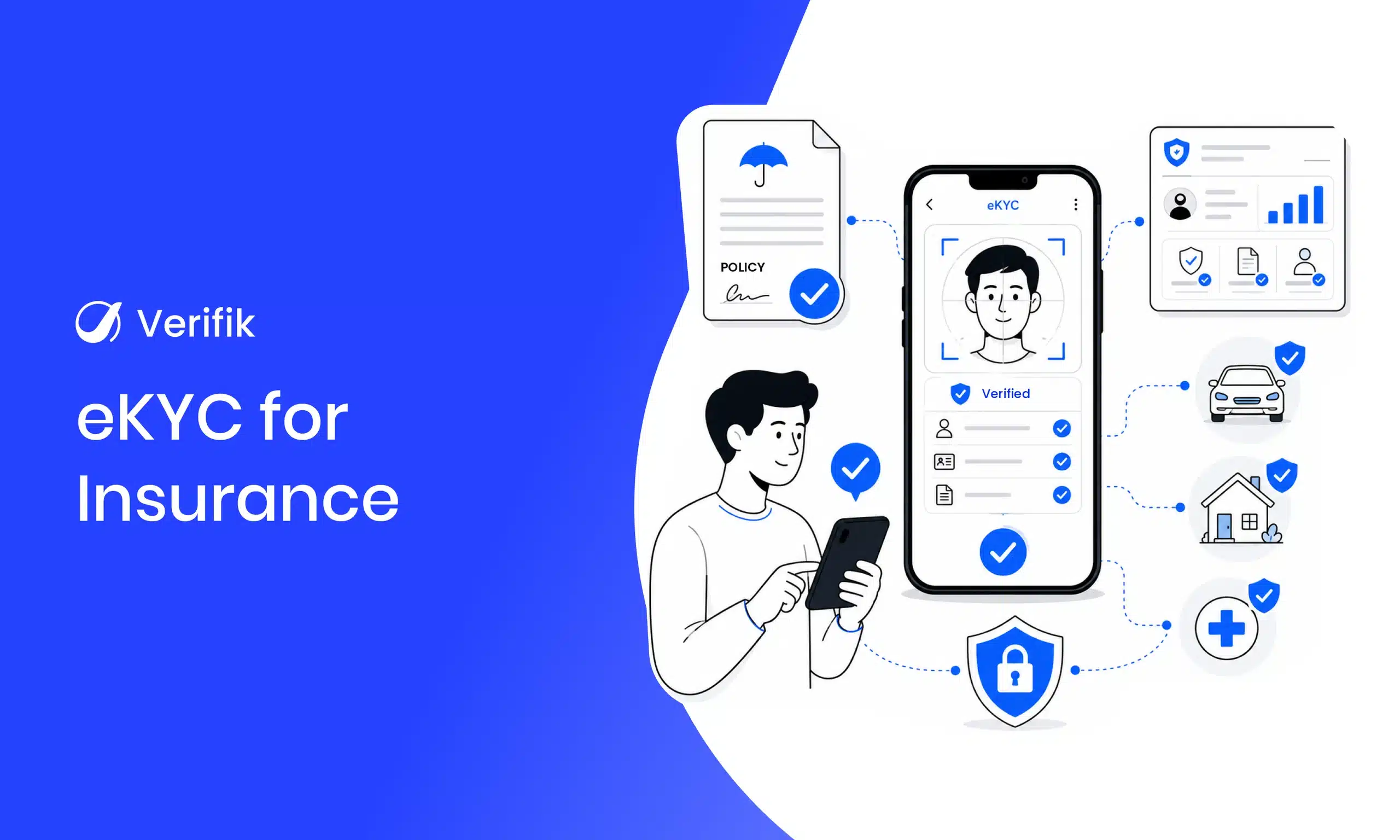
Short answer: eKYC for insurance is the digital verification of a policyholder’s or claimant’s identity before issuing a policy or handling a claim: document check, biometrics with liveness and lookups against official registries and watchlists. In Colombia it rests on the Financial Superintendence’s SARLAFT rules and, for motor insurance and SOAT, on RUNT and Fasecolda data.
Buying insurance is increasingly digital, but identity verification often has not kept pace. Customers expect policies to be issued quickly, while insurers must verify identities, prevent fraud and meet regulatory requirements before providing coverage.
That is where eKYC makes the difference. By automating identity verification, it helps insurers verify policyholders faster, strengthen fraud prevention and deliver a smoother customer experience without compromising compliance.
In this guide we explain how eKYC is helping insurance providers modernize customer verification and build a safer onboarding process, with a focus on Colombia: what SARLAFT requires, what Fasecolda’s fraud figures show and how to verify the vehicle in motor insurance. If you are looking for the product itself, see eKYC for insurance with smartENROLL.
What is eKYC for insurance?
eKYC for insurance is the process of digitally verifying a customer’s identity before issuing policies, handling claims or providing insurance services. It combines OCR document reading with tampering detection, facial recognition with liveness detection and lookups against official databases and watchlists to verify identities securely and remotely.
By replacing manual verification with automation, eKYC helps insurers verify policyholders faster, strengthen compliance and reduce identity-related fraud across the customer lifecycle. For the broader concept, read what an eKYC solution is.
Want to try it? Create your Verifik account and make your first call today.
Why traditional insurance verification falls short
Insurance is increasingly sold through digital channels, but many verification processes still rely on manual reviews. As customers expect instant digital services, slow identity verification creates unnecessary delays at every stage of the customer journey.
The challenge goes beyond customer experience. Insurance companies also need to detect fraudulent applications, prevent identity misuse and comply with ever-evolving KYC and AML regulations. As verification volumes grow, relying only on manual processes becomes hard to sustain.
eKYC and SARLAFT: what Colombia’s Financial Superintendence requires from insurers
In Colombia, insurers are supervised by the Financial Superintendence (SFC) and apply SARLAFT, the anti-money laundering and counter-terrorist financing risk management system the SFC regulates in its Circular Básica Jurídica. Knowing the customer is the foundation of that system, and eKYC is how you do it without paper.
The SFC allows a simplified customer due diligence procedure, but only for the insurance products listed in subnumerals 4.2.2.2.1.4.4.1 to 4.2.2.2.1.4.4.15 of the Circular Básica Jurídica, as the Financial Superintendence’s Concept 106803 of 2021 clarifies. Even under that procedure, the insurer must carry out ongoing due diligence on the relationship and identify politically exposed persons (PEPs), and it may request any extra information it needs within 3 business days of onboarding.
SOAT, Colombia’s mandatory motor insurance, is the clearest example. According to the SOAT issuance conditions published by insurers, it is sold under the simplified customer due diligence method (External Circular 017 of 2021), with an online check of the vehicle’s record in RUNT, the national transit registry (External Circular 021 of 2017), and, when the policyholder is a company, a certificate of existence and legal representation no older than 30 days.
In practice, each step has its lookup: name and document number are validated against the Registraduría, the vehicle against RUNT, and PEP status and lists such as OFAC and the UN are screened before onboarding. Higher-risk customers get enhanced due diligence on top; the logic of each tier is in our guide to KYC tiers: CDD vs EDD vs simplified.
Key benefits of eKYC for insurance
Identity verification affects more than customer onboarding. It shapes policy issuance, fraud prevention, compliance and the overall customer experience.
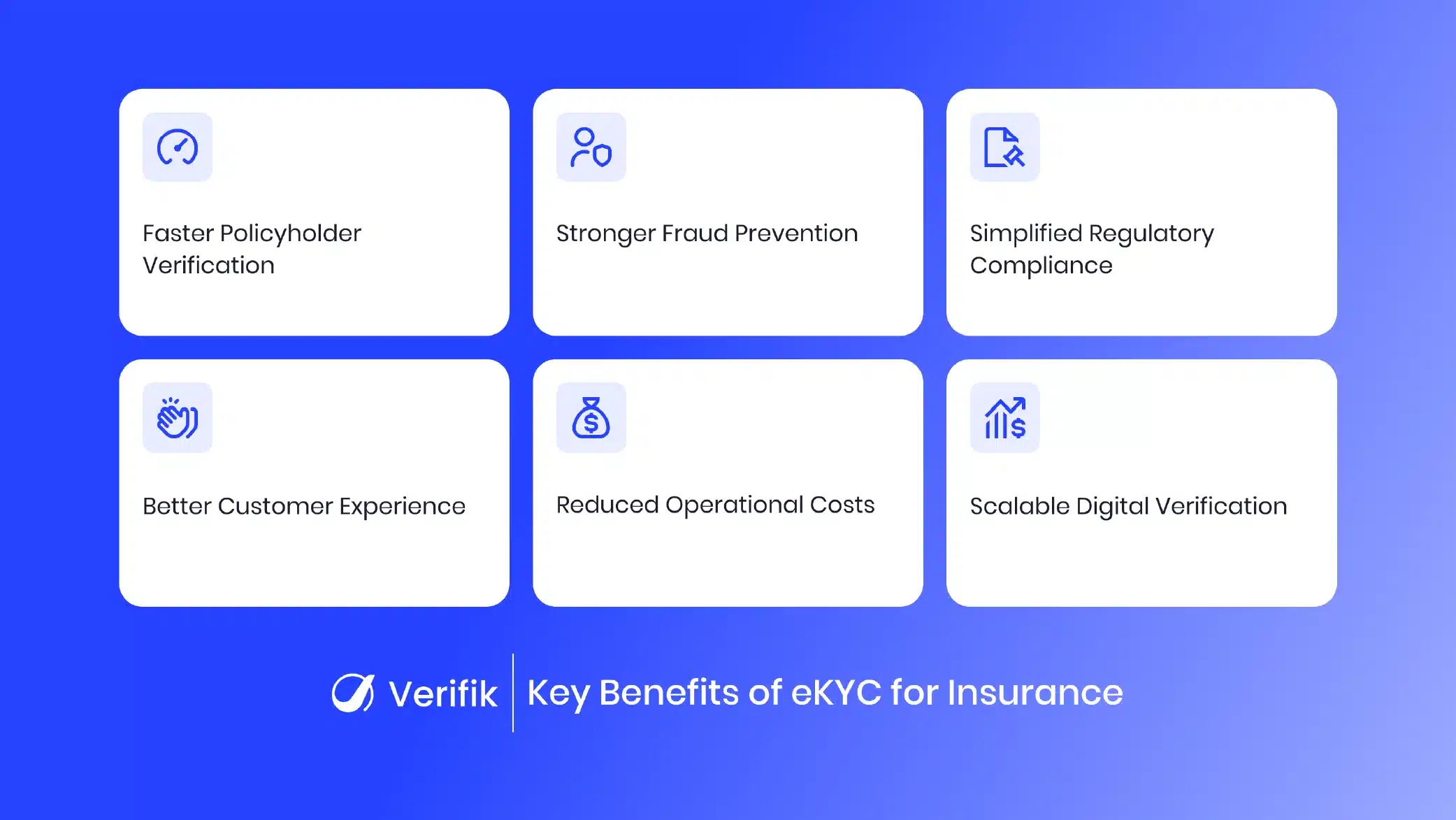
eKYC helps insurers improve each of these areas through a faster, safer and more consistent verification process.
Faster policyholder verification
Customers expect insurance services to be as digital as any other financial service they use. Lengthy document reviews and manual approvals can delay policy issuance and create unnecessary friction even before coverage begins.
An eKYC solution automates identity verification, allowing insurers to verify policyholders in minutes. Faster verification speeds up policy issuance and delivers a smoother customer experience.
Stronger fraud prevention
Insurance fraud is more sophisticated than ever, from identity theft to forged documents and impersonation attempts. Detecting these threats through manual review alone keeps getting harder.
Modern eKYC solutions combine document verification with tampering detection, facial recognition with liveness detection and database lookups to flag suspicious applications before a policy is issued, and to re-confirm the claimant’s identity when a claim comes in. This layered approach helps insurers reduce identity fraud while protecting legitimate policyholders.
Simplified regulatory compliance
Insurance providers operate under regulatory requirements that demand accurate identity verification and reliable record-keeping. Keeping manual processes consistent gets harder as customer volumes grow.
An eKYC solution standardizes verification workflows and leaves evidence of each one: with Verifik, every API response is signed (“Certified by Verifik.co”) and every smartENROLL case stays in the review console with its status (pending, in progress, approved, rejected or under review). This helps insurers cut manual effort and stay ready for regulatory reviews.
Better customer experience
The insurance buying process often starts with identity verification. A slow or complicated process can frustrate customers before they have even bought a policy.
eKYC removes unnecessary onboarding friction by letting customers verify their identity securely from almost any device. Faster approvals and smoother verification help insurers improve customer satisfaction from the first interaction.
Reduced operational costs
Manual verification requires dedicated staff, repeated document reviews and significant administrative effort. As customer acquisition grows, these repetitive tasks become more expensive.
By automating routine identity verification, eKYC reduces manual workloads and lets verification teams focus on higher-risk applications and exceptions. This improves operational efficiency without compromising verification quality.
Scalable digital verification
A verification process that handles hundreds of applications a month can struggle when thousands of policyholders need to complete onboarding. Growth tends to expose the limits of manual workflows.
An eKYC solution lets insurers process much larger verification volumes without growing operational resources at the same rate. That way, insurance providers scale their digital services with consistent security and compliance.
Insurance fraud in Colombia: what the numbers show
According to Fasecolda’s figures release, Colombia’s insurance industry identified 49,645 fraud cases worth more than COP 256 billion in 2025, based on data from companies representing 78% of written premiums. The most affected lines were SOAT, occupational risk, motor, health and theft.
Several of those schemes run through identity or documents. In SOAT, 26% of cases involve misuse or lending of policies and 24% forged supporting documents (32% are staged accidents). In theft insurance, 55% are linked to forged documents. And Revista Fasecolda estimates that the schemes most exposed to artificial intelligence, such as forgery, impersonation, staging, exaggeration and fictitious claims, reached about 25,000 cases, roughly 42% of the total, up about 47% from 2024.
Fraud also targets customers. La República reported, citing Fasecolda, that more than 20,000 customers have been scammed buying fake insurance online and that 4,081 fake-SOAT cases were recorded in 2024; scammers contact drivers with their name, plate, insurer and policy expiry date and offer fake renewals over WhatsApp. For international context, in the United States the NICB reported that mentions of AI in questionable claims grew more than 1,400% from 2025 to mid-2026.
Identity verification stops policy lending, impersonation and many forged documents, but it does not replace claims investigation: a staged accident or inflated damage is caught by claims analysis. What eKYC does provide is certainty about who buys and who claims.
Meanwhile, Colombia’s Superintendence of Industry and Commerce (SIC) published a draft circular, open for comments until 21 November 2026, that would require at least two independent identity verification mechanisms to onboard new customers at the entities it supervises and would bar making biometrics a condition of service without a real alternative. Insurers answer to the SFC, but it is a clear signal of where the market is heading.
Vehicle verification for motor insurance and SOAT
In motor insurance, knowing the customer includes knowing the vehicle. Verifik’s SOAT and technical inspection (RTM) verification API queries RUNT with the owner’s document type and number (CC, CE, PA, RC or NIT) and the plate, and returns the SOAT status (validity, policy number, insurer, issue and expiry dates), the technical inspection status (validity, certificate, inspection center and dates), vehicle details and owner confirmation. Because the lookup uses the owner’s document, it works directly when the policyholder is the owner.
For history, Fasecolda claims verification returns, by plate, each recorded claim with its ID, accident date and coverage type, a useful underwriting signal (more in our guide to vehicle insurance claims verification). And Fasecolda vehicle values by plate return the Fasecolda code, commercial value and specifications to set the insured value, with provenance and confidence data when the code is matched through RUNT. If you only need the vehicle record, there is the RUNT plate lookup.
Outside Colombia, Verifik also checks Chile’s SOAP by plate and Bolivia’s SOAT.
What it looks like in the API
This JavaScript example chains three lookups before issuing a motor policy: the policyholder’s cédula in the Registraduría (GET /v2/co/cedula), SOAT and technical inspection in RUNT (GET /v2/co/runt/vehiculo) and the Fasecolda claims history (GET /v2/co/fasecolda/sinister). The data is sample data:
import axios from "axios";

const api = axios.create({
  baseURL: "https://api.verifik.co",
  headers: {
    Accept: "application/json",
    Authorization: `Bearer ${process.env.VERIFIK_TOKEN}`,
  },
});
const get = async (path, params) => (await api.get(path, { params })).data;

// "DD/MM/YYYY" -> Date
const toDate = (s) => {
  const [d, m, y] = s.split("/").map(Number);
  return new Date(y, m - 1, d);
};

async function preIssuanceCheck(documentNumber, plate) {
  // 1. Policyholder identity (Registraduría)
  const person = await get("/v2/co/cedula", { documentType: "CC", documentNumber });

  // 2. SOAT and technical inspection in RUNT (owner's document + plate)
  const runt = await get("/v2/co/runt/vehiculo", { documentType: "CC", documentNumber, plate });

  // 3. Claims history by plate (Fasecolda)
  const claims = await get("/v2/co/fasecolda/sinister", { plate }).catch((e) =>
    e.response?.status === 404 ? { data: { sinister: [] } } : Promise.reject(e)
  ); // 404 = no claims on record

  // Example rules: your insurer sets them; Verifik returns signed evidence
  const { soat, techReview } = runt.data;
  const daysToExpiry = (toDate(soat.dueDate) - new Date()) / 86400000;
  let decision = "issue";
  if (claims.data.sinister.length > 0 || !techReview.valid) decision = "manual-review";
  else if (!soat.valid || daysToExpiry < 30) decision = "offer-soat-renewal";

  return { fullName: person.data.fullName, soat, techReview, claims: claims.data.sinister, decision };
}

console.log(await preIssuanceCheck("1020304050", "ABC123"));
Sample 200 response for the SOAT and RTM lookup (fictitious data):
{
  "data": {
    "documentType": "CC",
    "documentNumber": "1020304050",
    "plate": "ABC123",
    "vehicleInformation": {
      "color": "GRIS",
      "brand": "SAMPLE MAKE",
      "line": "LINE 1.6",
      "status": "ACTIVO",
      "enrollmentDate": "14/03/2019",
      "plate": "ABC123"
    },
    "soat": {
      "valid": true,
      "expeditionDate": "02/12/2025",
      "dueDate": "03/12/2026",
      "coverageStartDate": "04/12/2025",
      "soatNumber": "00000001"
    },
    "techReview": {
      "valid": true,
      "reviewNumber": "00000002",
      "expeditionDate": "10/03/2026",
      "dueDate": "10/03/2027",
      "requireTechReview": true
    },
    "consultationDateTime": "2026-11-20T13:10:00.000Z"
  },
  "signature": {
    "dateTime": "November 20, 2026 8:10 AM",
    "message": "Certified by Verifik.co"
  }
}
Sample 200 response for the claims history by plate (fictitious data):
{
  "data": {
    "plate": "ABC123",
    "sinister": [
      {
        "id": "1",
        "accidentDate": "18/06/2023",
        "protection": "Pérdida Menor Cuantía"
      }
    ]
  },
  "signature": {
    "message": "Certified by Verifik.co",
    "dateTime": "November 20, 2026 8:10 AM"
  },
  "id": "EX001"
}
To screen the policyholder or beneficiaries against the OFAC list, the OFAC lookup in Python:
import os
import requests

r = requests.get(
    "https://api.verifik.co/v2/ofac",
    headers={
        "Accept": "application/json",
        "Authorization": f"Bearer {os.getenv('VERIFIK_TOKEN')}",
    },
    params={"documentType": "CC", "documentNumber": "1020304050"},
    timeout=30,
)
data = r.json()["data"]
print(r.status_code, data["fullName"], data["foundInOFAC"])
The rules belong to the insurer: Verifik returns signed evidence, and your rules engine or underwriting team decides whether to issue, offer a renewal or send the case to manual review.
Transform insurance customer verification with smartENROLL
An eKYC strategy is only as effective as the platform behind it. Insurance providers need a solution that verifies identities quickly, reduces fraud and supports regulatory compliance without slowing down policy issuance.
smartENROLL is Verifik’s no-code onboarding flow and brings together email validation with OTP, phone verification by SMS and WhatsApp, facial recognition with liveness detection, document scanning with tampering detection and screening against government databases and blacklists, under your own brand. You configure it for your insurance products, and unclear cases land in the KYC review console so your team can approve or reject them. As an extra signal on contact data, Phone Lookup returns the listed owner of a number when the source has a match.
Explore the eKYC solution for insurers, book a meeting with our team or try the lookups at app.verifik.co.
Conclusion
Customer verification is no longer just a regulatory requirement. It is a core part of delivering a fast, secure and trustworthy insurance experience. As customer expectations evolve, insurers need verification processes that keep pace without increasing fraud or operational complexity.
eKYC provides that foundation by helping insurers verify policyholders faster, strengthen fraud prevention and simplify compliance through a secure digital flow. When choosing an eKYC solution, look beyond individual features: in Colombia, look for a platform that covers the Registraduría, the SARLAFT watchlists and vehicle data in RUNT and Fasecolda. If you serve other sectors too, see how it applies in eKYC for fintech and eKYC for banks. Ready to start? Create your account and try the lookups with your own token.