 Identity Card
 National Identity Document
 Citizenship ID
 Unique Identity Document
 Personal Identification Document
 Unique Population Registry Code
 Personal Identity Card
 Civil Identity Card
 Identity and Electoral Card
 Check Plate Colombia
 Check Plate Peru
 Check Plate Mexico
 Check Plate Argentina
 Check Plate Chile
 Check Plate USA
 Check Plate Brazil


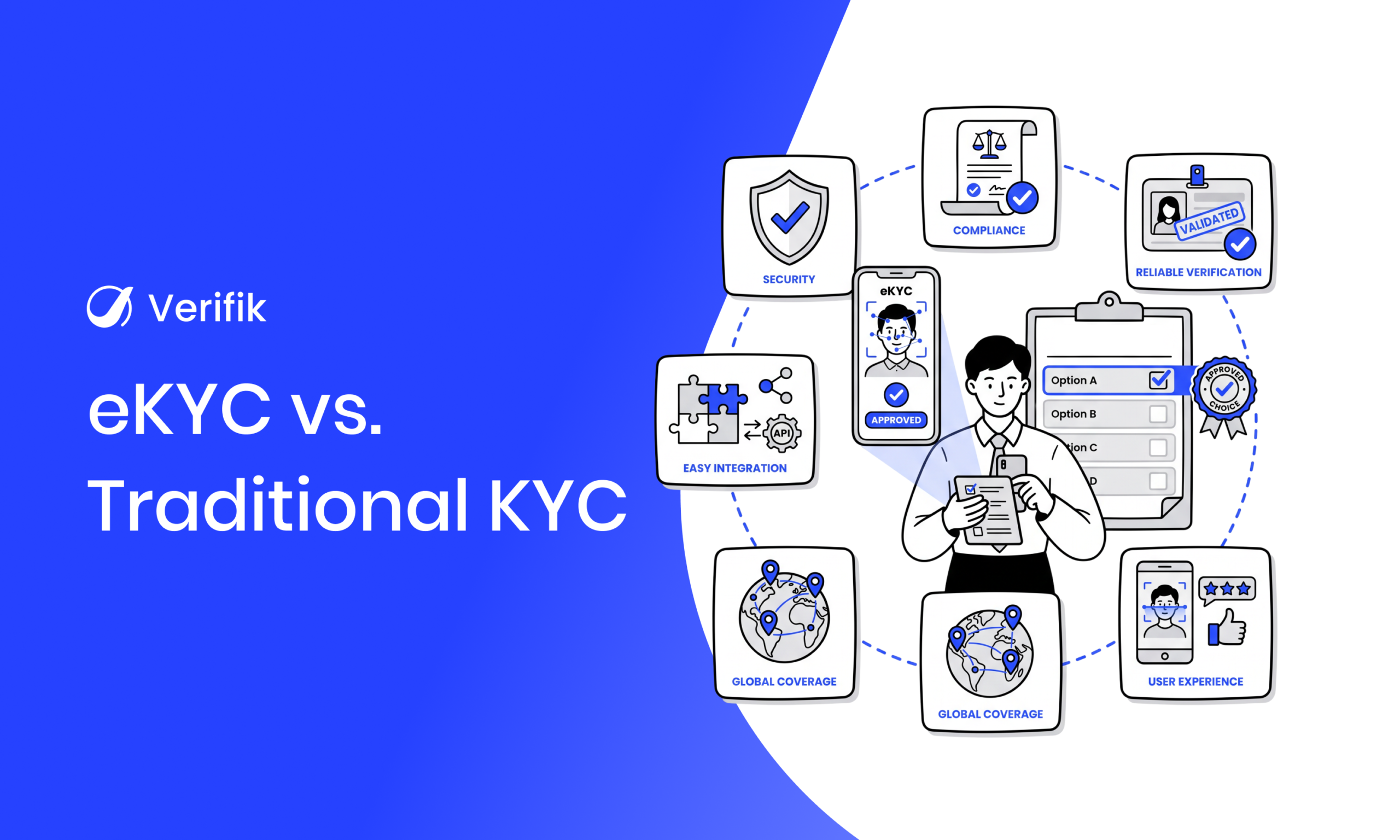
For years, traditional Know Your Customer (KYC) processes helped businesses verify customer identities and meet regulatory requirements. But as customer onboarding moved online, manual verification processes became slower, more expensive, and increasingly difficult to scale. Today, businesses are expected to onboard customers quickly without compromising security or compliance. That’s why many organizations are replacing traditional KYC with electronic Know Your Customer (eKYC) solutions that automate identity verification and reduce manual effort. In this guide, we’ll break down the key differences between eKYC and traditional KYC, compare their advantages and limitations, and help you determine which approach is the right fit for your business.
What is Traditional KYC?
Traditional Know Your Customer (KYC) is a manual identity verification process used by businesses to verify a customer’s identity before providing financial products or services. It typically involves collecting identity documents, manually reviewing them, and confirming that the customer meets regulatory requirements before onboarding. While traditional KYC has long been the standard for regulatory compliance, its manual workflows can slow customer onboarding, increase operational costs, and make it difficult to scale as verification volumes grow.
To put eKYC vs traditional KYC into practice, see how smartENROLL does it.
What Is eKYC?
Electronic Know Your Customer (eKYC) is the digital evolution of traditional KYC. It uses technologies such as AI-powered identity verification, OCR, local and international database screening, OTP Verification, phone and email intelligence, facial recognition, liveness detection, and biometric authentication to verify customer identities remotely without relying on manual document reviews. Unlike traditional KYC, eKYC automates much of the verification process, which helps businesses reduce manual reviews, strengthen fraud prevention, and deliver a faster, more seamless customer onboarding experience. eKYC doesn’t change the goal of KYC. It changes how businesses achieve it by replacing manual processes with intelligent automation. 
Traditional KYC vs eKYC: A Detailed Comparison
Both traditional KYC and eKYC serve the same purpose, but they differ in speed, security, scalability, and the overall customer onboarding experience. Here’s how they compare:
1. Verification Speed
One of the biggest differences between traditional KYC and eKYC is how quickly identities can be verified. Traditional KYC often requires customers to submit documents, wait for manual reviews, and sometimes provide additional information before verification is complete. An eKYC solution automates much of this workflow, allowing legitimate customers to complete identity verification within minutes. Faster onboarding not only improves customer satisfaction but also enables businesses to start serving customers sooner.
2. Customer Experience
Customer onboarding is often the first interaction someone has with your business. If identity verification feels slow or confusing, customers may abandon the process before creating an account. Traditional KYC introduces friction through paperwork, repeated document submissions, and manual verification. eKYC removes many of these barriers by enabling secure, self-service identity verification from any device.
3. Fraud Prevention
Fraud techniques have become significantly more sophisticated than they were a decade ago. Manual document reviews may detect obvious inconsistencies, but they often struggle against forged documents, identity spoofing, and AI-generated deepfakes. Modern eKYC solutions combine AI, facial recognition, liveness detection, and fraud analytics to identify suspicious activity before fraudulent users gain access.
4. Compliance
Both traditional KYC and eKYC help businesses meet regulatory requirements. The difference lies in how efficiently they do it. Traditional KYC depends heavily on manual documentation and record management, while eKYC automates verification workflows, maintains audit trails, and simplifies compliance reporting. For organizations operating across multiple regions, automation can significantly reduce compliance overhead.
5. Operational Efficiency
Every manual verification requires time, resources, and trained personnel. As customer volumes grow, these manual processes become increasingly expensive. eKYC automates repetitive verification tasks, reducing manual reviews while allowing compliance teams to focus on higher-risk cases. Automation doesn’t replace compliance teams. It allows them to spend more time on decisions that genuinely require human expertise.
6. Scalability
A verification process that works for 500 customers each month may struggle with 50,000. Traditional KYC typically scales by hiring more people. eKYC scales by automating more of the verification process, allowing businesses to handle higher volumes without significantly increasing operational costs. 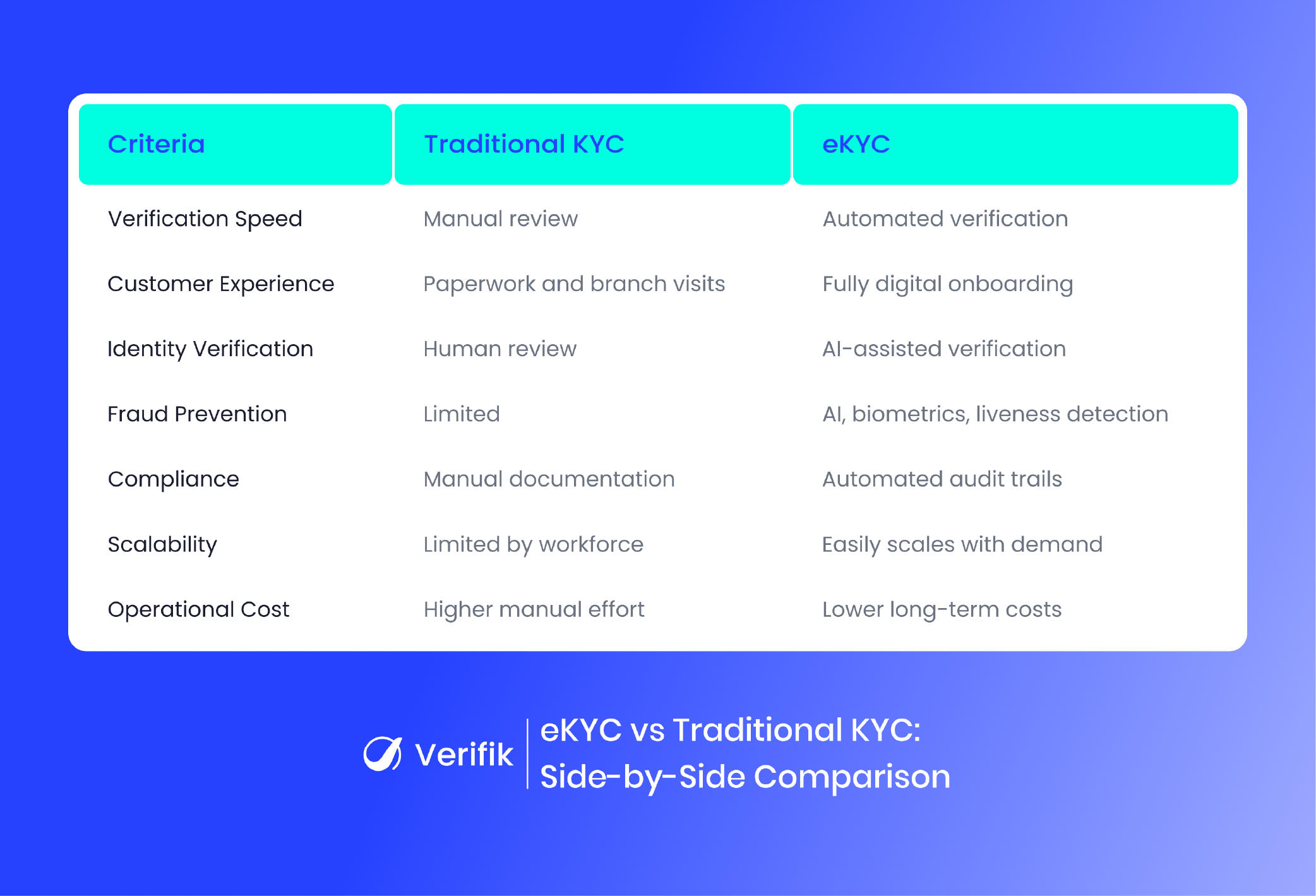
Is Traditional KYC Still Relevant?
Despite the rise of digital onboarding, traditional KYC still has a place in certain verification workflows. Some high-risk industries, complex corporate onboarding processes, or regulatory scenarios may still require manual verification as part of the customer due diligence process. For most digital-first businesses, however, eKYC offers greater efficiency, stronger fraud prevention, and a better customer experience without compromising compliance.
Which One Should Your Business Choose?
If your organization still relies heavily on manual verification, the real question isn’t whether eKYC is better than traditional KYC. It’s whether your current onboarding process can keep up with modern customer expectations and evolving fraud risks. Businesses looking to improve operational efficiency, reduce onboarding friction, strengthen compliance, and scale customer onboarding are increasingly adopting eKYC as the preferred approach.
If you work at a bank, our guide to eKYC for banks applies this comparison to account opening: KYC and AML requirements, the step-by-step flow and how to match checks to each customer’s risk.
Modernize Customer Onboarding With smartENROLL
Choosing eKYC is only the first step. Choosing the right eKYC platform is what determines how effectively your business can automate identity verification while balancing security, compliance, and customer experience. smartENROLL combines AI-powered identity verification, OCR, local and international database screening, OTP verification, phone and email intelligence, facial recognition, liveness detection, biometric authentication,and fraud detection into a single platform designed for modern digital onboarding. Whether you’re a bank, fintech, insurance provider, telecom company, or another regulated business, smartENROLL helps you onboard customers faster while reducing fraud and simplifying compliance. Book your free demo today. 
eKYC or traditional KYC: which to choose
The choice between eKYC and traditional KYC ultimately depends on how your business operates and how you want to onboard customers. While traditional KYC still serves a purpose in certain scenarios, eKYC provides the speed, scalability, and automation modern businesses need to deliver secure and seamless customer onboarding.