Updated: November 14, 2026 · checked against the official API documentation.
Short answer: To verify a Colombian ID by API, send GET /v2/co/cedula with documentType (CC or PPT), the number without dots and your Bearer token. Verifik checks the Registraduría and returns the holder's full name with a timestamped signature. To confirm the ID is still valid, use the Registraduría certificate lookup with the issue date.
Colombia ID verification API: what it checks in 2026
Verifik's cédula endpoint queries Colombia's Registraduría Nacional del Estado Civil and confirms that the number exists and whose name it belongs to. It supports two documents: the citizenship card (cédula de ciudadanía, CC) and the Temporary Protection Permit (PPT) issued to Venezuelan migrants. It does not cover the foreigner ID card, which has its own endpoint (see our guide to verifying Colombian foreigner IDs), or company NITs.
With the response you can match the name your user typed against the registered one, block non-existent numbers before an account is opened and keep a lookup ID as evidence for your KYC audit trail.
Colombia ID verification API endpoint and parameters
The route is GET https://api.verifik.co/v2/co/cedula (POST with the same fields also works). You authenticate with the Authorization: Bearer <token> header and ask for JSON with Accept: application/json.
| Parameter | Type | Required | Description |
|---|
documentType | string | Yes | CC or PPT (not NIT) |
documentNumber | string | Yes | 5 to 10 characters, no spaces or dots |
Colombia ID verification API code examples
All three examples run the same lookup. Swap the test number for your user's and keep the token in an environment variable, never in client-side code.
cURL
curl -G "https://api.verifik.co/v2/co/cedula" \
  -H "Accept: application/json" \
  -H "Authorization: Bearer $VERIFIK_TOKEN" \
  --data-urlencode "documentType=CC" \
  --data-urlencode "documentNumber=123456789"
Node.js
import axios from "axios";

const { data } = await axios.request({
  method: "GET",
  url: "https://api.verifik.co/v2/co/cedula",
  params: { documentType: "CC", documentNumber: "123456789" },
  headers: {
    Accept: "application/json",
    Authorization: `Bearer ${process.env.VERIFIK_TOKEN}`,
  },
});
console.log(data.data.fullName, data.id);
Python
import os, requests

url = "https://api.verifik.co/v2/co/cedula"
headers = {
    "Accept": "application/json",
    "Authorization": f"Bearer {os.getenv('VERIFIK_TOKEN')}",
}
params = {"documentType": "CC", "documentNumber": "123456789"}
r = requests.get(url, headers=headers, params=params, timeout=30)
print(r.status_code, r.json())
Sample Colombia ID verification response and fields
A successful lookup returns HTTP 200 with the holder's names, the document you queried and a Verifik signature. The data below is fictitious.
{
  "data": {
    "arrayName": [
      "JUAN",
      "CARLOS",
      "PEREZ",
      "GOMEZ"
    ],
    "documentNumber": "123456789",
    "documentType": "CC",
    "firstName": "JUAN CARLOS",
    "fullName": "JUAN CARLOS PEREZ GOMEZ",
    "lastName": "PEREZ GOMEZ"
  },
  "signature": {
    "dateTime": "November 14, 2026 9:15 AM",
    "message": "Certified by Verifik.co"
  },
  "id": "CC01A"
}
| Field | What it holds |
|---|
fullName | Holder's full name |
firstName / lastName | Given names and surnames |
arrayName | Each name as an item in a list |
documentType / documentNumber | The document you queried |
signature | Date and time of the lookup with the message “Certified by Verifik.co” |
id | Lookup ID for your audit trail |
Colombia ID verification API error codes
These are the cases the documentation lists. None of them should become an automatic rejection without review: a 404 can simply be a mistyped number.
| Code | Response | What to do |
|---|
| 200 | Successful lookup | Match the name and store id and signature |
| 404 | NotFound: “Record not found.” | Ask the user to check the number and document type |
| 409 | MissingParameter: “missing documentType” or “missing documentNumber” | Send both parameters |
| 409 | MissingParameter: “documentType must be one of: [CC,PPT]” | Use CC or PPT; foreigner IDs use their own endpoint |
{
  "code": "NotFound",
  "message": "Record not found."
}
{
  "code": "MissingParameter",
  "message": "documentType must be one of: [CC,PPT]"
}
Check Colombian ID validity with the Registraduría certificate API
If you also need to know whether the cédula is currently valid, GET /v2/co/registraduria/certificado takes the number and the issue date (not the date of birth) in DD/MM/YYYY format. It returns the status in novedad (for example, VIGENTE), a verification code and the certificate as a base64-encoded PDF (certificate documentation).
import os, requests

url = "https://api.verifik.co/v2/co/registraduria/certificado"
headers = {"Accept": "application/json", "Authorization": f"Bearer {os.getenv('VERIFIK_TOKEN')}"}
params = {"documentNumber": "123456789", "date": "10/10/2020"}  # issue date, DD/MM/YYYY
r = requests.get(url, headers=headers, params=params, timeout=60)
print(r.status_code, r.json())
{
  "data": {
    "codigoVerificacion": "ABC123XYZ",
    "novedad": "VIGENTE",
    "pdfBase64": "JVBERi0xLjQK...",
    "documento": {
      "cedula": "123456789",
      "fechaExpedicion": "10/10/2020",
      "lugarExpedicion": "BOGOTA D.C.",
      "nombre": "JUAN CARLOS PEREZ GOMEZ"
    }
  },
  "signature": {
    "dateTime": "November 14, 2026 9:16 AM",
    "message": "Certified by Verifik.co"
  }
}
If the date is not in DD/MM/YYYY, the API answers 409 MissingParameter. When the source is temporarily unavailable it may answer 409 with Endpoint_out_of_service: retry later instead of rejecting the user. Treat the PDF and personal fields as sensitive data.
How to use Colombia ID verification in onboarding
- Ask for the document type and number in your sign-up form.
- Call
/v2/co/cedula and compare fullName with the name the user entered. - If you have the issue date, confirm validity with the Registraduría certificate.
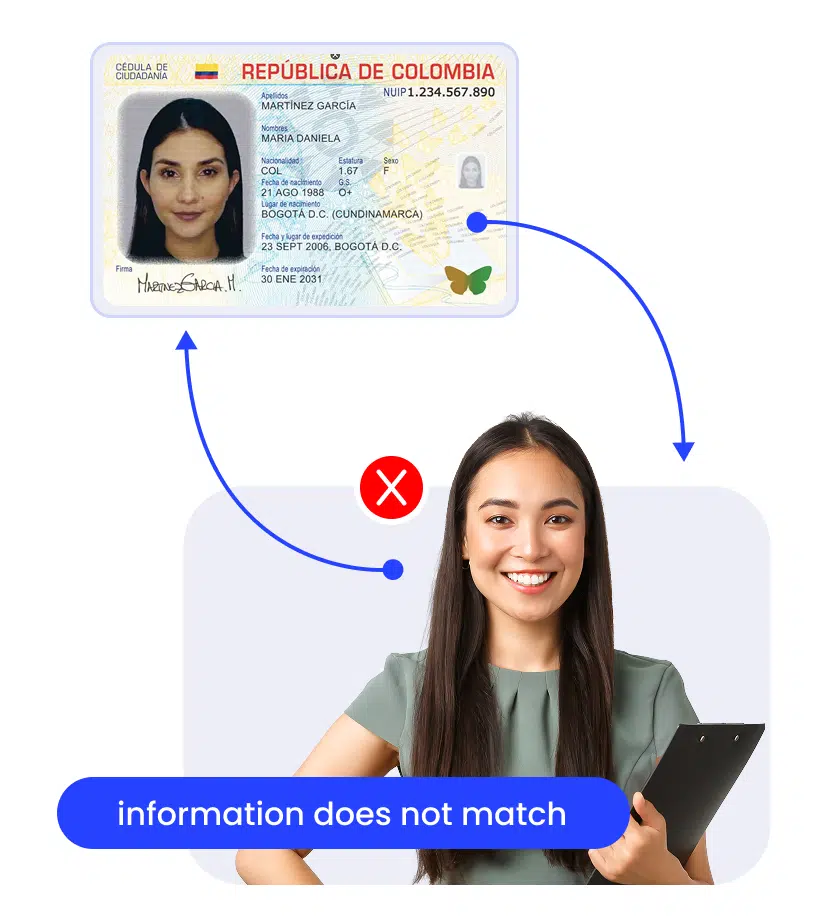
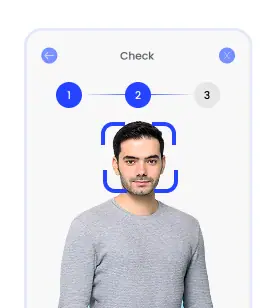
- To know the person signing up is the holder, add a selfie with liveness detection and a face match against the ID.
- Depending on your risk, run a Colombian police record check by API and watchlist screening.
- Store the
id and signature of every response in the customer file.
The full Colombia KYC flow, with every endpoint, is in our Colombia KYC API guide, and the new anti-impersonation duties are summarised on our Law 2573 of 2026 page. For a no-code explanation, read our cédula de ciudadanía verification guide.
Ready to try it? Create your free Verifik account, generate your token and run your first Colombian ID check from your code.


 Logistics and Transportation
 Logistics and Transportation
 Data Intelligence
 Ticketing
 Crypto
 Hotels
 Gaming and Casinos
 Cybersecurity
 Open Banking
 Virtual Notary
By Use Case
 Effective Marketing
 Tax Compliance
 Onboarding Simplification
 Ticketing
 Buy Now Pay Later
 Database Security
 Medical Data Security
 Voter Verification
 Digital Signature
By Technology
 Zero Knowledge Proof
 Facial / Liveness Detection
 HumanAuthn
 Identity Card
 National Identity Document
 Citizenship ID
 Unique Identity Document
 Personal Identification Document
 Unique Population Registry Code
 Personal Identity Card
 Civil Identity Card
 Identity and Electoral Card
Vehicle Verification
 Check Plate Colombia
 Check Plate Peru
 Check Plate Mexico
 Check Plate Argentina
 Check Plate Chile
 Check Plate USA
 Check Plate Brazil
Other
 Blog
 Compliance
 Documentation
 ISO 27001 / SOC 2 Tipo 2