 Identity Card
 National Identity Document
 Citizenship ID
 Unique Identity Document
 Personal Identification Document
 Unique Population Registry Code
 Personal Identity Card
 Civil Identity Card
 Identity and Electoral Card
 Check Plate Colombia
 Check Plate Peru
 Check Plate Mexico
 Check Plate Argentina
 Check Plate Chile
 Check Plate USA
 Check Plate Brazil


For regulated businesses, customer onboarding is about more than creating a seamless user experience. Every new customer must be verified in a way that satisfies regulatory requirements while protecting the business from financial crime and identity fraud. Meeting these obligations through manual processes is becoming increasingly difficult. Growing customer volumes, evolving regulations, and increasingly sophisticated fraud techniques have made compliance more complex than ever. That’s why more and more organizations are adopting eKYC to streamline their verification processes. By automating identity verification and standardizing verification workflows, eKYC helps regulated businesses strengthen compliance while improving operational efficiency. In this guide, we’ll explain the key eKYC compliance requirements and how regulated businesses can meet them more efficiently.
What Is eKYC Compliance?
eKYC compliance refers to the use of digital identity verification processes to help businesses meet Know Your Customer (KYC) and Anti-Money Laundering (AML) requirements. Instead of relying on manual document reviews, organizations use technologies such as OCR, AI-powered identity verification, facial recognition, liveness detection, and biometric authentication to verify customer identities securely and remotely. The objective of eKYC compliance isn’t simply to verify identities. It’s to establish a consistent, auditable, and secure verification process that supports regulatory obligations while delivering a better customer onboarding experience. 
Looking for a way to put this into practice? See how smartENROLL handles it.
Core Compliance Requirements Every eKYC Solution Should Meet
The effectiveness of an eKYC solution isn’t measured by the number of verification features it offers. It’s measured by how well those features work together to help businesses meet regulatory requirements while maintaining secure, efficient customer onboarding. The following capabilities form the foundation of a compliant eKYC solution.
1. Customer Identity Verification
At the core of every KYC framework is one fundamental requirement: verifying that a customer is genuinely who they claim to be. Without reliable identity verification, businesses increase their exposure to fraud, financial crime, and regulatory non-compliance. Modern eKYC solutions automate identity verification using OCR, AI-powered document verification, facial recognition, and biometric authentication. This enables businesses to verify identities more accurately while reducing manual reviews and accelerating customer onboarding.
2. Document Authentication
Collecting an identity document is only the first step. Businesses must also confirm that the document is genuine, unaltered, and valid before relying on it for customer verification. An eKYC platform automatically analyzes document security features, detects signs of tampering, and identifies inconsistencies that may indicate fraud. This allows businesses to identify suspicious documents early while maintaining a consistent verification process.
3. Biometric Identity Verification
Verifying an identity document alone doesn’t confirm that the person presenting it is its legitimate owner. Regulators increasingly expect businesses to strengthen identity assurance by validating the customer’s presence during onboarding. Biometric verification compares a customer’s live facial image with the photograph on the submitted identity document. This additional verification layer helps businesses reduce identity impersonation while increasing confidence in the onboarding process. 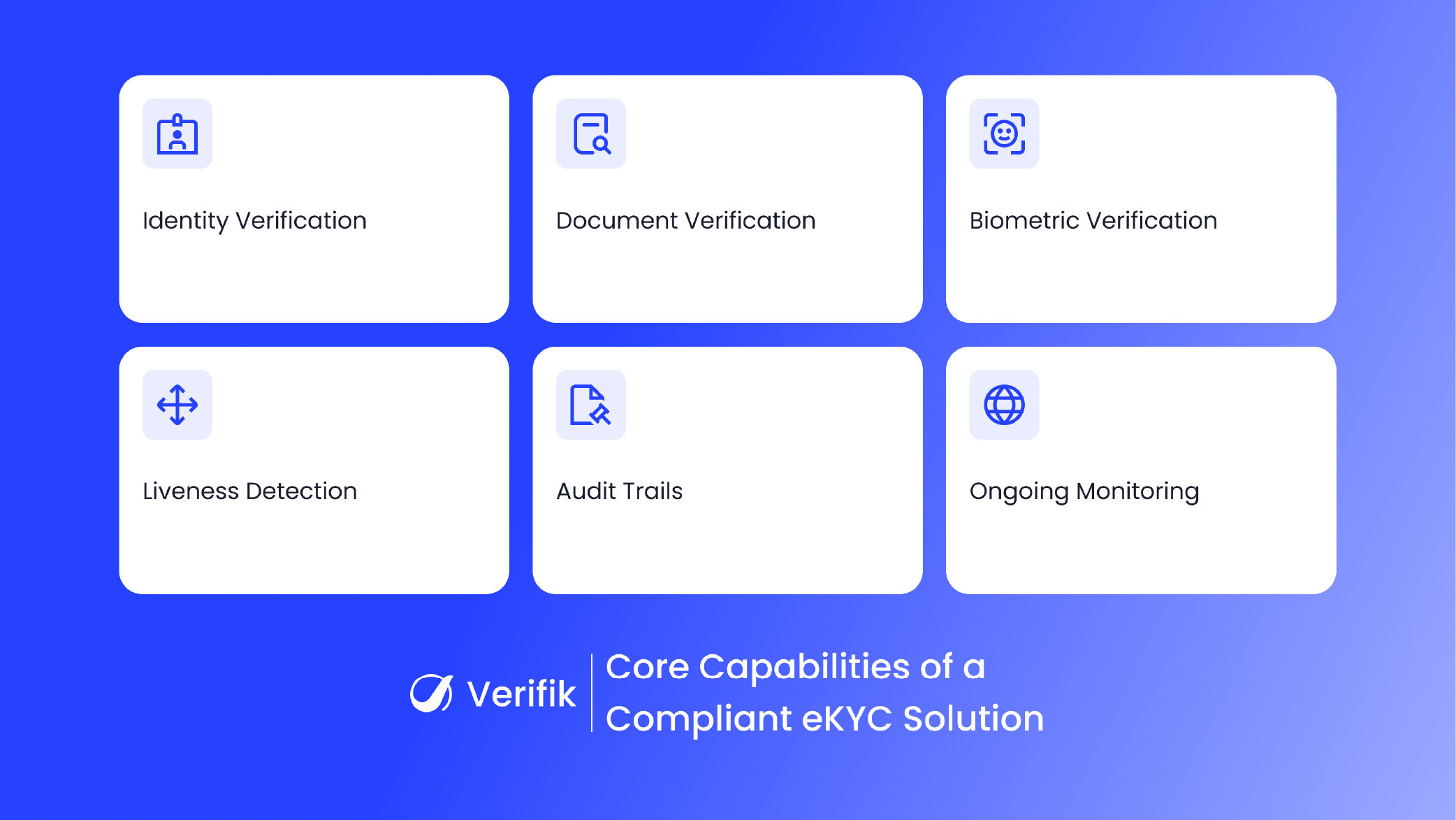
4. Liveness Detection
As fraud techniques become more advanced, verifying a matching face is no longer enough. Criminals now use photographs, prerecorded videos, masks, and AI-generated deepfakes to bypass traditional verification methods. Liveness detection confirms that a real person is present during identity verification by analyzing natural facial movements and other authenticity signals. This significantly strengthens fraud prevention while supporting secure, compliant digital onboarding.
5. Record Keeping and Audit Trails
Compliance responsibilities continue long after customer onboarding is complete. Businesses must maintain accurate verification records and be able to demonstrate how customer identities were verified whenever required by regulators or internal audits. An eKYC solution automatically stores verification data, timestamps verification events, and maintains detailed audit trails. This improves record management, simplifies compliance reporting, and reduces the administrative burden on compliance teams.
6. Ongoing Compliance Monitoring
Customer risk profiles can change over time due to new regulations, changing business relationships, or emerging financial crime risks. Compliance therefore extends beyond the initial onboarding process. Modern eKYC platforms support ongoing compliance by enabling businesses to update customer information, perform additional verification when required, and maintain accurate customer records throughout the relationship. This helps organizations remain compliant while responding more effectively to evolving regulatory requirements.
To see how these requirements play out at a regulated financial institution, read our guide to eKYC in banking.
Conclusion
eKYC compliance means having a digital onboarding process that keeps customer information secure while staying aligned with changing regulations. By combining automated identity verification with standardized verification workflows, businesses can strengthen compliance, reduce fraud, improve operational efficiency, and create a better onboarding experience for legitimate customers.
Meet eKYC Compliance Requirements With smartENROLL
Meeting compliance requirements starts with choosing the right eKYC platform. The right solution helps you automate identity verification while strengthening security, simplifying compliance, and improving customer onboarding. smartENROLL brings together AI-powered identity verification, OCR, facial recognition, liveness detection, biometric authentication, OTP verification, fraud detection, and seamless integrations in one platform. Designed for regulated businesses, it helps automate compliant customer onboarding while strengthening fraud prevention and improving operational efficiency. Book your free demo today!