Identity Card
 National Identity Document
 Citizenship ID
 Unique Identity Document
 Personal Identification Document
 Unique Population Registry Code
 Personal Identity Card
 Civil Identity Card
 Identity and Electoral Card
 Check Plate Colombia
 Check Plate Peru
 Check Plate Mexico
 Check Plate Argentina
 Check Plate Chile
 Check Plate USA
 Check Plate Brazil


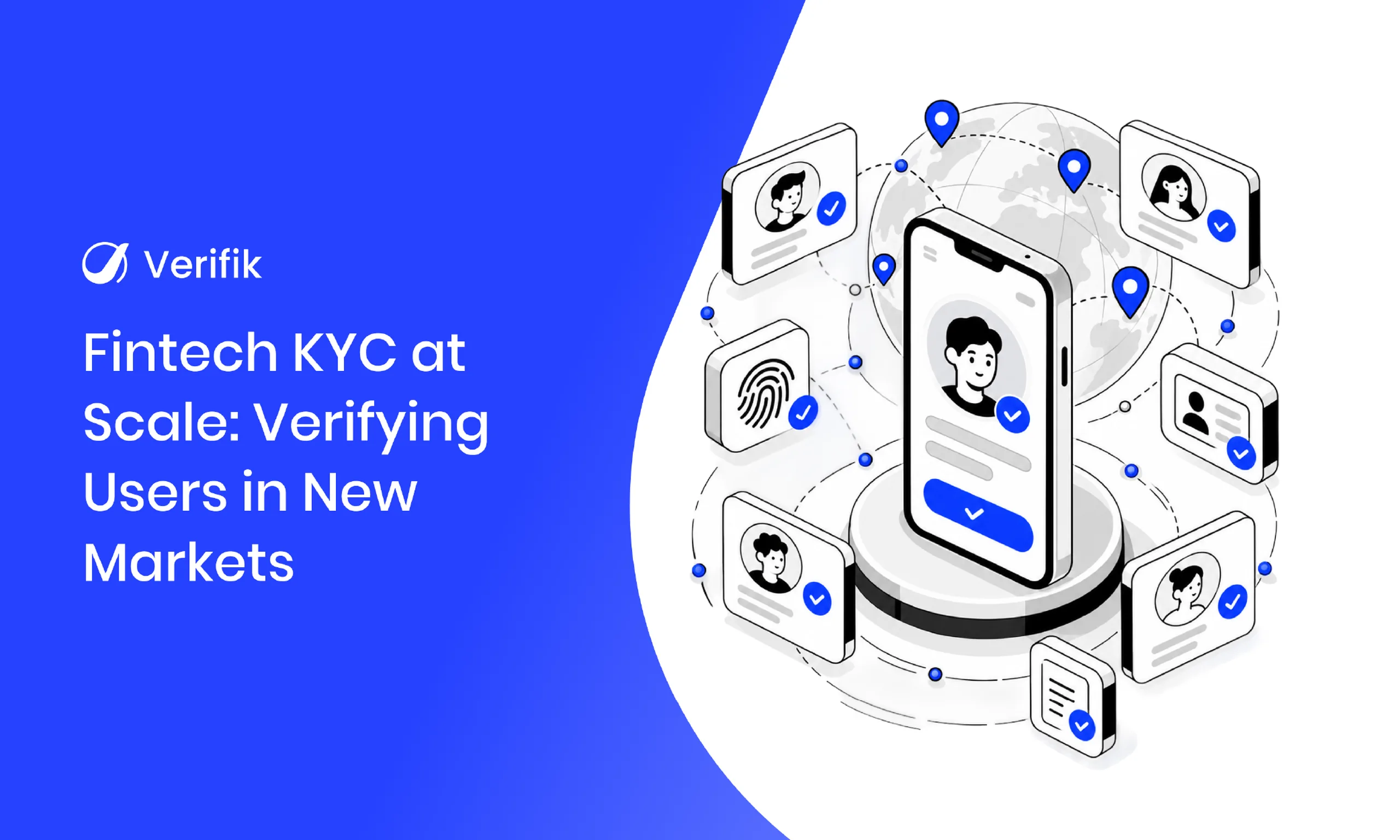
Short answer: Fintech KYC in new markets means adapting user verification to each country: its documents (cédula, INE or CURP, DNI, CPF, RUN), its official registries (Registraduría, RENIEC, RUES, CNPJ, CUIT) and its regulator’s rules. What scales is one core flow with a module per country, not a new flow for every launch.
Every new market is a new verification problem, and a fintech KYC solution built for one country rarely survives the next border.
And fintechs are crossing borders more often. According to the Mapa Fintech 2026 by FinteChile, EY and Finnovista, 85% of Chilean fintechs already operating abroad plan to keep expanding, with Colombia (33%), Peru (28%) and Mexico (24%) as targets. In Colombia, foreign companies already make up about 37% of the fintech ecosystem, according to the Finnovista Fintech Radar Colombia 2025, and 316 foreign fintechs operate in Mexico, according to the Finnovista Fintech Radar Mexico 2026. Every new market brings new documents, new registries and a new regulator.
This article explains what changes at each border, the checks to run before launch and the operating model that scales. For the fundamentals, read the pillar article eKYC for fintech: requirements, process and benefits.
Why new markets break single-country verification
Verification is local work. Everything your flow depends on (documents, data sources and rules) changes when you cross a border.
Documents change at every border
Colombia’s cédula, Mexico’s INE, Brazil’s CPF-backed IDs, Argentina’s DNI and Peru’s DNI share nothing but the word national. Security features, data formats and even card sizes differ. A document model trained on one country’s IDs will misread the next country’s, and every misread is a lost customer or a missed forgery.
Registries don’t travel
The truth about identity lives in local registries: the Registraduría and RUES (companies) in Colombia, RENIEC in Peru, CPF and CNPJ in Brazil, CUIT in Argentina. None of them answers queries from a provider that never integrated them. A check that skips local registries is comparing the document with itself.
Each source also evolves at its own pace. In Peru, RENIEC explained on November 20, 2026 that with the digital DNI (DNId), a verifiable credential signed by RENIEC in the Perú Pass wallet, companies will be able to validate identity without querying RENIEC each time. It is voluntary and does not replace the traditional DNI, so a RENIEC DNI lookup remains the path for users who only carry the physical card (see our Peru KYC API guide).
Regulators write their own rules
Colombia’s Financial Superintendence, Mexico’s CNBV, Brazil’s Central Bank and Peru’s SBS set their own rules on remote identification, data storage and reporting. An approval in one market means nothing in the next. Confirm every requirement with local legal counsel before launch; our compliance section summarizes data and identity rules by country.
Rules also change from one month to the next. In Colombia, Law 2573 of 2026 has been in force since November 19, 2026: according to Portafolio, a selfie can no longer be an automatic requirement to apply for credit, although lenders must still verify the applicant’s identity. A flow copied from another country that relies only on biometrics needs an alternative path here.
You can try what this fintech KYC in new markets guide covers in your own account: create a Verifik account.
What changes country by country: IDs and registries in LATAM
This table sums up, for the markets where the region’s fintechs expand most, which document the user presents, which source it is checked against and which Verifik lookup covers it. Source names are the ones each endpoint’s documentation gives.
| Country | Identity document | Verification source | Business registry | Verifik endpoint |
|---|---|---|---|---|
| Colombia | Citizenship card (CC) or PPT | Registraduría Nacional del Estado Civil | RUES (NIT) | /v2/co/cedula, /v3/co/rues-complete |
| Mexico | INE card or CURP | INE voter list; RENAPO for CURP | Folio Mercantil Electrónico (FME) | /v2/mx/ine, /v2/mx/curp, /v2/mx/company |
| Peru | DNI (8 digits) | RENIEC | RUC (SUNAT) | /v3/pe/cedula, /v3/pe/company |
| Brazil | CPF (with date of birth) | Official Brazilian sources | CNPJ (14 digits) | /v2/br/cedula, /v2/br/company |
| Argentina | DNI | Official Argentine sources | CUIT (11 digits) | /v2/ar/cedula, /v2/ar/company |
| Chile | RUN | Registro Civil | — | /v2/cl/cedula |
Each market is covered in detail in our country guides: Colombia KYC API, Peru KYC API and how to verify the INE in Mexico. If your expansion includes Venezuelan users, also see how to look up a Venezuelan cédula by API.
Pre-launch checks per market
Before you commit to a launch date, review six fronts in every new country: local document formats, national ID registries, business registries, sanctions and PEP lists, local regulator rules and data residency requirements.
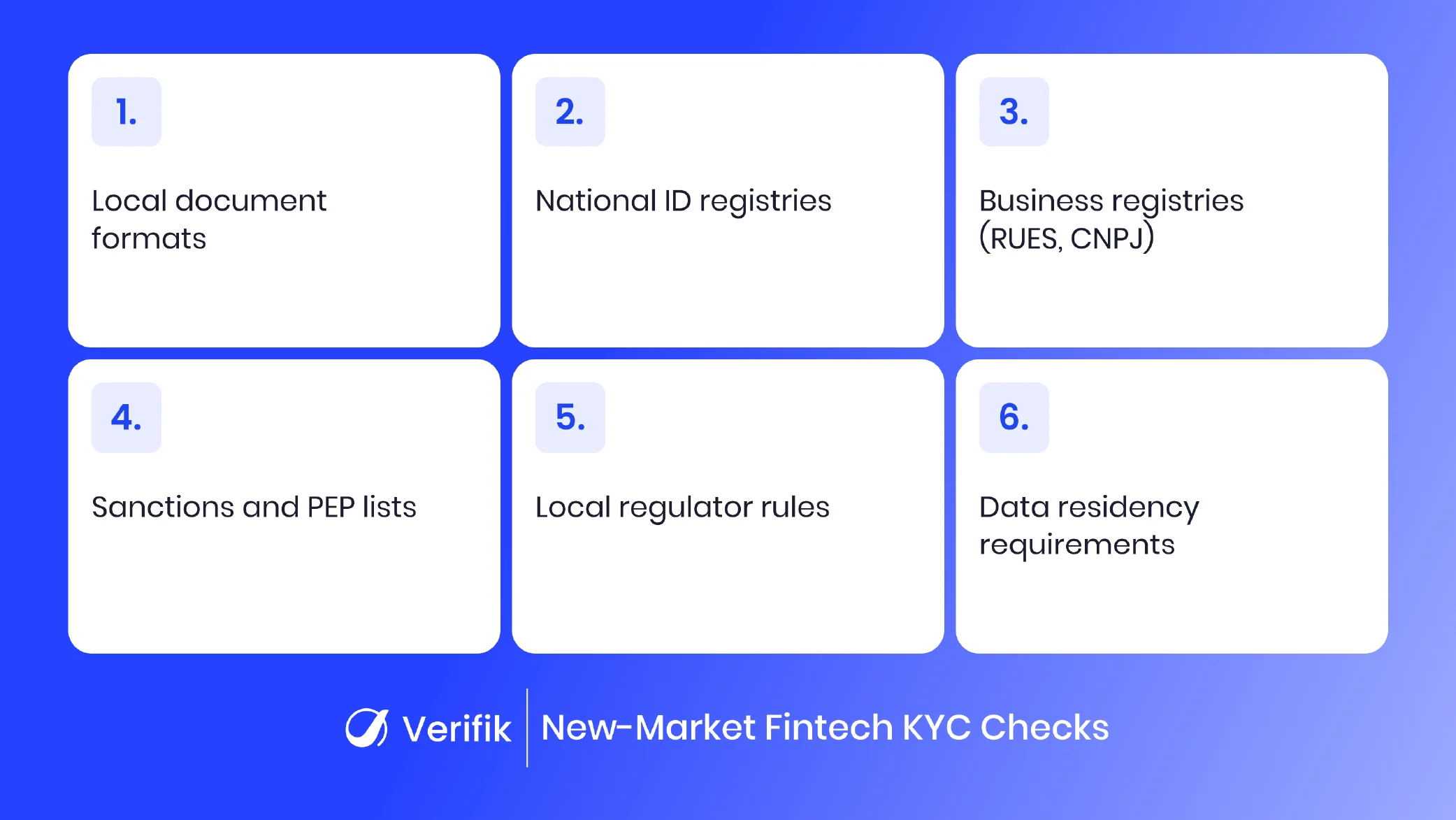
The six KYC checks a fintech has to settle in every new market before launch.
The first four are technical and are solved with integrations. The last two are legal: the level of due diligence each regulator expects (we explain it in KYC tiers: CDD, EDD and simplified) and where the data must stay. To keep them all in one list, use our KYC requirements checklist for fintech startups.
Single-market KYC vs multi-market KYC
Use this comparison to contrast single-market KYC with multi-market KYC before you commit to a launch date. Fintech eKYC software should cover every row natively, not as custom work.
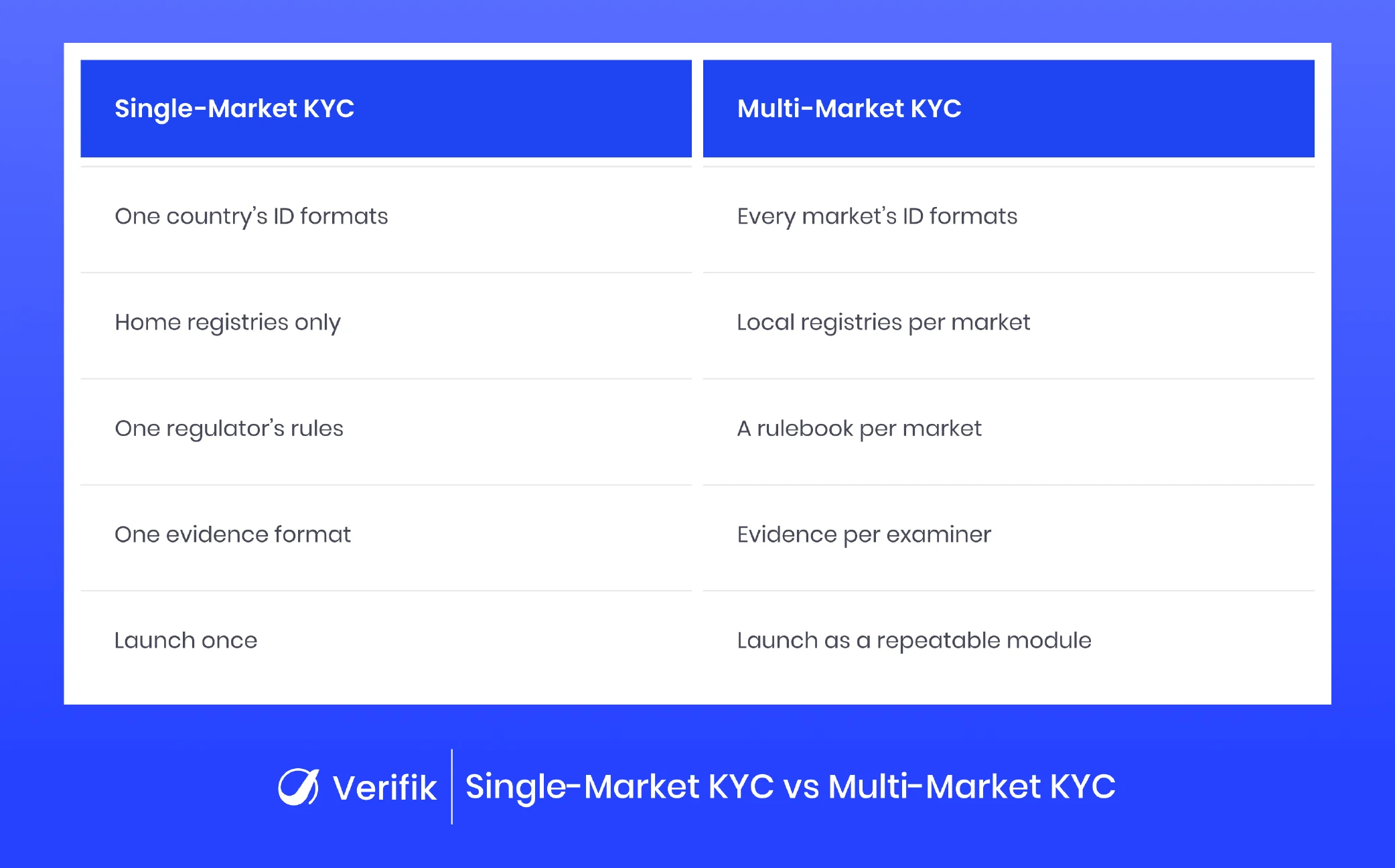
How running KYC in one market differs from running it in several markets at once.
If your provider can’t name the registries in the multi-market column, it can’t verify users in that market.
Build once, adapt per market
The teams that scale fastest run one core flow with market modules, not one flow per country.
One core flow, local modules
Document capture, biometrics and liveness detection work the same everywhere. What changes per market is the document set, the registries queried and the evidence format. Build the core once, then plug in a market module for each launch.
Registry coverage as a launch requirement
Make local registry coverage a launch requirement, not a backlog item. If the registries aren’t integrated before day one, your first users get weaker verification than in your home market, and examiners will notice.
Evidence every examiner accepts
Every regulator wants proof in its own format, but they all want the same thing: what was checked, what passed, what failed and when. A fintech eKYC platform that keeps time-stamped evidence of every check lets you answer every examiner from a single record.
What it looks like in the API: one flow, one adapter per country
In code, “one core flow with market modules” means the onboarding logic doesn’t change; only a per-country adapter does: the endpoint and the parameters each source expects. This Node.js 18+ example uses the identity endpoints from the table; the numbers are sample data.
// Node.js 18+ (native fetch). Sample data.
const BASE = "https://api.verifik.co";
const headers = {
  Accept: "application/json",
  Authorization: `Bearer ${process.env.VERIFIK_TOKEN}`,
};

// One adapter per country: only the endpoint and parameters change
const identityAdapters = {
  CO: (doc) => ["/v2/co/cedula", { documentType: "CC", documentNumber: doc.number }],
  MX: (doc) => ["/v2/mx/curp", { documentType: "CURP", documentNumber: doc.number }],
  PE: (doc) => ["/v3/pe/cedula", { documentType: "DNI", documentNumber: doc.number }],
  BR: (doc) => ["/v2/br/cedula", { documentType: "CPF", documentNumber: doc.number, dateOfBirth: doc.dateOfBirth }],
  AR: (doc) => ["/v2/ar/cedula", { documentType: "DNIAR", documentNumber: doc.number }],
  CL: (doc) => ["/v2/cl/cedula", { documentType: "RUN", documentNumber: doc.number }],
};

async function verifyIdentity(country, doc) {
  const adapter = identityAdapters[country];
  if (!adapter) throw new Error(`No adapter for market: ${country}`);
  const [path, params] = adapter(doc);
  const res = await fetch(`${BASE}${path}?${new URLSearchParams(params)}`, { headers });
  if (!res.ok) throw new Error(`${country} HTTP ${res.status}`);
  return res.json();
}

// The core flow is the same in every market
console.log(await verifyIdentity("CO", { number: "1020304050" }));
console.log(await verifyIdentity("PE", { number: "12345678" }));
console.log(await verifyIdentity("BR", { number: "01234567890", dateOfBirth: "17/02/1990" }));
Sample response from the Colombian cédula lookup (fictitious data; the fields are the ones in the documentation):
{
  "data": {
    "arrayName": [
      "ANA",
      "MARIA",
      "PEREZ",
      "GOMEZ"
    ],
    "documentNumber": "1020304050",
    "documentType": "CC",
    "firstName": "ANA MARIA",
    "fullName": "ANA MARIA PEREZ GOMEZ",
    "lastName": "PEREZ GOMEZ"
  },
  "signature": {
    "dateTime": "November 23, 2026 8:10 AM",
    "message": "Certified by Verifik.co"
  },
  "id": "EX001"
}
The same applies to business verification (KYB) when your customers are merchants or SMEs. In Python:
import os
import requests

HEADERS = {
    "Accept": "application/json",
    "Authorization": f"Bearer {os.getenv('VERIFIK_TOKEN')}",
}

# Business registry per market (KYB): same flow, different adapter
KYB = {
    "CO": ("/v3/co/rues-complete", {"documentType": "NIT", "category": "RM"}),
    "MX": ("/v2/mx/company", {"documentType": "FME"}),
    "PE": ("/v3/pe/company", {"documentType": "RUC"}),
    "BR": ("/v2/br/company", {"documentType": "CNPJ"}),
    "AR": ("/v2/ar/company", {"documentType": "CUIT"}),
}

def verify_company(country: str, number: str) -> dict:
    path, params = KYB[country]
    r = requests.get(
        f"https://api.verifik.co{path}",
        headers=HEADERS,
        params={**params, "documentNumber": number},
        timeout=30,
    )
    r.raise_for_status()
    return r.json()

print(verify_company("BR", "00000000000100"))  # sample CNPJ, 14 digits
print(verify_company("PE", "20100000001"))  # sample RUC
Biometrics, on the other hand, are identical in every market. Face comparison with liveness takes the selfie (probe), the document photo (gallery) and the thresholds:
// Same biometric step in every market
const res = await fetch("https://api.verifik.co/v2/face-recognition/compare-with-liveness", {
  method: "POST",
  headers: { ...headers, "Content-Type": "application/json" },
  body: JSON.stringify({
    probe: selfieBase64, // live selfie capture (base64)
    gallery: [documentPhotoBase64], // document photo (base64)
    search_mode: "FAST",
    liveness_min_score: 0.6,
    compare_min_score: 0.8,
  }),
});
console.log(res.status, await res.json());
Watchlists are also checked by API, for example the OFAC list check by document or by name, and you can repeat the lookup whenever your risk policy requires it. For how this differs from anti-money laundering, read KYC vs AML.
What breaks in the first 90 days
Three things surprise every expanding fintech. Document variants you never tested, such as older IDs still in circulation. Registry outages during local holidays. And consent texts that passed legal review in your home market but fail abroad. Budget time for all three.
How smartENROLL helps fintechs expanding across markets
smartENROLL is Verifik’s eKYC solution designed for fintechs in Latin America, where varied ID formats, strict regulators and uneven registry access make verification harder.
Documents configured country by country
Configure which countries and document types you accept (ID card, driver’s license or passport), with one block per country inside the same project.
Local registries, market by market
Query the Registraduría, RUES, RENIEC, CNPJ, CUIT and other national registries by API, and add checks against government databases and watchlists as a screening step inside smartENROLL.
Market modules, not rebuilds
Adding a country means configuring its allowed countries, accepted documents and the registries to query in the same project, on top of the same core flow.
Biometrics with liveness
Face comparison plus single-image liveness, iBeta Level 2 certified, designed to detect printed photos, video replays and 3D masks.
Sanctions and PEP lists
AML background and sanctions-list checks during onboarding, plus API lookups for PEP, adverse media and OFAC to re-verify a user whenever your policy calls for it.
Evidence and data control
Every enrollment stays in the review console with its status (pending, in progress, approved, rejected or under review), and you can receive the events by webhook. Data retention is set per project or flow: keep files for a defined period, keep them only during the session or store no images at all, with masked OCR and AES-256-GCM encryption.
Planning your next market? See smartENROLL for fintech, book a meeting with our team to review the documents and registries of your launch country, or try the lookups at app.verifik.co.
Conclusion
Verifying users in new markets comes down to three local realities: documents, registries and regulators. Fintechs that scale treat each market as a module on top of one core flow, gate launches on registry coverage and keep evidence every examiner accepts.
Test your next market before you commit to it. smartENROLL is designed for exactly that test, with document and registry coverage across Latin America. Create your account and try your launch country’s lookups with your own token.