Identity Card
 National Identity Document
 Citizenship ID
 Unique Identity Document
 Personal Identification Document
 Unique Population Registry Code
 Personal Identity Card
 Civil Identity Card
 Identity and Electoral Card
 Check Plate Colombia
 Check Plate Peru
 Check Plate Mexico
 Check Plate Argentina
 Check Plate Chile
 Check Plate USA
 Check Plate Brazil


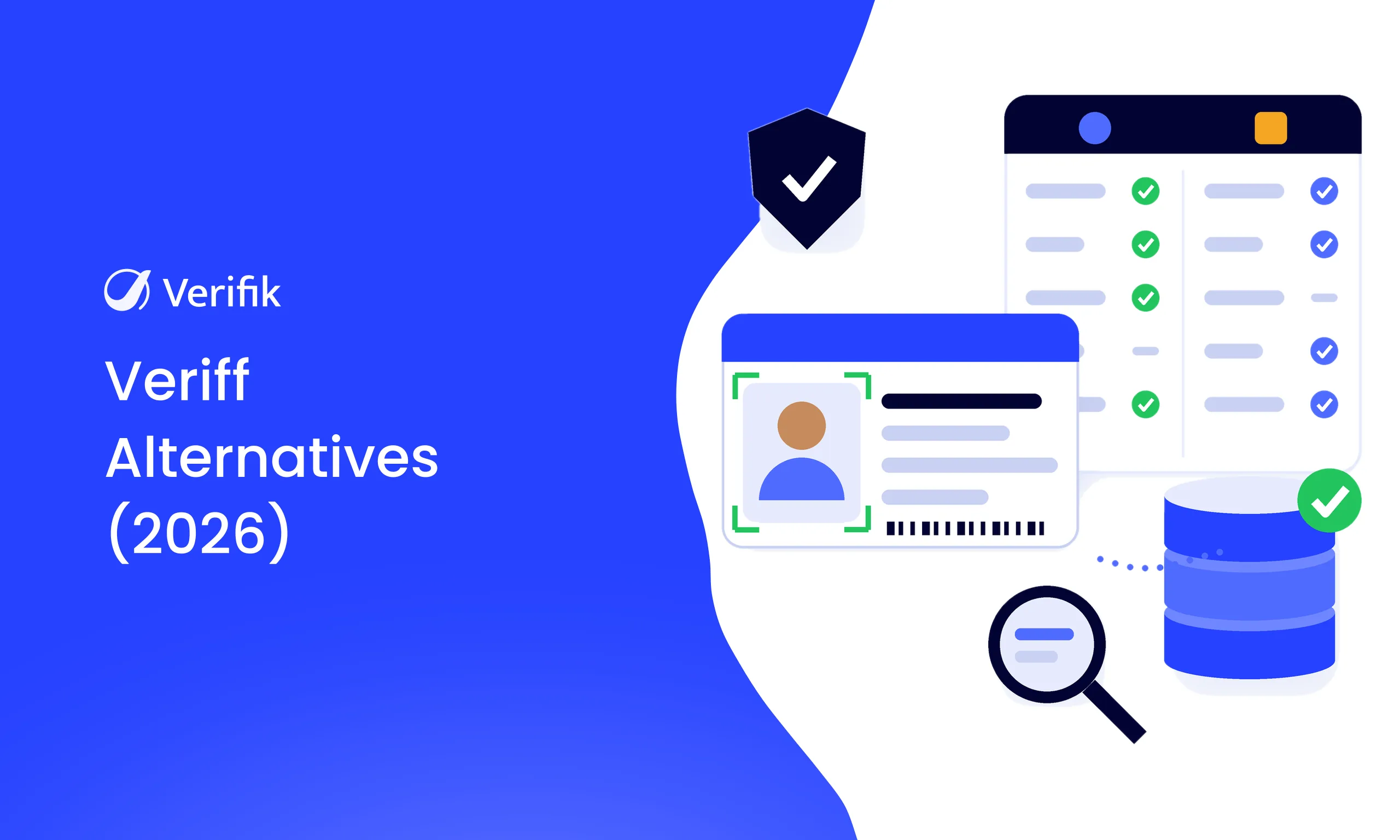
Short answer: Veriff is a global document and biometric verification platform with self-serve plans from $0.80 per verification and a $49 monthly minimum. The most compared alternatives in 2026 are Verifik (Latin American government sources and smartCHECK from $49/month), Sumsub, Jumio, MetaMap and Truora. Pick based on your countries, data sources and volume.
If your team uses Veriff or is evaluating it, it pays to check the market before you renew, move to an Enterprise plan or launch in a new country. This guide compares five alternatives using facts from their public websites as of November 26, 2026, explains when Veriff is still the better choice and shows how to run a pilot that adds an official-registry check to your document-and-selfie flow. When a fact is not public, we say so.
What Veriff is and who it fits
Veriff positions itself as an enterprise identity verification platform with three solutions: identity verification (document, face match and liveness), biometric authentication for returning users and business verification (KYB). Its identity verification page describes a flow where the user photographs an ID, takes a selfie and gets a decision in seconds, with support for more than 12,500 documents from 230+ countries and territories and an end-user flow in 50 languages and dialects.
According to its website, Veriff builds its decision engine, liveness, face match and document forensics models in-house, and works with named specialist partners for database verification and AML screening. It fits platforms with users in many countries that need automated document checks, with SDKs for iOS, Android and web, and teams that would rather start without a sales call.
If the use case is clear, create an account and test the endpoint from your own code.
Why teams look for Veriff alternatives
Not every reason applies to every company. These are the ones backed by what Veriff itself publishes on its pricing page:
- A monthly minimum on every plan. Self-serve plans charge per verification, but each carries a minimum commitment: $49 on Essential, $99 on Plus and $209 on Premium. At low or uneven volumes, the minimum matters more than the unit price.
- Extras billed per verification. PEP and sanctions screening (+$0.64), ongoing monitoring (+$0.09) and two-year extended retention (+$0.30) are charged on top of the monthly minimum.
- Data retention tied to the plan. Sessions are kept for 3 months on Essential and 6 months on Plus and Premium, and the page notes that Veriff does not notify you before deletion. If you must keep evidence for audits, you need the add-on or your own process.
- Custom pricing above a certain volume. Veriff points businesses with more than 5,000 verifications a month to its Enterprise plan, which has no published price.
- Official sources by country. If your process requires confirming the ID number against each country’s registry (RENAPO in Mexico, RENIEC in Peru or the Registraduría in Colombia), compare database coverage country by country, because at Veriff database verification is a separate product delivered with partners.
5 Veriff alternatives compared (2026)
The table sums up what each vendor publishes on its own website. It is not a rating: use it to know what to ask in each demo. “Not published” means we could not find the fact on their public website on November 26, 2026.
| Vendor | Focus | Published coverage | Official sources and databases | Published pricing | Trial |
|---|---|---|---|---|---|
| Verifik | Identity, biometrics, background, business and vehicle APIs, plus no-code smartCHECK | 90+ APIs from 15+ countries | Yes, e.g. CURP and INE (Mexico), DNI at RENIEC (Peru) and Registraduría (Colombia), plus watchlists such as OFAC, UN and Interpol | smartCHECK plans from $49/month | Sandbox with documented test data |
| Veriff (reference) | Document and biometrics, authentication, KYB and AML, self-serve or Enterprise | 230+ countries and territories and 12,500+ documents | Database verification as a separate product, with specialist partners | From $0.80 per verification, $49/month minimum | 15 days (up to 50 sessions) and sandbox |
| Sumsub | KYC, AML, KYB, transaction monitoring and fraud prevention | Global | Database validation and non-doc verification in the custom plan | From $1.35 per verification, $149/month minimum | 14 days with 50 checks |
| Jumio | Identity verification, biometrics, risk signals, AML and reusable identity | 5,000+ ID types | Risk signals from hundreds of global data sources | Not published | Not published |
| MetaMap | Verification platform with custom workflows for Latin America | Mexico, Colombia, Argentina, Brazil and more countries in the region | Yes, e.g. CURP, INE and RFC (Mexico), RUNT and Registraduría (Colombia) and CPF (Brazil) | Not published | Free Tier: 3 months or 300 verifications |
| Truora | Digital identity, background checks, reusable identity and e-signatures | Mexico, Colombia, Peru, Chile and Argentina on its home page; background checks in 7 countries | Yes: legal and judicial records, PEP, sanctions and restrictive lists | Not published | Not published |
Sources: each vendor’s pages as of November 26, 2026, including Sumsub pricing, MetaMap’s Latin America platform page and Truora’s background check docs. Jumio facts come from jumio.com. Prices and plans change: confirm them on each site before you decide.
1. Verifik
Verifik brings official-source lookups, biometrics with liveness and background checks together in one API. Instead of stopping at the photo of the ID, it confirms the number in the country’s registry: in Mexico it validates the CURP and the INE (see the INE guide), in Peru it checks the DNI at RENIEC (see the DNI lookup guide) and in Colombia it checks the cédula at the Registraduría. Its documentation includes watchlists such as OFAC, the UN and Interpol, and smartCHECK runs the same lookups from the web, with no code.
2. Sumsub
Sumsub publishes a Basic plan from $1.35 per verification with a $149 monthly minimum, covering ID verification, liveness and face match, and a Compliance plan from $1.85 with a $299 minimum that adds AML and proof of address. Database validation, non-doc verification and KYB sit in its custom plan. It offers a 14-day trial with 50 checks and says it charges for successful verifications only.
3. Jumio
Jumio offers an identity intelligence platform: it says it supports more than 5,000 ID types, combines biometrics and liveness designed to stop deepfakes, risk signals from hundreds of data sources and AML screening, and backs its decisions with its own identity graph. It also offers selfie-based reusable identity. It does not publish pricing on its website.
4. MetaMap
MetaMap says it offers more than 350 tools and data sources, including government sources such as CURP, INE and RFC in Mexico, BDUA, RUNT, SISBEN and the Registraduría in Colombia and CPF in Brazil. It does not publish pricing, and its Free Tier lets you evaluate for three months or 300 verifications. We cover it in depth in our guide to MetaMap alternatives.
5. Truora
Truora combines digital identity validation (document, biometrics with liveness and anti-fraud signals), background checks, reusable identity and e-signatures. Its background check documentation covers seven countries: Colombia, Mexico, Brazil, Chile, Peru, Costa Rica and Ecuador. See also our comparison of Truora alternatives.
When Veriff is still the better choice
Switching vendors has a cost, so Veriff may still be the right call in several cases:
- Your users come from many countries and what you need most is recognizing IDs from all over the world, with an end-user flow translated into dozens of languages.
- You want to start today on self-serve, with published per-verification pricing, a free trial and no sales call.
- You value review by trained specialists when automation can’t decide, which Veriff includes from the Plus plan.
- You already integrated its SDKs, your approval and fraud rates meet your targets and your volume fits your plan’s minimum.
In those cases, an alternative can work as a complement: for example, to confirm IDs from the Latin American countries where you operate against the official source.
How to test an alternative without slowing onboarding
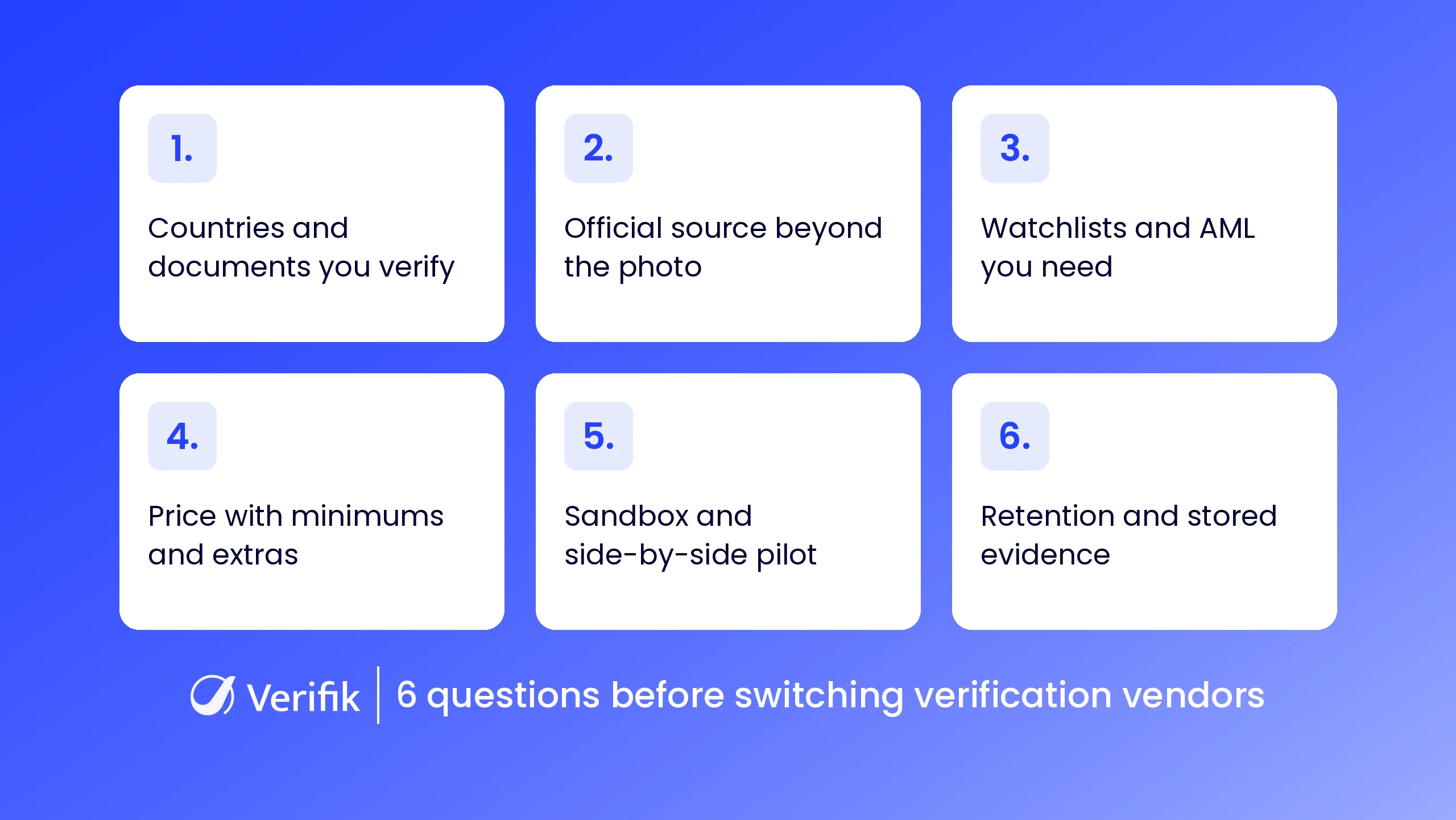
The safest way to compare is a side-by-side pilot: send a sample of your cases to the alternative, compare results with your current vendor and only then move real traffic. Before you start, answer these six questions with your team.
A simple pilot with Verifik takes the number your document-and-selfie flow already extracted and confirms it in the official registry. In Mexico, the CURP API takes the document type and number. The CURP below is the one from the docs:
curl -G "https://api.verifik.co/v2/mx/curp" \
  -H "Accept: application/json" \
  -H "Authorization: Bearer $VERIFIK_TOKEN" \
  --data-urlencode "documentType=CURP" \
  --data-urlencode "documentNumber=ABCD890513ABCDEF09"
A successful response returns the registry name and date of birth, plus a signature you can store as evidence:
{
  "data": {
    "documentType": "CURP",
    "documentNumber": "ABCD890513ABCDEF09",
    "firstName": "Juan",
    "lastName": "Pérez",
    "fullName": "Juan Pérez",
    "dateOfBirth": "1989-05-13",
    "nationality": "Mexican"
  },
  "signature": {
    "message": "Certified by Verifik.co",
    "dateTime": "January 16, 2024 3:44 PM"
  },
  "id": "MX001"
}
In Peru, the RENIEC DNI lookup works the same way, with the 8-digit DNI:
curl -G "https://api.verifik.co/v3/pe/cedula" \
  -H "Accept: application/json" \
  -H "Authorization: Bearer $VERIFIK_TOKEN" \
  --data-urlencode "documentType=DNI" \
  --data-urlencode "documentNumber=71647369"
{
"data": {
"documentType": "DNI",
"documentNumber": "71647369",
"firstName": "FELIPE",
"lastName": "TRUJILLO HERNANDEZ",
"fullName": "FELIPE TRUJILLO HERNANDEZ",
"dateOfBirth": "19-12-1995",
"civilStatus": "SOLTERO",
"department": "CALLAO",
"province": "CALLAO",
"district": "CALLAO"
},
"signature": {
"dateTime": "April 16, 2025 2:43 PM",
"message": "Certified by Verifik.co"
},
"id": "FHBCC"
}To keep the pilot from touching the rest of your code, wrap the lookup in a function that always returns the same shape, whatever the country:
import os
import requests

API = "https://api.verifik.co"
HEADERS = {
    "Accept": "application/json",
    "Authorization": f"Bearer {os.getenv('VERIFIK_TOKEN')}",
}

# Country -> (path, document type), per docs.verifik.co
REGISTRIES = {
    "MX": ("/v2/mx/curp", "CURP"),
    "PE": ("/v3/pe/cedula", "DNI"),
}

def check_registry(country, number, extracted_name):
    """Confirms in the official source the number your document-and-selfie flow already extracted."""
    path, doc_type = REGISTRIES[country]
    r = requests.get(f"{API}{path}", headers=HEADERS, timeout=60,
                     params={"documentType": doc_type, "documentNumber": number})
    if not r.ok:
        return {"country": country, "in_registry": False, "code": r.json().get("code")}
    data = r.json()
    return {
        "country": country,
        "in_registry": True,
        "name_matches": data["data"]["fullName"].upper() == extracted_name.upper(),
        "evidence": data["signature"],  # keep it in the case file
    }
Track approval rate, false rejections, response time and cost per approved customer, extras included. With those four numbers, the decision stops being an opinion. In the sandbox you can test with the documented test data before sending real cases.
Which alternative to choose for your case
- Fintech, lending or BNPL in Latin America: prioritize official sources by country and predictable pricing. Verifik, MetaMap and Truora work with government sources in the region; see also our guide to eKYC for fintech.
- Expanding into new countries in the region: compare, country by country, which registry each vendor checks; our guide to KYC when entering new markets helps you build that list.
- Global platforms with many ID types: Veriff, Sumsub and Jumio publish global document coverage.
- Regulated businesses that need AML in the same plan: Sumsub’s Compliance plan includes AML and proof of address; at Veriff, PEP and sanctions screening is a per-verification extra.
Pricing and how to start with Verifik
Verifik publishes its smartCHECK plans: Starter $49/month, Basic $129/month, Plus $299/month and Business $649/month, with two months free on annual billing (for example, $490/year for Starter). You can create an account, try the endpoints in the sandbox and, if you have high volume, book a session to review volume pricing and how to add Verifik to your current flow.