 Identity Card
 National Identity Document
 Citizenship ID
 Unique Identity Document
 Personal Identification Document
 Unique Population Registry Code
 Personal Identity Card
 Civil Identity Card
 Identity and Electoral Card
 Check Plate Colombia
 Check Plate Peru
 Check Plate Mexico
 Check Plate Argentina
 Check Plate Chile
 Check Plate USA
 Check Plate Brazil


Short answer: Truora is a Latin American platform for digital identity, background checks and e-signatures that does not publish pricing for identity verification. The most compared alternatives in 2026 are Verifik (official Latin American sources, plans from $49/month), MetaMap, Veriff, Sumsub and Jumio. Pick by countries, sources and pricing model.
If your team uses Truora or is evaluating it, it pays to review the market before you renew or launch a new country. This guide compares five alternatives using facts from their public websites on November 19, 2026, explains when Truora is still the better choice and shows how to run a side-by-side pilot. Where a fact is not published, we say so.
What Truora is and who it fits
On its website, Truora describes itself as a digital trust platform for Latin America with four lines: digital identity verification (document checks, biometrics with liveness, anti-fraud signals and phone and email checks), background checks (judicial records, PEP, sanctions, restrictive lists and credit risk), Truora Pass for reusing an identity that was already verified, and e-signatures. Flows plug in through the web, an API or WhatsApp, and its home page highlights Mexico, Colombia, Peru, Chile and Argentina.
Its background check documentation lists coverage in seven countries: Colombia, Mexico, Brazil, Chile, Peru, Costa Rica and Ecuador, for people, companies and vehicles. It is a good fit for companies that want identity, background checks, signatures and WhatsApp messaging from a single vendor.
You can try what this Truora alternatives guide covers in your own account: create a Verifik account.
Why teams look for Truora alternatives
Not every reason applies to every company. These are the ones backed by what Truora itself publishes:
- No published identity pricing. The digital identity pricing page lists the included validators but shows no amounts and sends you to sales. If you need to estimate cost per customer before a meeting, a published price makes comparison easier.
- Background checks sold in volume plans. Background check plans range from 100 queries a month to more than 6,000 a year, with no published unit price.
- WhatsApp needs an extra plan. According to the same page, WhatsApp validation is available with the advanced Customer Engagement plan.
- Specific sources and countries. If you operate outside the seven countries in its background check coverage, or need very specific sources (driver’s licenses, vehicles, court cases, company registries), compare each vendor’s catalogue country by country.
5 Truora alternatives compared (2026)
The table sums up what each vendor publishes on its own site. It is not a rating: use it to know what to ask in each demo. “Not published” means we did not find the fact on the vendor’s public site on November 19, 2026.
| Vendor | Focus | Published coverage | Official sources and background checks | Published price | Trial |
|---|---|---|---|---|---|
| Verifik | Identity, biometrics, background, business and vehicle APIs, plus no-code smartCHECK | 90+ APIs from 15+ countries | Yes, e.g. Registraduría, Police and RUNT (Colombia), INE and CURP (Mexico), DNI (Peru), plus international watchlists | smartCHECK plans from $49/month | Sandbox with documented test data |
| Truora | Digital identity, background checks, reusable identity and e-signatures, with WhatsApp flows | Mexico, Colombia, Peru, Chile and Argentina on its home page; background checks in 7 countries | Yes: judicial records, PEP, sanctions and restrictive lists | Not published (identity); background checks in volume plans with no unit price | Not published |
| MetaMap | KYC/AML, onboarding and authentication platform (part of Incode) | Latin America, North America and Africa | Yes, e.g. CURP, INE, RFC, RUNT, SISBEN and Registraduría | Not published | Free Tier: 3 months or 300 verifications |
| Veriff | Document and biometric verification, self-serve or enterprise | 230+ countries and territories and 12,500+ documents | Database verification as a separate product | From $0.80 per verification, $49/month minimum | 15 days (up to 50 sessions) and a sandbox |
| Sumsub | KYC, AML, KYB and fraud prevention | Global | Database validation in the custom plan | From $1.35 per verification, $149/month minimum | 14 days with 50 checks |
| Jumio | Identity verification, biometrics, risk signals and AML | 5,000+ ID document types | Government database checks and AML screening | Not published | Not published |
Sources: each vendor’s pages checked on November 19, 2026, including Veriff pricing and Sumsub pricing. MetaMap facts come from metamap.com and Jumio facts from jumio.com. Prices and plans change: confirm them on each site before you decide.
1. Verifik
Verifik brings official-source lookups, biometrics with liveness and background checks into one API. In Colombia it validates the cédula against the Registraduría and checks the Police, Procuraduría, Contraloría and RUNT (see the Colombia KYC guide and the court case lookup guide); in Mexico it validates the INE and CURP (INE guide); and its documentation covers watchlists such as OFAC, the UN and Interpol. If you would rather not code, smartCHECK runs the same lookups from the web or a CSV file.
2. MetaMap
MetaMap, now part of Incode, says it offers more than 350 tools and data sources, including government sources such as BDUA, NIT, RUNT, SISBEN and the Registraduría in Colombia and CURP, INE and RFC in Mexico. It does not publish pricing, and its Free Tier allows an evaluation of three months or 300 verifications. For another regional option, our MetaMap alternatives guide covers it in depth.
3. Veriff
Veriff publishes three self-serve plans priced per verification: Essential at $0.80 with a $49 monthly minimum, Plus at $1.39 with a $99 minimum and Premium at $1.89 with a $209 minimum. It offers a 15-day trial and a free sandbox, and recommends its custom-priced Enterprise plan for businesses with more than 5,000 verifications a month. It fits if you need global document coverage and would rather start without a sales call.
4. Sumsub
Sumsub publishes a Basic plan from $1.35 per verification with a $149 monthly minimum and a Compliance plan from $1.85 with a $299 minimum that adds AML and address checks. Database validation and non-document verification sit in its custom plan, and it offers a 14-day trial with 50 checks.
5. Jumio
Jumio offers an identity platform with global coverage: it says it supports more than 5,000 ID document types, pairs biometrics with liveness built to stop deepfakes, AML screening and government database checks, and backs its decisions with its own identity graph. It does not publish pricing on its site.
When Truora is still the better choice
Switching vendors has a cost, so Truora can still be the right call in several cases:
- Your onboarding, collections or sales happen inside WhatsApp and you want identity checks to live in the same conversational flow.
- You need identity, background checks, e-signatures and reusable identity under one contract and one console.
- You operate in the countries its background checks cover, and the flows you already set up meet your conversion and fraud targets.
- You value hands-on help from local experts during implementation, which Truora highlights on its site.
In those cases, an alternative can work as a second provider for specific sources or countries instead of replacing everything.
How to test an alternative without pausing onboarding
The safest way to compare is a side-by-side pilot: send a sample of your cases to the alternative, compare results with your current vendor and only then move real traffic. Before you start, answer these six questions with your team.
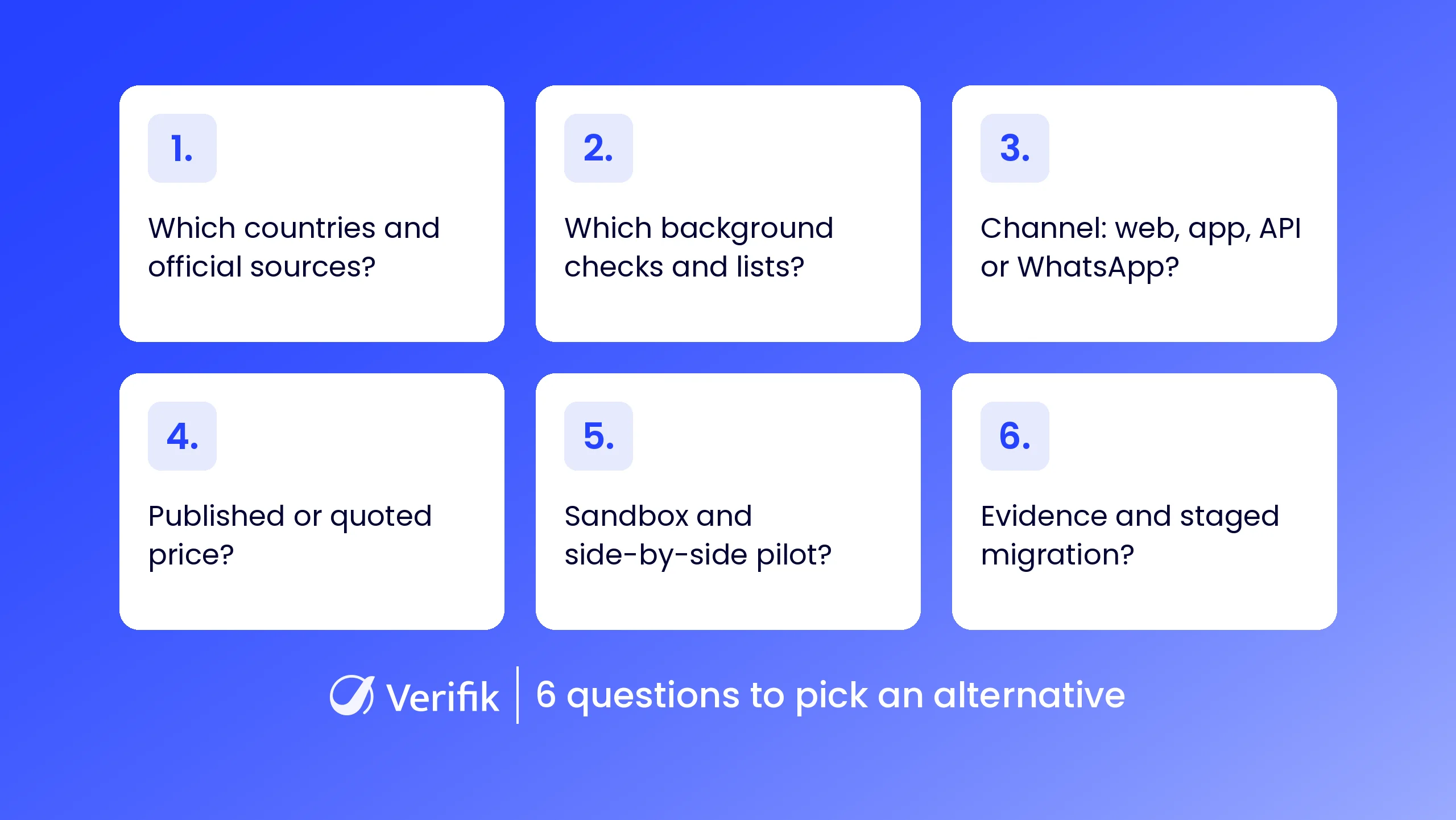
With Verifik, a typical pilot in Colombia starts by validating the cédula against the Registraduría with the endpoint in the Colombian ID API docs. The number in the example comes from the documentation:
curl -G "https://api.verifik.co/v2/co/cedula" \
  -H "Accept: application/json" \
  -H "Authorization: Bearer $VERIFIK_TOKEN" \
  --data-urlencode "documentType=CC" \
  --data-urlencode "documentNumber=1121329662"
A successful response returns the registered name and a signature you can keep as evidence:
{
  "data": {
    "arrayName": [
      "JULIO",
      "CESAR",
      "CABANA",
      "CONTRERAS"
    ],
    "documentNumber": "1121329662",
    "documentType": "CC",
    "firstName": "JULIO CESAR",
    "fullName": "JULIO CESAR CABANA CONTRERAS",
    "lastName": "CABANA CONTRERAS"
  },
  "signature": {
    "dateTime": "October 8, 2025 8:21 PM",
    "message": "Certified by Verifik.co"
  },
  "id": "I70IL"
}
Then check judicial records with the National Police using the police record check:
curl -G "https://api.verifik.co/v2/co/policia/consultar" \
  -H "Accept: application/json" \
  -H "Authorization: Bearer $VERIFIK_TOKEN" \
  --data-urlencode "documentType=CC" \
  --data-urlencode "documentNumber=1032386359"
{
"data": {
"documentType": "CC",
"documentNumber": "1032386359",
"firstName": "LILIA MANUELA",
"lastName": "LESPORT FERNANDEZ",
"fullName": "LILIA MANUELA LESPORT FERNANDEZ",
"arrayName": [
"LILIA",
"MANUELA",
"LESPORT",
"FERNANDEZ"
],
"details": "NO TIENE ASUNTOS PENDIENTES CON LAS AUTORIDADES JUDICIALES de conformidad con lo establecido en el artículo 248 de la Constitución Política de Colombia."
},
"signature": {
"dateTime": "March 13, 2024 10:48 PM",
"message": "Certified by Verifik.co"
},
"id": "7QS69"
}So that switching vendors does not touch the rest of your code, wrap the calls in an adapter that always returns the same shape. That way you can run both vendors side by side during the pilot:
import os
import requests

API = "https://api.verifik.co"
HEADERS = {
    "Accept": "application/json",
    "Authorization": f"Bearer {os.getenv('VERIFIK_TOKEN')}",
}

def lookup(path, number, doc_type="CC"):
    r = requests.get(f"{API}{path}", headers=HEADERS, timeout=60,
                     params={"documentType": doc_type, "documentNumber": number})
    r.raise_for_status()
    return r.json()

# Neutral adapter: your app gets the same shape whatever the provider
def verify_colombia(number, declared_name):
    id_card = lookup("/v2/co/cedula", number)
    police = lookup("/v2/co/policia/consultar", number)
    return {
        "provider": "verifik",
        "name_matches": id_card["data"]["fullName"] == declared_name.upper(),
        "no_pending_matters": police["data"]["details"].startswith("NO TIENE"),
        "evidence": [id_card["signature"], police["signature"]],  # keep it in the case file
    }
Track approval rate, false rejections, response time and cost per approved customer. With those four numbers, the decision stops being an opinion. If you also verify faces, add face comparison with liveness to the same adapter.
Which alternative to choose for your use case
- Fintech, lending or BNPL in Latin America: prioritize official sources by country and predictable pricing. Verifik and MetaMap have regional government sources; see also the eKYC for fintech guide.
- Platforms with users worldwide: Veriff, Sumsub and Jumio publish global document coverage.
- Mobility, logistics and drivers: besides identity you need licenses, fines, vehicles and background checks. Verifik checks RUNT, SIMIT and the Police in Colombia; see how to vet drivers before dispatch.
- Conversational onboarding in WhatsApp: Truora has the most integrated product for that channel; the other options connect through an API, SDK or hosted web page.
Pricing and how to start with Verifik
Verifik publishes its smartCHECK plans: Starter $49/month, Basic $129/month, Plus $299/month and Business $649/month, with two months free on annual billing (for example, $490/year for Starter). You can create an account, try the endpoints in the sandbox and, if you have high volume, book a session to review volume pricing and migration from your current vendor.