 Identity Card
 National Identity Document
 Citizenship ID
 Unique Identity Document
 Personal Identification Document
 Unique Population Registry Code
 Personal Identity Card
 Civil Identity Card
 Identity and Electoral Card
 Check Plate Colombia
 Check Plate Peru
 Check Plate Mexico
 Check Plate Argentina
 Check Plate Chile
 Check Plate USA
 Check Plate Brazil


Short answer: MetaMap is an identity verification platform that is now part of Incode and does not publish prices. The most compared alternatives in 2026 are Verifik (APIs backed by official Latin American sources, with plans from $49/month), Truora, Incode, Veriff and Sumsub. Choose based on your countries, the official sources you need and the pricing model.
If your team uses MetaMap or is evaluating it, it makes sense to review the market before a renewal or a new country launch. This guide compares five alternatives using facts taken from their public pages on November 5, 2026, explains when MetaMap is still the better choice and shows how to run a pilot without pausing your onboarding. Where a fact is not published, we say so.
What MetaMap is and who it fits
According to its Latin America page (in Spanish), MetaMap offers identity verification, KYC and AML, onboarding, authentication and financial risk, with more than 350 tools and data sources, including government sources. It lists, among others, CURP, INE, RFC and Cédula Profesional in Mexico; BDUA, NIT, RUNT, SISBEN and the Registraduría in Colombia; AFIP and DNI in Argentina; and CPF and CNPJ in Brazil. It also says more than 450 Latin American companies trust the platform and that it does business in other countries such as Chile, Peru, Ecuador and Panama.
The same site says MetaMap is now part of Incode and that together they serve businesses in North America, Latin America and Africa. For pricing, the page invites you to talk to an expert: there is no public plan table.
You can try what this MetaMap alternatives guide covers in your own account: create a Verifik account.
Why teams look for MetaMap alternatives
There is no single reason, and not every reason applies to every company. These are the most common ones, backed by what MetaMap itself publishes:
- New ownership. After the acquisition by Incode, some teams want to understand how the product will evolve and prefer to have a second provider evaluated.
- Unpublished pricing. MetaMap quotes through its sales team. If you need to estimate cost before a meeting, or start at low volume, a published price makes the decision easier.
- Limited trial. Its Free Tier terms (version of June 1, 2023) describe an evaluation period of three months or 300 verifications, whichever comes first.
- Country-specific sources. Some use cases need checks that go beyond the document and the selfie, such as criminal records, driver’s licences or vehicle data, so it pays to compare which sources each provider has for your countries.
5 MetaMap alternatives compared (2026)
The table summarizes what each provider publishes on its own site. It is not a score: use it to know what to ask in each demo. “Not published” means we could not find the fact on their public site on November 5, 2026.
| Provider | Focus | Published coverage | Official Latin American sources | Published price | Trial |
|---|---|---|---|---|---|
| Verifik | Identity, biometrics, background and vehicle APIs, plus no-code smartCHECK | More than 90 APIs from more than 15 countries | Yes, for example INE and CURP (Mexico), Registraduría, RUNT and National Police (Colombia) | smartCHECK plans from $49/month | Sandbox with documented test data |
| MetaMap | KYC/AML, onboarding and authentication platform | Latin America, North America and Africa | Yes, for example CURP, INE, RFC, RUNT and Registraduría | Not published | Free Tier: 3 months or 300 verifications |
| Truora | Digital identity, background checks and e-signature, with WhatsApp flows | Mexico, Colombia, Peru, Chile and Argentina on its site | Background checks and restrictive lists | Not published | Not published |
| Incode | Identity verification, authentication and deepfake defense | 190+ countries and 4,900+ document types | Not published by country | Not published | Not published |
| Veriff | Document and biometric verification, self-serve or enterprise | 230+ countries and 12,500+ documents | Database verification on the Enterprise plan | From $0.80 per verification, $49 monthly minimum | 15 days, 50 verifications and sandbox |
| Sumsub | KYC, AML and fraud prevention | Global | Database validation on the custom plan | From $1.35 per verification, $149 monthly minimum | 14 days with 50 checks |
Sources: each provider’s pages checked on November 5, 2026, including Truora, Veriff pricing and Sumsub pricing. Incode facts come from its site, incode.com. Prices and plans change: confirm them on each site before you decide.
1. Verifik
Verifik brings official Latin American sources, biometrics with liveness and background and vehicle checks together in one API. In Colombia it checks the cédula with the Registraduría, police records and RUNT; in Mexico it validates the INE against the voter registry and the CURP; and in Peru it covers the DNI (see the Peru KYC guide), among other services described in the Colombia KYC guide and the INE verification guide. If you don’t want to write code, smartCHECK runs the same checks from the web or from a CSV. Companies such as UNI2 Microcrédito and Monet already verify identity with Verifik.
2. Truora
Truora presents itself as a digital trust platform for Latin America: document validation, biometrics and liveness, background checks, restrictive lists, reusable identity and e-signature, integrated by API, SDK or WhatsApp flows. It is worth a look if your lending or sign-up flow lives inside WhatsApp.
3. Incode
Incode is now MetaMap’s parent company. Its site describes document verification, biometrics, liveness, deepfake detection and authentication, with coverage in more than 190 countries. If you already use MetaMap, talking to Incode helps you understand the roadmap before you switch providers.
4. Veriff
Veriff publishes self-serve plans priced per verification, from $0.80 with a $49 monthly minimum commitment, and a 15-day trial with unlimited test verifications in the sandbox. It fits if you need global document coverage and prefer to start without a sales call.
5. Sumsub
Sumsub publishes a Basic plan from $1.35 per verification with a $149 monthly minimum, charges for successful verifications only and offers a 14-day trial with 50 checks. Database validation is listed on its custom plan.
When MetaMap is still the better choice
Switching providers has a cost, so MetaMap may still be the right call in several cases:
- You already have flows, rules and manual reviews set up on its platform and they work well for your business.
- You operate in North America, Latin America and Africa and want a single provider for those regions.
- You need the government sources MetaMap lists for Mexico, Colombia, Argentina and Brazil, and your current results meet your conversion and fraud goals.
- You are interested in Incode’s technology and prefer to grow within the same group.
In those cases, an alternative can work as a backup second provider rather than a replacement.
How to test an alternative without pausing onboarding
The safest way to compare is a side-by-side pilot: send a sample of your cases to the alternative, compare its decisions with your current provider’s and only then move real traffic. These six steps work with any provider.
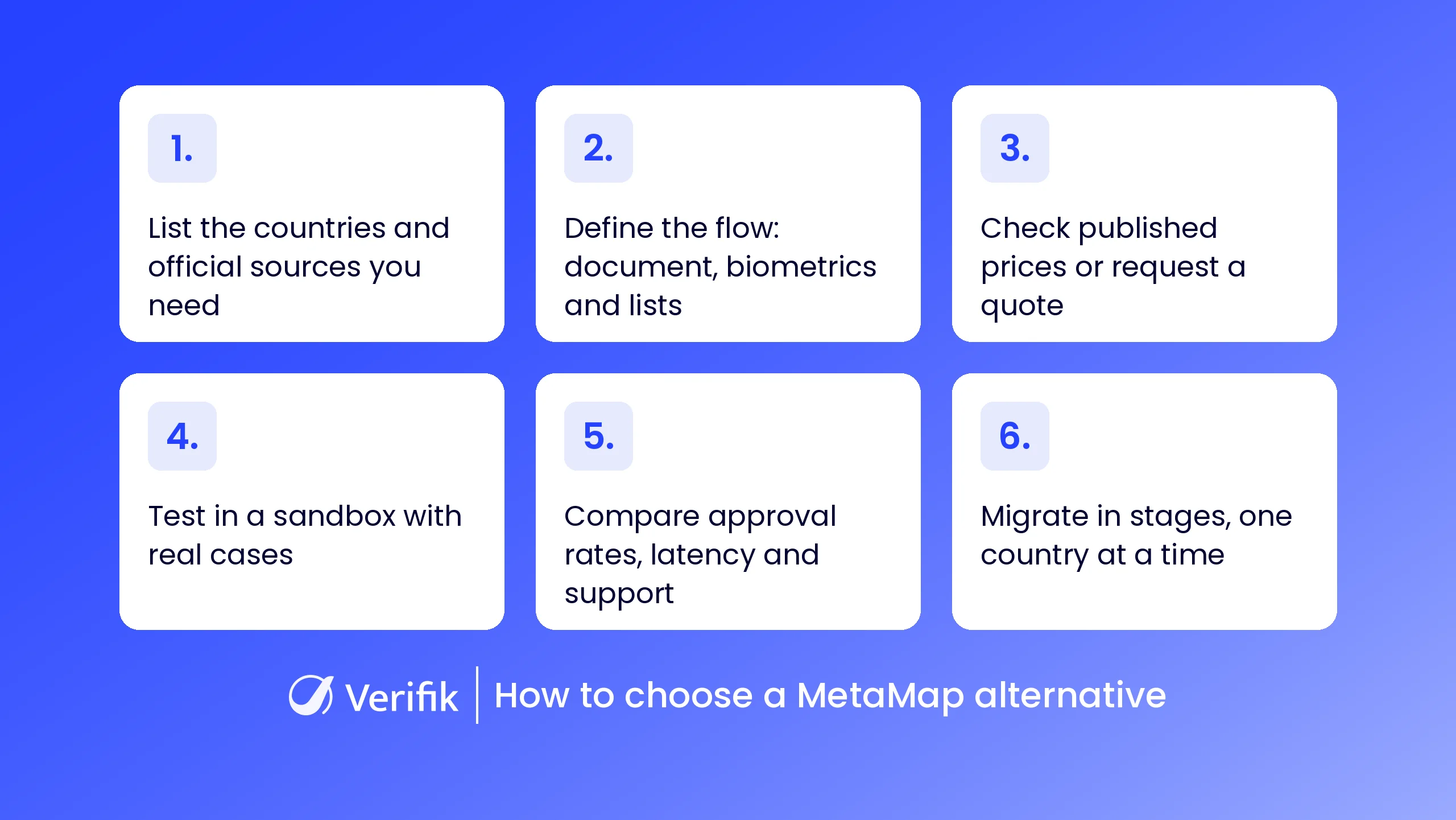
With Verifik, the first step for Mexico is to validate the INE card against the voter registry with its CIC, OCR or elector key. The example uses the sandbox test value published in the INE documentation:
curl -G "https://api.verifik.co/v2/mx/ine" \
  -H "Accept: application/json" \
  -H "Authorization: Bearer $VERIFIK_TOKEN" \
  --data-urlencode "documentType=INE" \
  --data-urlencode "documentNumber=187639699"
A successful response returns the card status and a signature you can store as evidence:
{
  "data": {
    "cic": "187639699",
    "documentNumber": "187639699",
    "documentType": "INE",
    "electorKey": "CSFTGV76061131H400",
    "emissionNumber": "1",
    "emissionYear": "2018",
    "identifierType": "cic",
    "message": "Vigente como medio de identificacion y puede votar",
    "ocr": "0276031206745",
    "registrationYear": "2010",
    "validity": "31 de diciembre de 2030"
  },
  "signature": {
    "dateTime": "July 14, 2026 10:00 AM",
    "message": "Certified by Verifik.co"
  }
}
Then compare the selfie with the document photo and confirm it is a live person with the compare with liveness endpoint:
curl -X POST "https://api.verifik.co/v2/face-recognition/compare-with-liveness" \
  -H "Content-Type: application/json" \
  -H "Authorization: Bearer $VERIFIK_TOKEN" \
  -d '{
    "probe": "<selfie_base64>",
    "gallery": ["<document_photo_base64>"],
    "search_mode": "FAST",
    "liveness_min_score": 0.6,
    "compare_min_score": 0.8
  }'
{
"id": "CWL01",
"data": {
"comparison": {
"score": 0.88
},
"liveness": {
"liveness_score": 0.91,
"min_score": 0.6,
"passed": true
}
},
"signature": {
"message": "Certified by Verifik.co",
"dateTime": "January 16, 2024 3:44 PM"
}
}So that switching providers doesn’t touch the rest of your code, wrap the calls in an adapter that always returns the same shape. That way you can run both providers side by side during the pilot:
import axios from "axios";

const verifik = axios.create({
  baseURL: "https://api.verifik.co",
  headers: { Authorization: `Bearer ${process.env.VERIFIK_TOKEN}` },
  timeout: 60000,
});

// Neutral adapter: your app gets the same result shape whatever the provider
export async function verifyMexico({ cic, selfieBase64, documentPhotoBase64 }) {
  // 1) INE card against the voter registry (lista nominal)
  const { data: ine } = await verifik.get("/v2/mx/ine", {
    params: { documentType: "INE", documentNumber: cic },
  });

  // 2) Selfie against the document photo, with liveness
  const { data: face } = await verifik.post("/v2/face-recognition/compare-with-liveness", {
    probe: selfieBase64,
    gallery: [documentPhotoBase64],
    search_mode: "ACCURATE",
  });

  return {
    provider: "verifik",
    cardValid: ine.data.message.startsWith("Vigente"),
    faceMatches: face.data.comparison.score >= 0.8,
    isLive: face.data.liveness.passed,
    evidence: [ine.signature, face.signature], // store it in the customer file
  };
}

// During the pilot, run this adapter side by side with your current provider
// and compare decisions case by case before moving real traffic.
Measure the approval rate, false rejections, response time and cost per approved customer. With those four numbers the decision stops being an opinion. For more criteria, see how to choose an eKYC solution.
Which alternative to choose for your use case
- Fintech, lending or BNPL in Latin America: prioritize official sources by country and predictable pricing. Verifik and Truora focus on the region; see also the eKYC solution for BNPL.
- Banks and regulated entities: ask for traceable evidence of every check and review your regulator’s requirements. The eKYC for banks guide sums up what to require.
- Platforms with users worldwide: Veriff, Sumsub and Incode publish document coverage in more than 190 countries.
- Logistics, mobility and drivers: you need licences, fines and vehicles on top of identity. Verifik checks RUNT, SIMIT and police records in Colombia; see the Colombia driver vetting guide.
Pricing and how to start with Verifik
smartCHECK plans are published on the site: Starter $49/month, Basic $129/month, Plus $299/month and Business $649/month, with a discount for annual billing (for example, $490/year on Starter). You can create an account, try the endpoints with the sandbox test data and, if you have high volume, book a meeting to review volume discounts and the migration from your current provider.