Identity Card
 National Identity Document
 Citizenship ID
 Unique Identity Document
 Personal Identification Document
 Unique Population Registry Code
 Personal Identity Card
 Civil Identity Card
 Identity and Electoral Card
 Check Plate Colombia
 Check Plate Peru
 Check Plate Mexico
 Check Plate Argentina
 Check Plate Chile
 Check Plate USA
 Check Plate Brazil


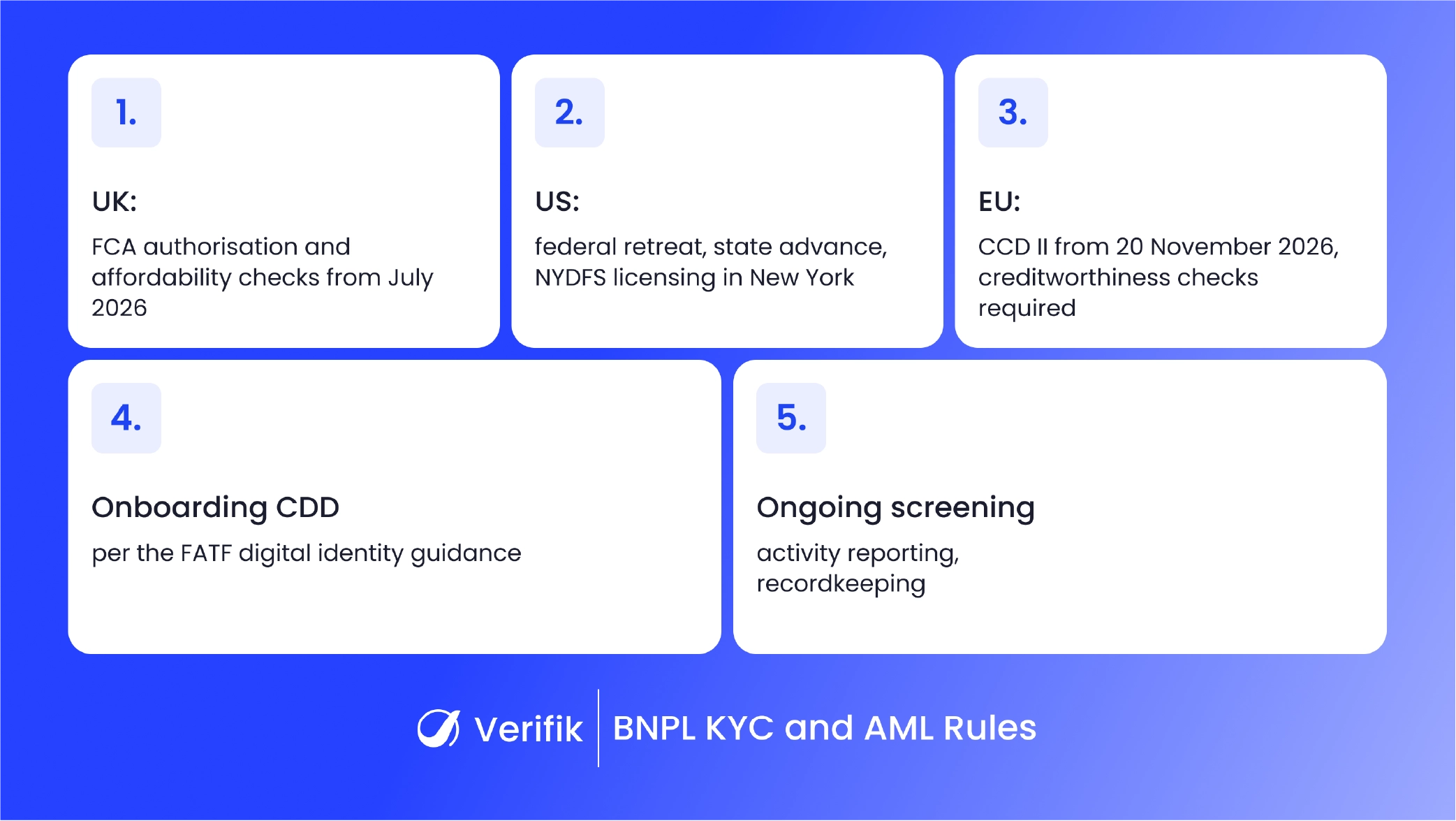
In the UK, 20% of consumers used BNPL in the twelve months to May 2024, according to the Financial Conduct Authority. From 15 July 2026, every UK BNPL lender must be authorised by the FCA and run affordability checks before extending credit.
A KYC solution for BNPL lenders is no longer a competitive advantage there. It is the licence to operate.
This post explains the KYC and AML requirements BNPL lenders face in the UK, the US, and the EU, and what changes in Colombia. For the strategic picture, see our complete guide to KYC for BNPL.
How BNPL Ended Up in a Regulatory Gray Zone
BNPL grew fast because it looked like a payment method, not a loan: small amounts, short terms, no interest, approved in seconds. Most credit rules were written for larger, longer loans, so BNPL slipped through old exemptions.
Regulators have now closed or are closing those gaps one by one, and lenders still operating as if the gray zone exists are building on borrowed time.
To put bnpl kyc requirements into practice, see how Database Screening does it.
United Kingdom: FCA Authorisation and Affordability Checks
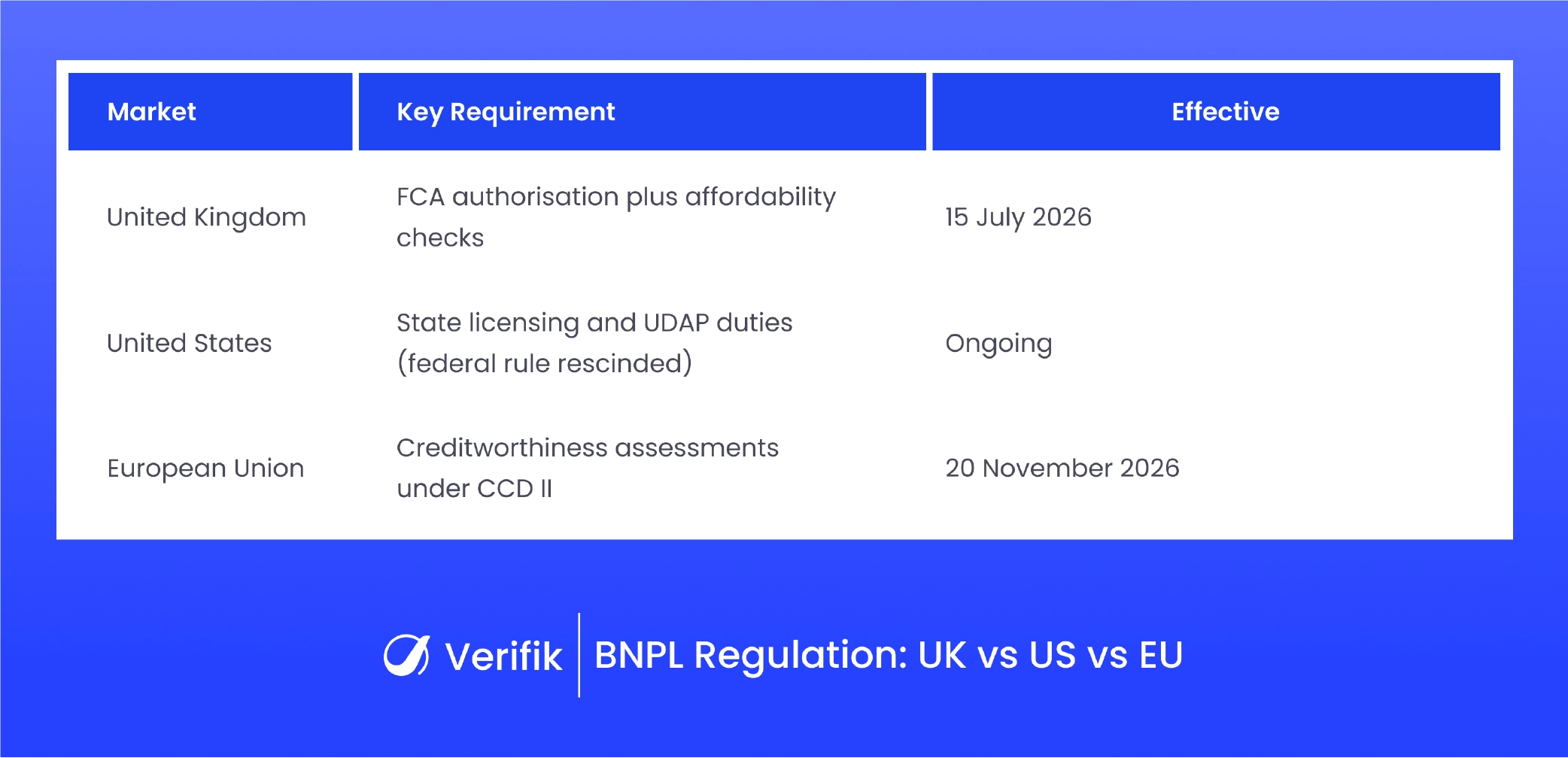
The UK regime is clear. From 15 July 2026, third-party BNPL (legally “Deferred Payment Credit”) requires FCA authorisation. Lenders must run proportionate affordability checks, give clear pre-contract information, support customers in difficulty, and accept complaints through the Financial Ombudsman Service. Read the FCA announcement.
The FCA does not demand mortgage-style underwriting. But lenders must show their decisions were responsible: real identity verification, real affordability assessment, and evidence for both.
United States: Federal Retreat, State-Level Advance
The federal picture is unsettled. The CFPB’s May 2024 interpretive rule would have treated BNPL providers as credit card issuers under the Truth in Lending Act, imposing dispute rights, billing statements, and disclosure duties.
In May 2025 the CFPB rescinded the rule and confirmed it will not issue a revised version. That removed one compliance threat, but it did not remove the obligations that remain.
State law is filling the gap. New York’s BNPL Consumer Protection Act, signed in May 2025, requires NYDFS licensing and gives NYDFS power to set maximum allowable interest, charges, and fees. Seven state attorneys general opened investigations into major BNPL providers in December 2025.
The practical read: build verification that would satisfy a state examiner, not just the current federal floor.
European Union: CCD II Ends the Exemption
The revised Consumer Credit Directive (Directive 2023/2225) takes the hardest line of the three regimes and has applied since 20 November 2026. The old exemption for interest-free credit repayable within three months is gone. Only genuinely supplier-direct deferred payment of up to 50 days (14 days for large online sellers) escapes the regime. Everything else, including all third-party BNPL, becomes regulated consumer credit.
That brings mandatory creditworthiness assessments, standardised pre-contract information, and a right of withdrawal. If an application is rejected based solely on automated processing, the consumer can demand human review and an explanation.
For eKYC design, the message is direct: your checkout must assess repayment capacity, document it, and offer a human path when automation says no.
AML Obligations That Apply in Every Market
Consumer credit rules vary by market, but anti-money laundering obligations follow the borrower, not the product. BNPL lenders are credit providers, and the FATF standards treat them accordingly.
Customer Due Diligence at Onboarding
Verify the customer’s identity with reliable, independent source documents or data before the first loan. The FATF Guidance on Digital Identity confirms that remote identity proofing is acceptable when done properly, which is the legal foundation for eKYC. For BNPL, “before the first loan” means at checkout, in seconds.
Ongoing Monitoring and Screening
Sanctions, PEP, and adverse media lists change daily, so customers must be re-screened over the life of the relationship. BNPL’s repeat-purchase model makes this natural: every new plan is another chance to catch a newly listed name.
Suspicious Activity Reporting
BNPL flows are vulnerable to structuring and mule activity: many small loans, rapid applications, identities that look slightly off. Systems must detect and report suspicious patterns to the financial intelligence unit. Automated monitoring tuned for small-ticket, high-velocity patterns is what makes this workable.
Recordkeeping
Keep the evidence behind every verification decision: what was checked, what passed, what failed, and when. Examiners ask for it years later. A decision without a stored evidence trail is a finding waiting to happen.
The three regimes at a glance:
And in Latin America: The Case of Colombia
Entities supervised by Colombia’s Superintendencia Financiera must apply SARLAFT, which requires identifying and knowing the customer before onboarding. The shopper’s identity is validated against the official cédula registry; we cover the sources in our Colombia KYC API guide.
Law 2573 of 2026 has also been in force since November 19, 2026: according to Portafolio, a selfie can no longer be an automatic requirement to apply for credit, although lenders must still verify the applicant’s identity. A BNPL flow in Colombia needs a non-biometric path, for example validating the cédula against the official registry, an OTP code, and an assisted review, plus explicit consent when it does use biometrics, which are sensitive data under Law 1581 of 2012.
Partner merchants need checks too: RUES, Colombia’s official business registry, lets you verify the company (KYB) before activating it. In Mexico, Peru, and other markets in the region, confirm the rules with local counsel.
What This Means for Your Verification Stack
Add up these regimes and the pattern is clear: identity verification, age and eligibility checks, affordability assessment, watchlist screening, and stored evidence are now table stakes in every major market. A BNPL onboarding that cannot do all five at checkout speed is not a compliance solution.
Conditions differ by country, so confirm the details with your own supervisor and counsel. The direction of travel is not ambiguous: regulators everywhere are converging on verified identity plus assessed affordability before credit is extended.
How to Cover These Requirements With smartENROLL
smartENROLL is Verifik’s eKYC onboarding solution. In Latin America, where regulators like Colombia’s Superintendencia Financiera expect real customer identification and registry access varies by country, these are the pieces it brings to a BNPL lender.
Identity Verification With Evidence
Document verification, face matching with liveness detection, and validation against official registries run in one flow, and the result of each check is recorded for review.
Age Verification
The date of birth read from the ID or confirmed in the official registry lets you validate legal age. Residency and repayment-method checks remain controls in your own flow.
Affordability Stays With You
Verifik resolves identity; the affordability assessment runs on your credit bureau check and your own models. Identity checks plug in via API before or in parallel with that assessment.
Watchlist Screening on Fresh Data
Sanctions (OFAC and UN) and PEP screening run at onboarding, and you can repeat them via API or in batches during your periodic KYC reviews.
Regional Document and Registry Coverage
Reads and verifies Latin American national IDs and validates identity against each country’s official registry; for partner merchants, it validates the company in RUES and other business registries. Verifik’s public catalog covers 409 APIs across 51 countries: see coverage by country and pricing.
Audit-Ready Evidence Records
The results of every check are available in the review panel and sent via webhook, so you can keep them with your decision, ready for supervisors, auditors, and disputes.
Facing new BNPL rules in your market? Book a session and see how these checks would run in your checkout.
Conclusion
BNPL KYC and AML requirements have moved from gray zone to hard law. The UK demands FCA authorisation and affordability checks. The EU brings third-party BNPL fully into consumer credit regulation. US states are advancing where federal action retreated. AML duties apply in every market regardless of product design. And in Colombia, Law 2573 requires a verification path that does not depend on a selfie alone.
The lenders that treat this as a verification upgrade rather than a paperwork exercise will come out ahead. smartENROLL brings identity verification, age checks, and watchlist screening together in one flow, with validation against official Latin American registries, so your team can focus on the credit decision.