 Identity Card
 National Identity Document
 Citizenship ID
 Unique Identity Document
 Personal Identification Document
 Unique Population Registry Code
 Personal Identity Card
 Civil Identity Card
 Identity and Electoral Card
 Check Plate Colombia
 Check Plate Peru
 Check Plate Mexico
 Check Plate Argentina
 Check Plate Chile
 Check Plate USA
 Check Plate Brazil


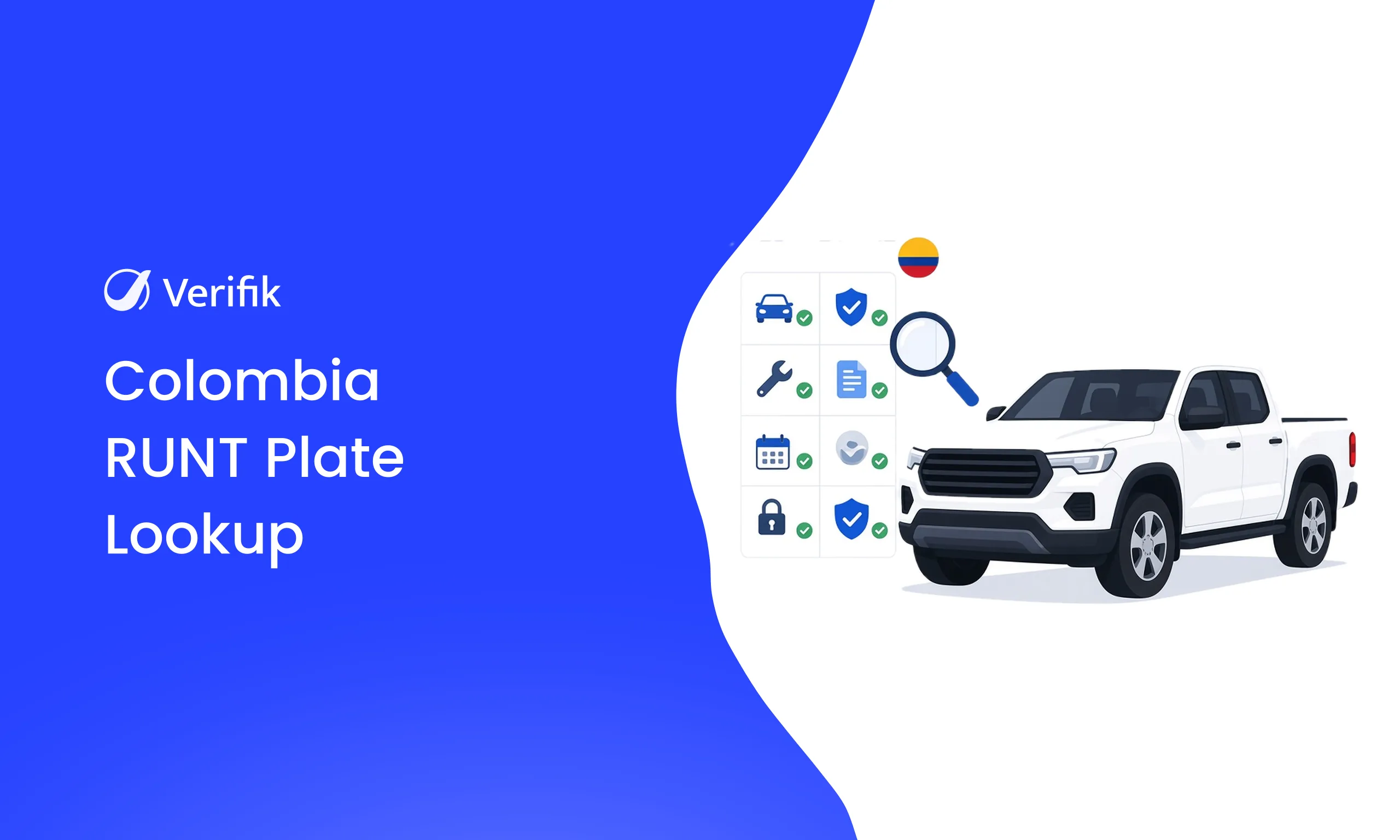
Short answer: To run a Colombia RUNT plate lookup by API, send GET https://api.verifik.co/v2/co/runt/vehicle-by-plate-only with one parameter, plate, and your Bearer token. You don’t need the owner’s ID document. Verifik returns signed JSON with the vehicle status, SOAT insurance, technical inspection (RTM), pledges, liens, ownership limitations and RUNT requests. You can test it free in sandbox with the plate AA123BA and then pay with smartCHECK credits from $49 a month. Updated: November 2026.
Several RUNT lookups by API, including some Verifik endpoints, ask for the plate plus the owner’s document type and number. During onboarding, an insurance quote or a used-car listing, you rarely have that data. Verifik’s RUNT – Vehicle Records by Plate Only endpoint solves that: with 1 parameter (the plate) you get the vehicle’s RUNT record, including general information, technical data, SOAT policies, technical inspection, guarantees, ownership limitations and requests.
This guide covers what the lookup returns, how to call it with the official documentation example, how it differs from Verifik’s other Colombian vehicle endpoints, which business rules you can automate and how much it costs.
What the Colombia RUNT plate lookup API returns
The response contains a data object with 12 blocks of vehicle information, plus plate and vin. These are the blocks Verifik documents (field names are in Spanish, as RUNT returns them):
informacionGeneral: make, line, model year, color, vehicle class and body type, fuel, service type, engine displacement (the field is spelledcilidraje), doors, engine, chassis and VIN numbers, transit license, registration date, transit authority,estadoDelVehiculo(status),prendas(pledges),tieneGravamenes(liens) andrepotenciado.datosTecnicos: number of axles, seated passengers and gross vehicle weight.soat: mandatory SOAT insurance policies with insurer, policy number, status (for example “VIGENTE”, meaning active), issue, start and expiry dates, and rate type.tecnoMecanica: whether the technical-mechanical inspection is current ("vigente": "SI").solicitudes: requests filed with the transit authority, with entity, status, date, request number and procedure.- Guarantees and limitations:
garantiasMobiliarias,garantiasFavorDe,limitacionPropiedadandnormalizacionSaneamiento. - Other blocks:
polizasResponsabilidadCivil(liability policies),informacionBlindaje(armoring) andtarjetaOperacion(operating card). - Signature: a
signatureobject with date and time and the message “Certified by Verifik.co”, useful as evidence for each lookup, plus a responseid.
The documentation points out two details: an empty array or object means RUNT has no rows for that section, and documentType and documentNumber may be null because this endpoint doesn’t take owner data.
If the use case is clear, create an account and test the endpoint from your own code.
Why run a RUNT plate lookup by API instead of by hand in 2026
According to the official RUNT website, 22,476,551 vehicles were registered as of August 1, 2026. RUNT offers a vehicle lookup by plate so citizens can see the information the system holds about their vehicle. And the check matters: in its press bulletin 002 of 2026 (May 8, 2026), RUNT reported that more than 10 million vehicles in Colombia do not have a current technical inspection. If your operation checks dozens or thousands of plates a month, Verifik’s API gives you the vehicle record as JSON, ready for your business rules:
- Fintech and auto-secured lending: confirm the vehicle is active and free of pledges and liens before disbursing.
- Insurers: read make, line, model year, service type and active SOAT to quote without asking for paperwork.
- Rental companies and fleets: track SOAT and technical inspection expiry for every vehicle. If you need to monitor those dates across a whole fleet, see our guide to the Colombia SOAT and RTM verification API.
- Used-car marketplaces: check that the listed plate matches the make and model in the ad.
How to call the Colombia RUNT plate lookup API: endpoint, code and response
All you need is your Verifik token (Authorization: Bearer header) and 1 required parameter:
plate: the vehicle plate, 5 to 9 alphanumeric characters (for exampleAA123BA).
cURL example
curl -G "https://api.verifik.co/v2/co/runt/vehicle-by-plate-only" \
  -H "Accept: application/json" \
  -H "Authorization: Bearer $VERIFIK_TOKEN" \
  --data-urlencode "plate=AA123BA"
Node.js example
import axios from "axios";

const { data } = await axios.get("https://api.verifik.co/v2/co/runt/vehicle-by-plate-only", {
  params: { plate: "AA123BA" },
  headers: {
    Accept: "application/json",
    Authorization: `Bearer ${process.env.VERIFIK_TOKEN}`,
  },
});

console.log(data);
Python example
Here is the Python example from the endpoint documentation:
import os, requests

url = "https://api.verifik.co/v2/co/runt/vehicle-by-plate-only"
headers = {"Accept": "application/json", "Authorization": f"Bearer {os.getenv('VERIFIK_TOKEN')}"}
response = requests.get(url, headers=headers, params={"plate": "AA123BA"})
print(response.json())
Sample response
And here is a shortened version of the sample 200 response from the documentation (we left out some informacionGeneral fields and the empty blocks):
{
  "data": {
    "informacionGeneral": {
      "claseVehiculo": "AUTOMOVIL",
      "estadoDelVehiculo": "ACTIVO",
      "fechaMatricula": "15/03/2018",
      "linea": "COROLLA",
      "marca": "TOYOTA",
      "modelo": "2020",
      "noPlaca": "AA123BA",
      "organismoTransito": "SECRETARIA DISTRITAL DE MOVILIDAD DE BOGOTA",
      "prendas": "NO",
      "tieneGravamenes": "NO",
      "tipoServicio": "Particular"
    },
    "soat": [
      {
        "entidadExpideSoat": "SEGUROS DEL ESTADO S.A.",
        "estado": "VIGENTE",
        "fechaVencimiento": "31/12/2024",
        "noPoliza": "SOAT-000001"
      }
    ],
    "tecnoMecanica": [
      {
        "vigente": "SI"
      }
    ],
    "limitacionPropiedad": [],
    "plate": "AA123BA",
    "vin": "9FB10000001"
  },
  "signature": {
    "dateTime": "September 16, 2026 8:00 PM",
    "message": "Certified by Verifik.co"
  },
  "id": "ABCDE"
}
Response codes to handle
| Code | What it means | What to do |
|---|---|---|
| 200 | Successful lookup | Apply your rules and store id and signature |
| 404 | {"code": "NotFound", "message": "Record not found."}: the plate has no record | Check the plate with the customer; don’t retry |
| 409 | Plate missing ("missing plate") or invalid | Fix the parameter before resending |
| 409 (unavailable) | The service is temporarily unavailable (Endpoint_out_of_service) | Retry later with backoff |
Dates come back as text in day/month/year format.
Want to try it? Create your free Verifik account and, in sandbox, use the plate AA123BA or the plates ABC10001 to ABC10010, which return stable 200 responses. The plate ERR40401 returns a 404 so you can test your error handling.
Which Verifik vehicle endpoint to use in Colombia
Verifik has several RUNT endpoints by plate. The main difference is what you send and what you get back:
| Endpoint | What it needs | What it returns |
|---|---|---|
/v2/co/runt/vehicle-by-plate-only | Plate only | Vehicle record: SOAT, technical inspection, guarantees, limitations and requests |
/v2/co/runt/propietarios | Plate only | Basic vehicle data and ownership records |
/v2/co/runt/vehicle-by-plate | Plate, document type and number | Complete vehicle record with history |
/v2/co/runt/vehicle-by-plate-simplified | Plate, document type and number | Essential vehicle data, without insurance or technical inspection history |
If you need to know who is listed as the owner, see our guide to the Colombia vehicle owner lookup by plate API. You can combine both endpoints: first the vehicle record, then the owners, each with the plate alone.
Colombia RUNT plate lookup for drivers, fleets and KYC onboarding
A plate lookup rarely runs alone. These are the most common flows where it’s combined with other Verifik checks:
- Logistics and delivery: before assigning a dispatch, vet the driver (identity, licence, SIMIT and police record) and the vehicle by plate. Our Colombia driver vetting API guide shows the full 6-step flow with code.
- Fleets and rental companies: repeat the lookup every month to catch expiries early. If you only need SOAT and RTM dates, the Colombia SOAT and RTM verification API is more direct.
- Lending and used-car sales: confirm status and liens by plate, then who is listed as owner with the vehicle owner lookup by plate.
- Customer onboarding: when you also need to verify the person (cédula, biometrics, police record or watchlists), the Colombia KYC API guide brings those endpoints together.
Business rules you can automate with the response
The response fields let you build simple approve-or-review rules. The diagram sums up the 6 checks and the list explains each one:
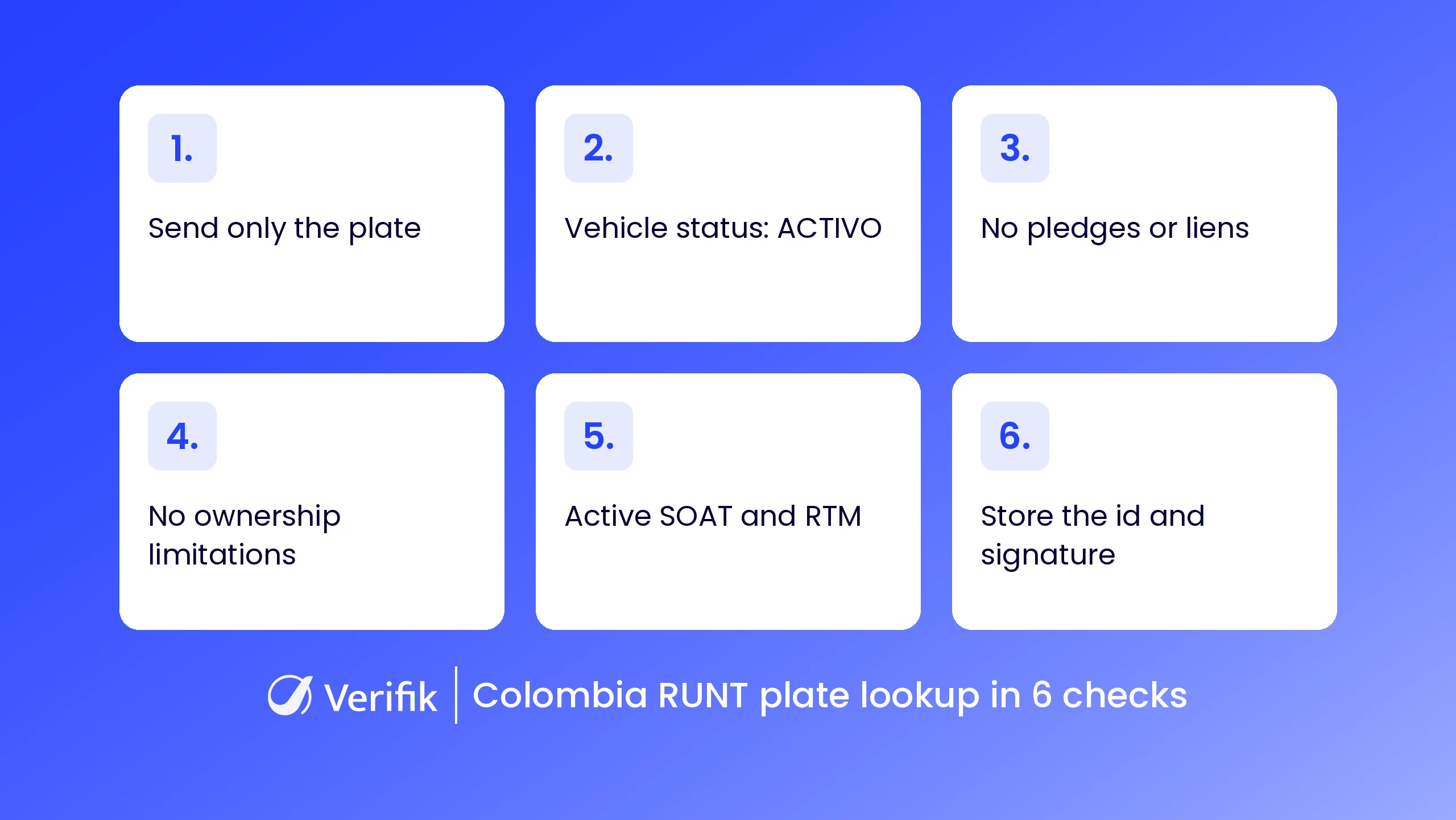
- Vehicle status: if
estadoDelVehiculoisn’t “ACTIVO”, send the case to review. - Pledges and liens: if
prendasortieneGravamenesisn’t “NO”, orgarantiasMobiliariashas rows, check the debt before accepting the vehicle as collateral. - Limitations: if
limitacionPropiedadisn’t empty, hold the deal until you review the details. - SOAT and technical inspection: compare the SOAT
fechaVencimientowith today’s date and check thattecnoMecanicashows"vigente": "SI". - Listing consistency: compare
marca,linea,modeloandtipoServiciowith what the customer declared. - Evidence: store the
idandsignatureof every response in the case file.
Here is what those rules look like in Python, including 404 and 409 handling:
import os, requests

def runt_plate_lookup(plate):
    r = requests.get(
        "https://api.verifik.co/v2/co/runt/vehicle-by-plate-only",
        headers={"Accept": "application/json",
                 "Authorization": f"Bearer {os.getenv('VERIFIK_TOKEN')}"},
        params={"plate": plate},
        timeout=60,
    )
    if r.status_code == 404:
        return {"decision": "reject", "reason": "plate not found in RUNT"}
    if r.status_code == 409:
        return {"decision": "retry", "reason": r.json().get("message")}
    r.raise_for_status()
    d = r.json()["data"]
    g = d.get("informacionGeneral", {})
    flags = []
    if g.get("estadoDelVehiculo") != "ACTIVO":
        flags.append("vehicle not active")
    if g.get("prendas") != "NO" or g.get("tieneGravamenes") != "NO":
        flags.append("pledges or liens")
    if d.get("limitacionPropiedad"):
        flags.append("ownership limitations")
    if not any(s.get("estado") == "VIGENTE" for s in d.get("soat", [])):
        flags.append("SOAT not active")
    if not any(t.get("vigente") == "SI" for t in d.get("tecnoMecanica", [])):
        flags.append("RTM not current")
    return {"decision": "review" if flags else "approve",
            "flags": flags, "evidence": r.json().get("id")}

print(runt_plate_lookup("AA123BA"))
If RUNT shows data a customer believes is wrong, RUNT states that transit authorities are the bodies responsible for changing the registered information. Sector regulations are published by the Ministry of Transport.
For a fuller picture, add other Verifik checks: the vehicle’s full RUNT history, the simplified vehicle data check by plate, SIMIT traffic fines and vehicle insurance claims.
How much the Colombia RUNT plate lookup API costs
Verifik doesn’t charge a per-endpoint subscription: each lookup is deducted from your smartCHECK plan credits. According to the smartCHECK pricing page:
- Starter: $49 a month, or $490 a year with $588 in credits.
- Basic: $129 a month, or $1,290 a year with $1,548 in credits.
- Plus: $299 a month, or $2,990 a year with $3,588 in credits.
- Business: $649 a month, or $6,490 a year with $7,788 in credits.
Annual plans include 2 free months. The cost of each call to /v2/co/runt/vehicle-by-plate-only is deducted from your credits and shown in your dashboard once you create your account.
Start your Colombia RUNT plate lookups by API today
With the plate alone you can tell whether a vehicle is active, whether its SOAT and technical inspection are current and whether it carries pledges or limitations, with a signed record of every lookup. Read the endpoint documentation and make your first call in sandbox.
Ready to start? Create your free Verifik account or book a demo to see how to add vehicle verification to your lending, insurance or rental flow.