 Identity Card
 National Identity Document
 Citizenship ID
 Unique Identity Document
 Personal Identification Document
 Unique Population Registry Code
 Personal Identity Card
 Civil Identity Card
 Identity and Electoral Card
 Check Plate Colombia
 Check Plate Peru
 Check Plate Mexico
 Check Plate Argentina
 Check Plate Chile
 Check Plate USA
 Check Plate Brazil


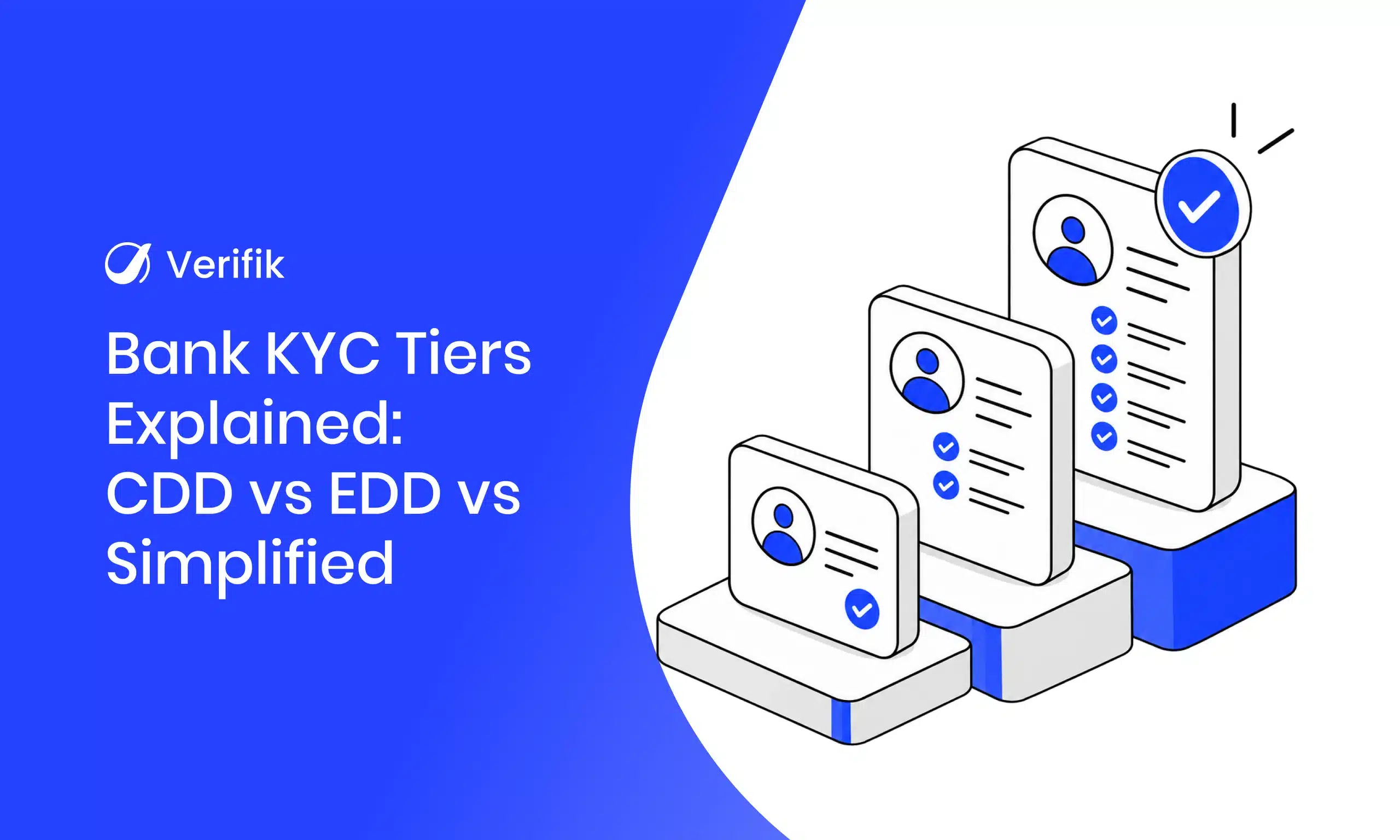
Short answer: KYC tiers (CDD vs EDD vs simplified) are three depths of the same risk-based process: simplified due diligence for low-risk products, customer due diligence (CDD) for most customers and enhanced due diligence (EDD) for high-risk customers such as PEPs. In Colombia, the SFC sets them through SARLAFT.
A Forrester Consulting study commissioned by Fenergo put the average cost of onboarding each institutional client in corporate and investment banking at USD 6,000. A modern bank eKYC platform helps sort customers into risk tiers, so low-risk applicants follow a fast path and high-risk ones get the level of scrutiny they need.
Banks use three tiers: simplified due diligence, customer due diligence (CDD) and enhanced due diligence (EDD), which Colombia’s Financial Superintendence calls intensified measures. This guide explains what each tier checks and when it applies.
For the full picture of requirements and benefits, see eKYC for banks: requirements, process and benefits. Getting the tiers right is also what makes digital onboarding fast without making it reckless.
The three bank KYC tiers
A modern bank eKYC platform applies the right tier to each applicant based on the rules your compliance team defines, so low-risk customers move fast and high-risk ones get full scrutiny.
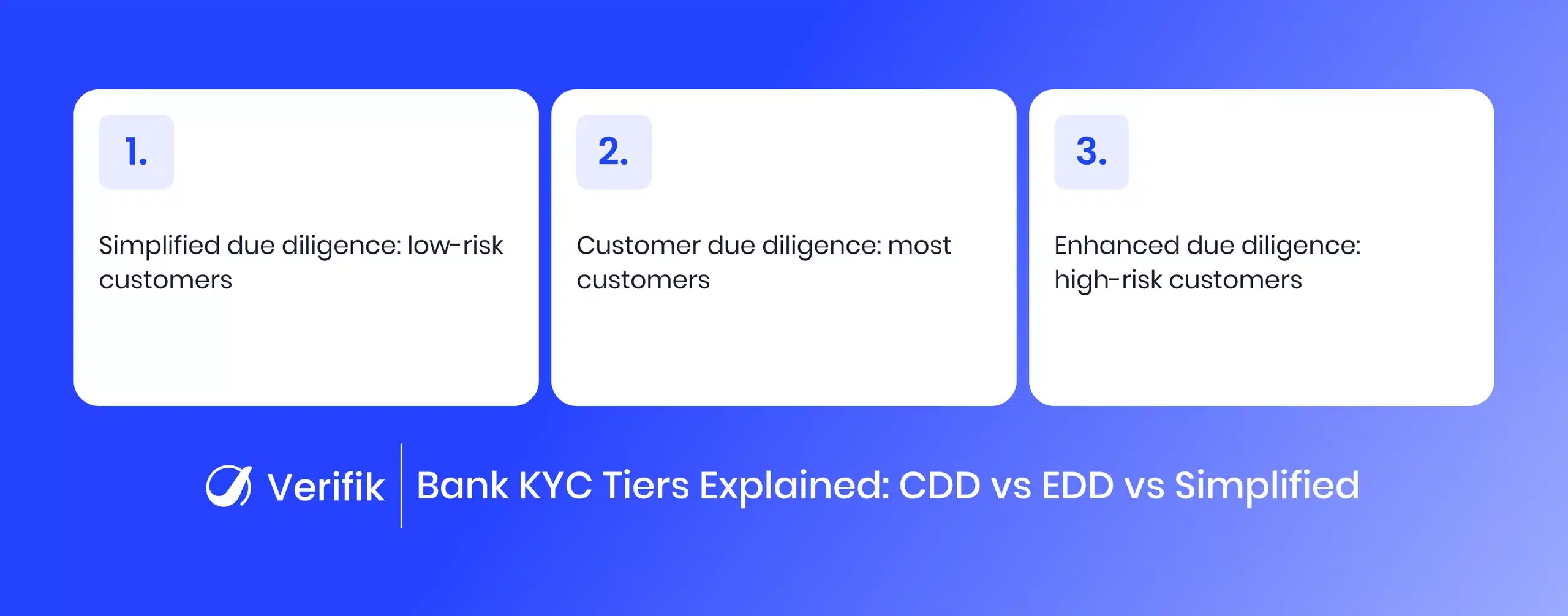
FATF Recommendation 10, the international standard most national AML rules follow, requires a risk-based approach: deeper checks when risk is higher and lighter checks when it is lower. External Circular 8 of 2024 from Colombia’s Financial Superintendence quotes it word for word. The full set of obligations behind each tier is covered in KYC and AML requirements for banks: a complete guide, and the difference between the two concepts in KYC vs AML.
The terms in Colombia. Under the SFC’s SARLAFT, the simplified tier is the procedimiento simplificado de conocimiento del cliente (simplified customer due diligence procedure); standard CDD is the procedimiento ordinario (ordinary procedure), and EDD maps to medidas intensificadas, which is why Colombian teams also say “debida diligencia intensificada” or “ampliada”. Real-economy companies supervised by Supersociedades apply the same due diligence and enhanced due diligence logic under SAGRILAFT, and suspicious transaction reports go to the UIAF.
Simplified due diligence: low-risk customers
Simplified due diligence (SDD) applies when the risk can be shown to be low: low-value products listed by the SFC and customers in low-risk segments.
The bank verifies identity with basic checks and asks for fewer documents, but the decision must be documented and justified by a risk assessment. SDD is what keeps onboarding fast for everyday customers and supports financial inclusion in markets like Colombia. There, the Financial Superintendence only allows the simplified procedure for the products listed in subsection 4.2.2.2.1.4 of the Circular Básica Jurídica, such as CDTs and CDATs of up to 25 monthly minimum wages and low-value deposits. According to SFC Concept 90697 of 2024, it requires at least the document type, name, number and issue date for individuals, and a certificate of existence and legal representation no older than 30 days for companies. Even so, screening against binding lists and identifying PEPs and beneficial owners remain mandatory.
Customer due diligence: the standard tier
CDD is the default tier for most customers. The bank verifies identity with reliable documents, identifies beneficial owners, records the purpose of the relationship and monitors transactions on an ongoing basis.
The beneficial-owner threshold depends on the country: the US FinCEN CDD Final Rule uses 25%, while in Colombia DIAN Resolution 000164 of 2021 (the beneficial ownership registry, RUB) uses 5% of capital, voting rights or benefits.
CDD generates most of the paperwork: identity documents, proof of address and incorporation documents all have to be extracted and validated.
Enhanced due diligence (EDD, called intensified in Colombia): high-risk customers
EDD is the deepest investigation, reserved for high-risk customers: politically exposed persons (PEPs), customers from high-risk jurisdictions on the FATF lists and entities with complex or opaque ownership structures.
On top of CDD, the bank establishes source of wealth and source of funds, runs deeper adverse media checks and applies stricter ongoing monitoring, usually with senior management approval. In Colombia, intensified measures can include extra information on the origin of assets and funds, an interview or visit and checks against public-entity databases, and the SFC requires senior management approval to onboard a PEP. EDD is mandatory, not optional, for these categories.
To follow this guide with your own integration, open a Verifik account and generate your access token.
CDD vs EDD vs simplified: side-by-side comparison
Here is how the checks differ across the three tiers.
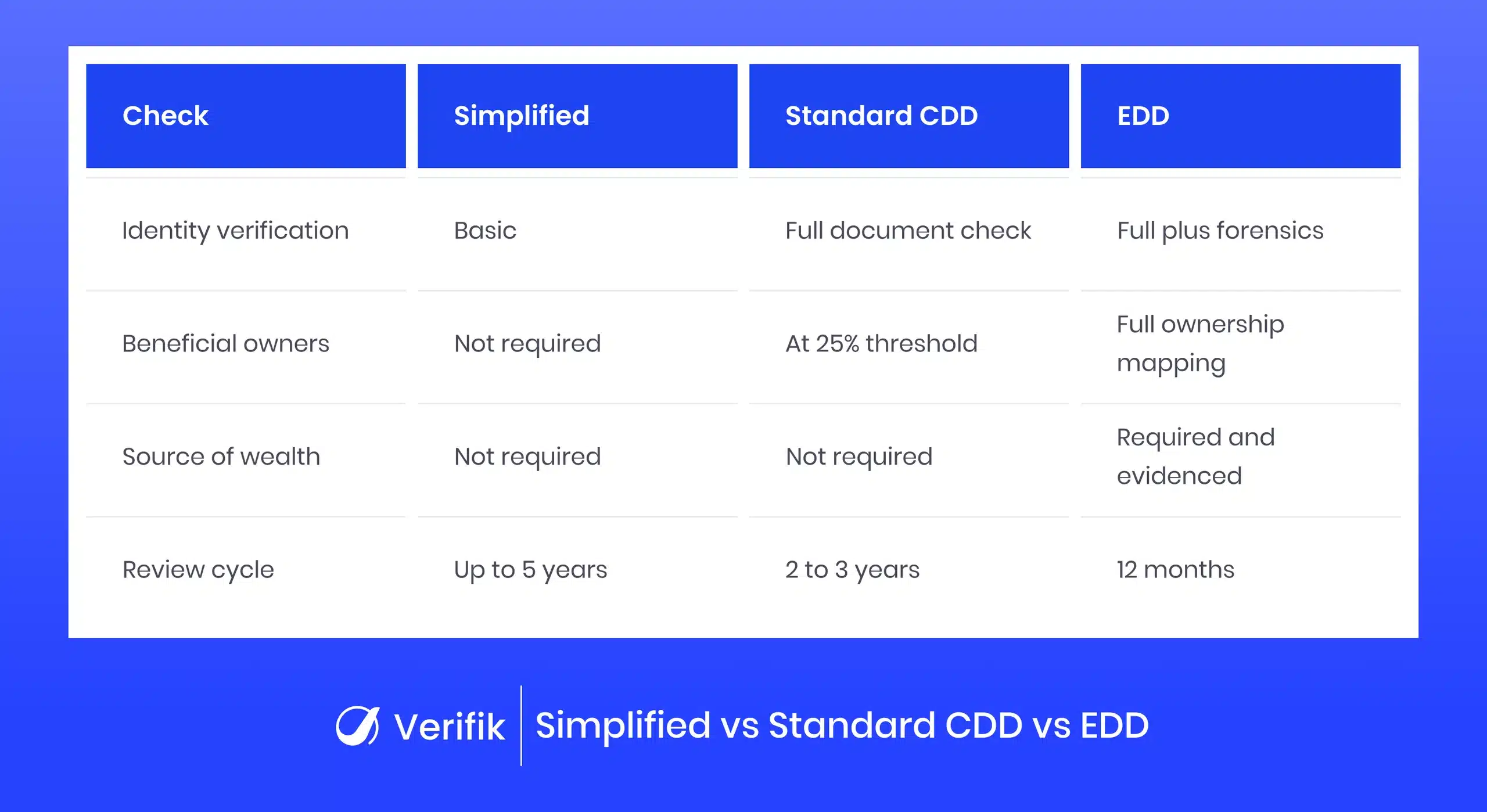
25% is the FinCEN CDD rule threshold (US); in Colombia, the DIAN RUB uses 5%, and the SFC simplified procedure also requires identifying PEPs and beneficial owners. Review cycles are common industry reference points; each institution sets its own in its SARLAFT manual based on its risk matrix.
What each tier looks like in practice
A tier is not a label on a form. It changes what the applicant experiences and what the reviewer sees.
The simplified journey
A salaried worker opening a basic product photographs a cédula or an INE voter ID, takes a selfie and is approved in minutes. If that customer later starts moving large sums without explanation, the tier changes and the bank asks for more information.
The CDD flow
A standard customer provides an identity document and proof of address, the system extracts the data, validates it against registries such as the Registraduría and, for companies, the RUES in Colombia, and screens against sanctions and PEP lists. Clear cases are approved automatically. Unclear cases go to a reviewer with an evidence package that includes images, pass or fail results and risk signals. Each step of that flow is explained in How bank eKYC works: a step-by-step explanation; if you only need the Colombian checks, see the Colombia KYC API.
EDD in practice
A high-risk case adds document forensics, source-of-wealth evidence such as tax returns or sale contracts, adverse media searches in several languages, background checks such as the SIGEP public servant lookup or court cases by radicado number, and sign-off from a more senior officer.
Corporate onboarding is far more demanding than retail: more documents, more owners to identify and much longer review times. Good eKYC software for banks keeps EDD cases moving by gathering the evidence automatically instead of leaving analysts to chase documents by email.
What each tier looks like in the API
With Verifik, each tier becomes a set of lookups. Every tier starts with the cédula (GET /v2/co/cedula, Registraduría), the UN sanctions list (GET /v2/onu) and the politically exposed persons lookup (GET /v2/co/politically-exposed-persons). Standard CDD adds OFAC (GET /v2/ofac) and, for companies, RUES. EDD adds adverse media (GET /v2/co/media/adverse), which returns an AML risk score from 0 to 100. This JavaScript example chains the lookups by tier (sample data):
import axios from "axios";

const api = axios.create({
  baseURL: "https://api.verifik.co",
  headers: {
    Accept: "application/json",
    Authorization: `Bearer ${process.env.VERIFIK_TOKEN}`,
  },
});

// tier comes from your SARLAFT risk matrix: "simplified" | "cdd" | "edd"
async function checksForTier(tier, documentNumber) {
  const id = { documentType: "CC", documentNumber };
  const get = async (path, params) => (await api.get(path, { params })).data;

  // Every tier: identity (Registraduría), binding lists (UN) and PEP
  const evidence = {
    cedula: await get("/v2/co/cedula", id),
    onu: await get("/v2/onu", id),
    pep: await get("/v2/co/politically-exposed-persons", id),
  };

  // Standard CDD: adds OFAC (and RUES when the customer is a company)
  if (tier === "cdd" || tier === "edd") {
    evidence.ofac = await get("/v2/ofac", id);
  }

  // EDD: adds adverse media (and court or disciplinary records)
  if (tier === "edd") {
    evidence.media = await get("/v2/co/media/adverse", { ...id, lang: "es" });
  }

  // Verifik returns signed evidence; the tier decision stays with your compliance team
  return evidence;
}

console.log(await checksForTier("edd", "1020304050"));
The PEP lookup in Python:
import os
import requests

r = requests.get(
    "https://api.verifik.co/v2/co/politically-exposed-persons",
    headers={
        "Accept": "application/json",
        "Authorization": f"Bearer {os.getenv('VERIFIK_TOKEN')}",
    },
    params={"documentType": "CC", "documentNumber": "1020304050"},
    timeout=30,
)
print(r.status_code, r.json())
Sample 200 response from the PEP lookup (fictitious data):
{
  "data": {
    "documentNumber": "1020304050",
    "documentType": "CC",
    "detail": [
      {
        "declarant": "SAMPLE PERSON",
        "entity": "Ministerio de Ejemplo",
        "positionContractor": "Asesor",
        "publicationType": "Declaración de Bienes",
        "declaration": "12345",
        "publicationDate": "15/03/2025",
        "declarationStatus": "Activa"
      }
    ]
  },
  "signature": {
    "dateTime": "November 18, 2026 8:02 AM",
    "message": "Certified by Verifik.co"
  },
  "id": "PEP01"
}
And an adverse media response for an EDD case (fictitious data):
{
  "data": {
    "fullName": "SAMPLE PERSON",
    "hasAdverseMedia": true,
    "riskScore": 85,
    "riskLevel": "HIGH",
    "totalArticles": 1,
    "matchedKeywords": [
      "lavado de activos",
      "fiscalia"
    ],
    "articles": [
      {
        "title": "Sample headline about a money laundering probe",
        "url": "https://example.com/noticia-de-ejemplo",
        "sourceName": "Sample outlet",
        "publishedAt": "2026-08-14T14:32:00.000Z",
        "matchedKeywords": [
          "lavado de activos",
          "fiscalia"
        ],
        "severity": "HIGH"
      }
    ]
  },
  "signature": {
    "dateTime": "2026-11-18 08:05:00",
    "message": "Certified by Verifik.co"
  }
}
The tier decision is the bank’s rule: Verifik returns the evidence, with every response signed, and your rules engine or compliance officer assigns the tier.
The trade-off: over-scrutiny vs under-scrutiny
Banks that can’t classify risk quickly fail in two ways at once. Over-scrutinizing low-risk customers creates friction, and every applicant who drops out over paperwork is lost revenue. Under-scrutinizing high-risk customers creates direct regulatory exposure.
In Colombia the topic is on the agenda: Law 2573 of 2026 takes full effect on November 19, 2026, and the SIC’s draft circular, still a draft, asks companies to classify transactions into at least three impersonation-risk levels with differentiated controls.
How customers move between tiers
A tier is assigned during onboarding, but it is never final. Risk is a moving target.
What triggers a tier change
New PEP list entries, adverse media findings, a change in beneficial owners, sudden shifts in transaction patterns or a move to a high-risk jurisdiction can push a customer up a tier.
The bank then reruns the checks for the new tier and records why. Moving down is less common and slower, because it needs evidence that the risk actually fell, not just that nothing bad happened recently.
Who decides and what examiners ask for
Compliance sets the tier rules, the system applies them and examiners review them. Examiners don’t mandate a specific technology; the FATF Digital Identity Guidance is technology-neutral.
What examiners do require is evidence: the risk assessment behind each tier assignment, the evidence behind each decision and a log of every tier change. How banks schedule those re-checks is covered in Periodic KYC review: how banks re-verify customers. If you are building your program from scratch, the KYC requirements checklist for fintech startups and the eKYC compliance requirements help you avoid gaps.
Why banks choose smartENROLL for tiered KYC
smartENROLL is Verifik’s eKYC solution for banking in Latin America, where risk-tiered workflows have to handle many ID formats and strict regulators.
Controls your team configures
Each project sets its own liveness and face-match thresholds, the number of attempts allowed (3 to 10), the accepted documents and the database validations, so the simplified, CDD and EDD flows don’t ask for the same things.
Scores to assign the tier
smartENROLL delivers scores and results (liveness, face match, validations) by webhook so your rules engine can assign the tier; borderline cases stay “Under Review” in the console.
Regional document coverage
It reads and verifies Latin American identity documents, including the Colombian cédula.
Database validation
It validates applicants against official sources and background records, and against your own lists that you can upload, on top of local registries such as RUES and the international sanctions and PEP sources available through the API, giving each tier the data depth it needs.
Review-ready evidence packages
Unclear cases reach reviewers with images, pass and fail results and scores on one screen, which is what EDD cases need most.
Periodic reviews with the same API
Rerun the lookups (PEP, OFAC and UN, adverse media, RUES) whenever your review policy calls for it; every response is signed for your case file.
Want to see the simplified, CDD and EDD flows with your own applicant profiles? Book a meeting with our team or try the lookups at app.verifik.co.
Conclusion
Simplified, CDD and EDD are not three products. They are three depths of the same risk-based process: light checks for demonstrably low risk, standard checks for most customers and deep investigation for the few high-risk customers. Banks that tier accurately onboard faster and stay safer.
The practical test is simple: can your platform route every applicant to the right tier and prove why? smartENROLL and the Verifik APIs give you the signed evidence to do it, with Latin American document and registry coverage. Ready to start? Create your account and try the lookups with your own token.