 Identity Card
 National Identity Document
 Citizenship ID
 Unique Identity Document
 Personal Identification Document
 Unique Population Registry Code
 Personal Identity Card
 Civil Identity Card
 Identity and Electoral Card
 Check Plate Colombia
 Check Plate Peru
 Check Plate Mexico
 Check Plate Argentina
 Check Plate Chile
 Check Plate USA
 Check Plate Brazil


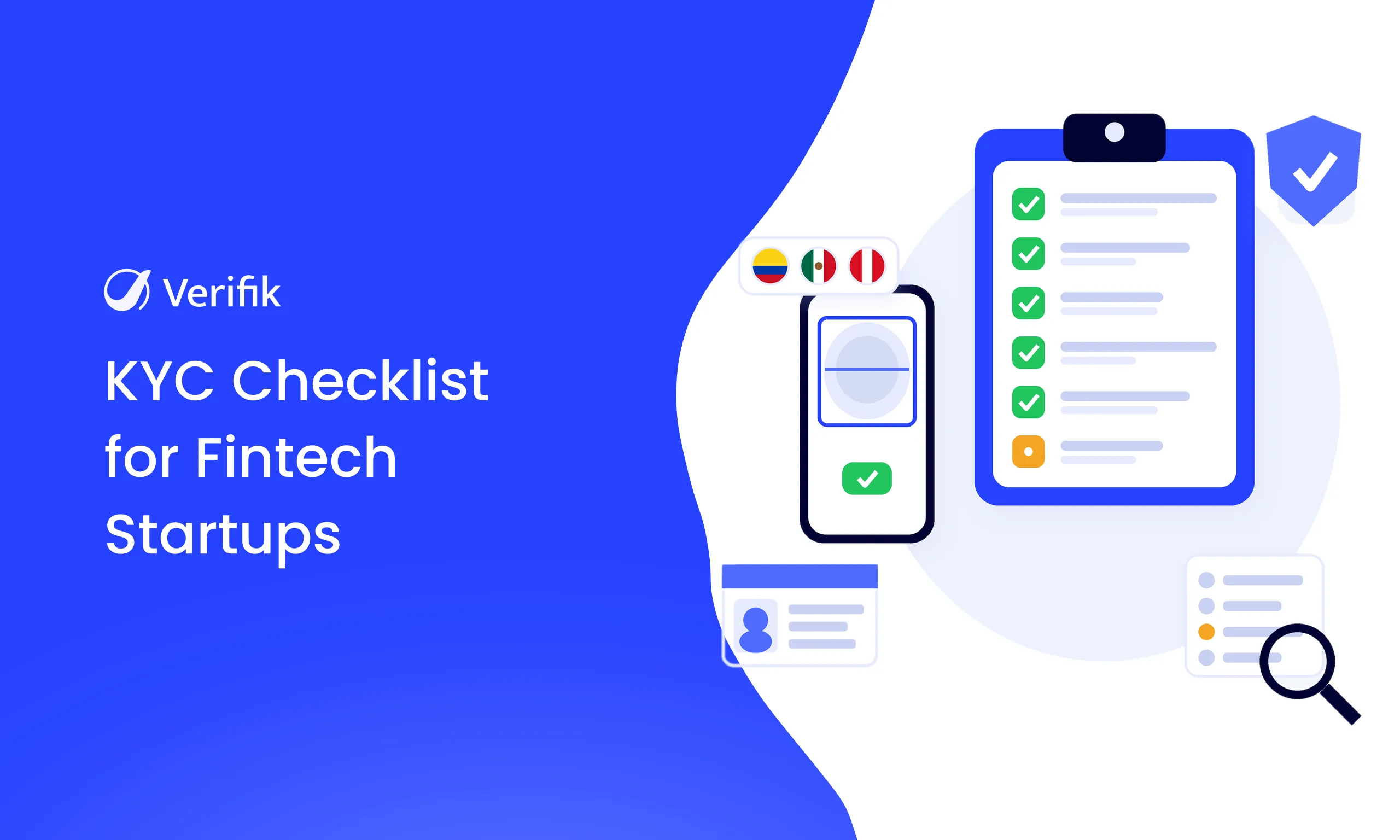
Short answer: KYC requirements for fintech startups come down to ten controls: a written identification programme, document verification, biometrics with liveness, beneficial owners, sanctions and PEP screening, risk tiers, ongoing monitoring, evidence, a compliance officer and independent testing. In Latin America, the SFC, CNBV and SBS set the details for each market.
Every fintech startup faces the same KYC rules as a bank, and a KYC solution for fintech has to cover them from day one.
According to Fenergo figures reported by Family Wealth Report, KYC fines rose 102% to a record $51 million in the first half of 2024. Startups are not exempt. This checklist walks through every requirement so you find the gaps before an examiner does.
For the full picture, read the pillar guide eKYC for fintech: requirements, process and benefits. The checklist assumes you are launching or scaling a fintech product.
The regulatory foundations you need to know
KYC rules come from national law, but most of them mirror the same international sources.
The FATF Recommendations set the baseline
The 40 FATF Recommendations are the international standard against money laundering and terrorist financing. They define customer due diligence, record keeping and suspicious-activity reporting, and their cornerstone is the risk-based approach.
National regulators turn them into detailed rules, so when a supervisor asks why you do something, the answer usually traces back to these standards. For the general framework for regulated businesses, see also the eKYC compliance requirements.
Beneficial ownership rules apply to business customers
If you onboard companies, you must identify the real people behind them. The U.S. FinCEN Customer Due Diligence Rule requires identifying every person who owns 25% or more of a legal-entity customer, plus one person with significant control.
Latin American supervisors follow the same logic: in Mexico, for example, the rules for financial technology institutions treat anyone who directly or indirectly acquires 25% or more of a company’s capital as exercising control.
Sanctions screening is non-negotiable
Every user must be screened against sanctions lists and politically exposed person databases. Lists change constantly, so screening has to run at onboarding and again over time. This is where startups most often fall short: lists feel like someone else’s problem until an examiner asks for your records.
Your local supervisor has the final say
Colombia’s Financial Superintendence, Mexico’s CNBV and Peru’s SBS each set their own rules on remote identification, data retention and reporting. International standards tell you what to do; local supervisors tell you exactly how. Confirm every point with local counsel before launch.
To follow this guide with your own integration, open a Verifik account and generate your access token.
KYC requirements by Latin American regulator: SFC, CNBV and SBS
These are the rules a fintech startup needs on its radar in three key markets in the region. Use them as a starting point and confirm with your counsel which regime applies to your licence.
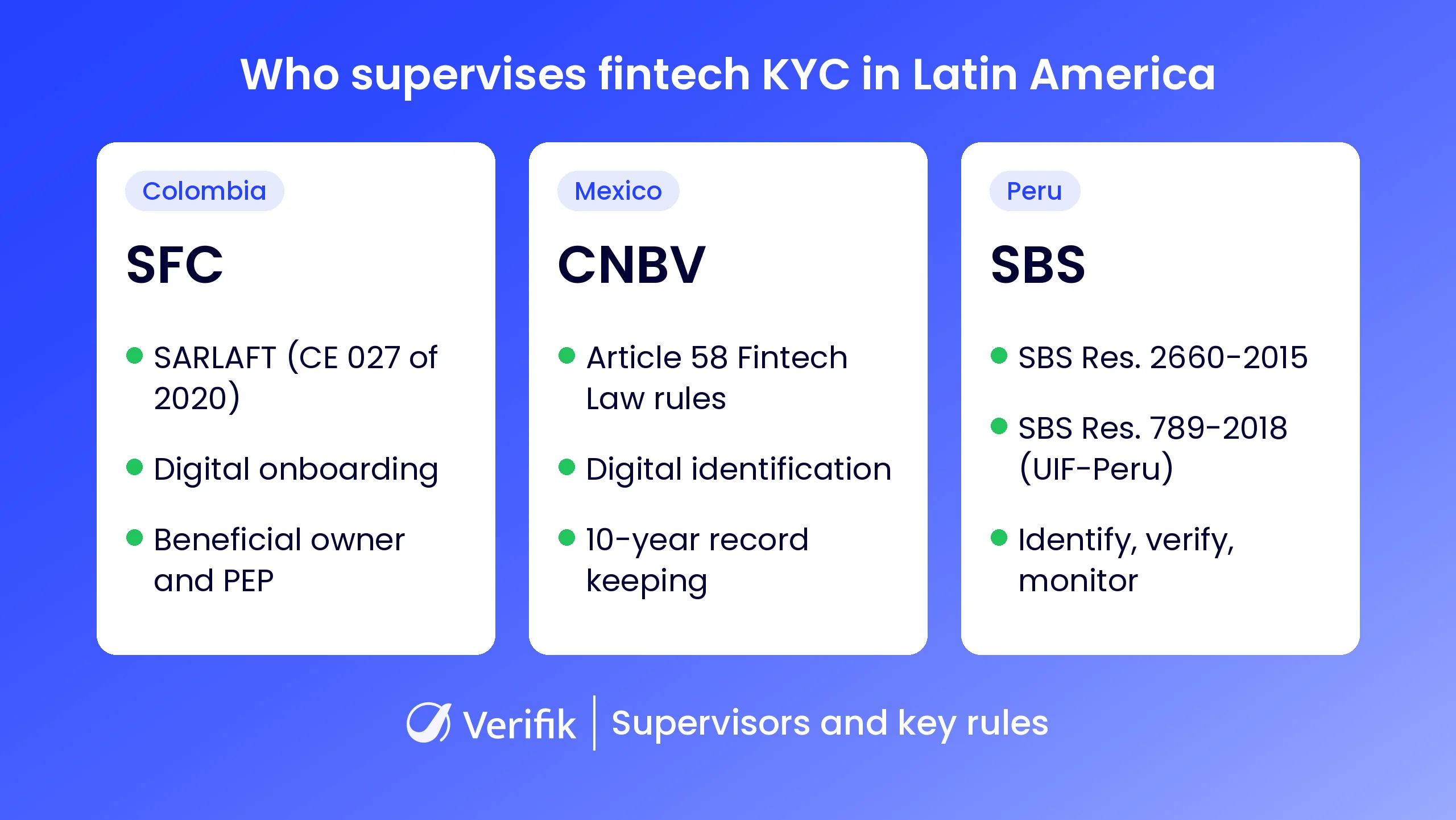
The table sums up what each rule asks for and which checklist item it touches.
| Country and supervisor | Key rule | What it means for your checklist |
|---|---|---|
| Colombia · Financial Superintendence (SFC) | SARLAFT, updated by External Circular 027 of 2020 (SARLAFT 4.0) | Risk-based customer knowledge, onboarding through digital channels without a mandatory form, due diligence on beneficial owners and PEPs, and alternative information sources such as public databases. |
| Mexico · National Banking and Securities Commission (CNBV) | Rules under Article 58 of the Fintech Law (DOF, 10 Sep 2018) | A customer identification and knowledge policy document delivered to the CNBV, identification through digital means, an automated system to flag unusual transactions, a Compliance Officer and record keeping for at least ten years. |
| Peru · Superintendence of Banking, Insurance and Pension Funds (SBS) | SBS Resolution 2660-2015 for financial-system firms and SBS Resolution 789-2018 for obliged entities supervised by UIF-Peru (official list of rules) | Three-stage due diligence (identification, verification and monitoring), identification of the beneficial owner and, if you cannot complete due diligence, not starting the relationship and assessing a suspicious transaction report. |
Colombia also has news for anyone who sells on credit: Law 2573 of 2026 takes effect on November 19, 2026 and requires sufficient and reasonable measures to verify the person and their document. On November 6, 2026 the Superintendence of Industry and Commerce published a draft circular for comments on the mechanisms to fully identify the prospective buyer; it is still a draft, not an issued rule. For Colombian sources, the Colombia KYC API hub sums up the available checks, and for Peru and Mexico see the Peru KYC API and Mexico INE verification guides.
The KYC checklist for startups
Work through these ten items in order. Each one maps to something an examiner will ask about, and eKYC software for fintech should handle the verification, screening and evidence parts without custom engineering.
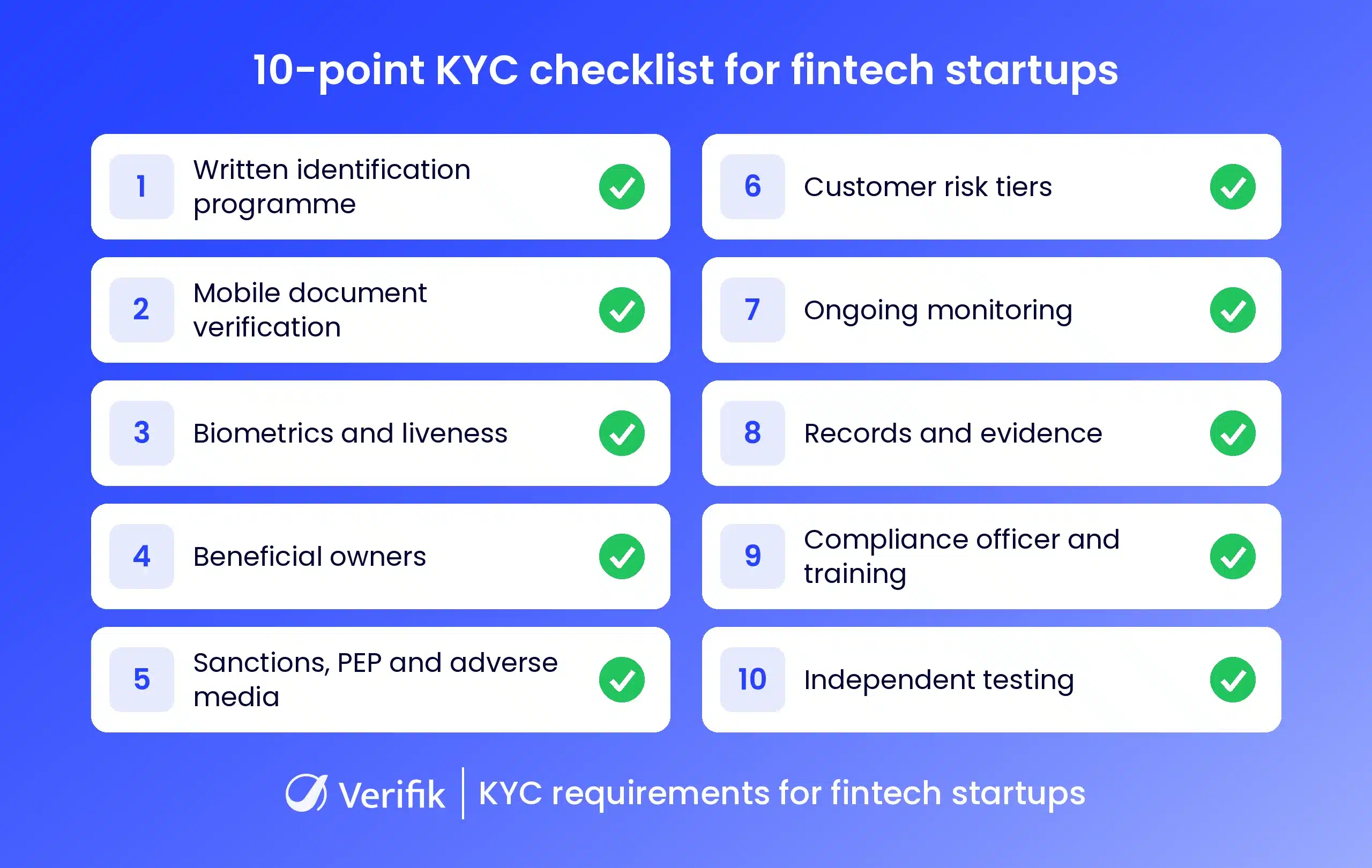
Items 1, 6, 9 and 10 are internal governance; the rest rely on verification technology.
1. A written customer identification programme
Write down what identity information you collect, which documents you accept and how you verify them. A programme that is not written down does not exist for an examiner. In Mexico, for example, that policy document is delivered to the CNBV.
2. Document verification built for phones
Your users verify with phone cameras, not scanners. The system must guide the photo, extract the data and check the document for tampering. Test with the real IDs of your market: Colombia’s cédula, Mexico’s INE and Peru’s DNI.
3. Biometric match and liveness detection
Match a live selfie to the ID photo and confirm a real person is present. Liveness stops printed photos, replayed videos and masks. Prefer single-image liveness with no awkward head movements.
4. Beneficial owner collection
For business customers, identify every owner with 25% or more, plus one person with control, with name, date of birth, address and ID number. Verify each one as an individual customer.
5. Sanctions, PEP and adverse media screening
Screen every new user against sanctions lists, PEP databases and adverse media at onboarding, and re-check them as often as your policy requires. Keep time-stamped records of every screening. To see how a specific check works, read the guide to automating OFAC sanctions list checks.
6. Risk-based customer tiers
Define simplified, standard and enhanced due diligence tiers with clear criteria. Low-risk domestic users get a fast path; high-risk profiles get deeper checks and manual review.
7. Ongoing monitoring
Monitor transactions for suspicious patterns after onboarding and keep customer data current. A user who was low risk at signup can change. Regulators expect periodic reviews.
8. Record keeping and evidence
Store what was checked, what passed, what failed and when, for every user. Evidence you cannot produce years later practically does not exist.
9. A designated compliance officer and training
Give one person responsibility for the AML programme and train everyone who deals with customers. The answer to who is responsible cannot be “everyone”.
10. Independent testing of your controls
Have someone outside daily operations test whether your controls work. Internal teams develop blind spots; an independent review finds them before an examiner does.
What items 3 and 5 look like in the API
These three calls cover the biometric and screening items on the list. Use the $VERIFIK_TOKEN variable (or os.getenv('VERIFIK_TOKEN') in Python); never paste a real token into your code.
Face match with liveness (item 3)
POST /v2/face-recognition/compare-with-liveness compares the selfie with the document face and, if compare_min_score is met, runs liveness on the selfie. Details in the compare-with-liveness documentation.
curl -X POST "https://api.verifik.co/v2/face-recognition/compare-with-liveness" \
  -H "Content-Type: application/json" \
  -H "Authorization: Bearer $VERIFIK_TOKEN" \
  -d '{
    "probe": "<selfie_base64>",
    "gallery": ["<document_face_base64>"],
    "search_mode": "FAST",
    "liveness_min_score": 0.6,
    "compare_min_score": 0.85
  }'
{
"id": "CWL01",
"data": {
"comparison": {
"score": 0.88
},
"liveness": {
"liveness_score": 0.91,
"min_score": 0.6,
"passed": true
}
},
"signature": {
"message": "Certified by Verifik.co",
"dateTime": "January 16, 2024 3:44 PM"
}
}OFAC list screening (item 5)
GET /v2/ofac checks the U.S. Treasury SDN list by document type and number or by full name, and returns foundInOFAC. See the OFAC documentation.
curl -G "https://api.verifik.co/v2/ofac" \
  -H "Accept: application/json" \
  -H "Authorization: Bearer $VERIFIK_TOKEN" \
  --data-urlencode "documentType=CC" \
  --data-urlencode "documentNumber=80927603"
{
"data": {
"documentType": "CC",
"documentNumber": "80927603",
"fullName": "MATEO ANDRES VERIFIK",
"firstName": "MATEO ANDRES",
"lastName": "VERIFIK",
"arrayName": [
"MATEO",
"ANDRES",
"VERIFIK"
],
"foundInOFAC": false,
"details": {}
},
"signature": {
"dateTime": "June 27, 2025 4:33 PM",
"message": "Certified by Verifik.co"
},
"id": "U4RBQ"
}Adverse media (item 5)
GET /v2/co/media/adverse searches negative news linked to the name and returns hasAdverseMedia, riskScore (0–100) and riskLevel. See the adverse media documentation.
import os
import requests

r = requests.get(
    "https://api.verifik.co/v2/co/media/adverse",
    params={"fullName": "MARIA FERNANDA ROJAS", "country": "co", "lang": "es"},
    headers={
        "Accept": "application/json",
        "Authorization": f"Bearer {os.getenv('VERIFIK_TOKEN')}",
    },
    timeout=30,
)
print(r.json())
{
"data": {
"fullName": "MARIA FERNANDA ROJAS",
"hasAdverseMedia": false,
"riskScore": 0,
"riskLevel": "LOW",
"totalArticles": 0,
"matchedKeywords": [],
"articles": []
},
"signature": {
"dateTime": "2026-10-30 20:30:00",
"message": "Certified by Verifik.co"
}
}What getting it wrong costs
Fines are not theoretical. In the same period, according to Fenergo’s figures, banks received the largest penalties for AML, KYC, sanctions and monitoring failures ($136 million), followed by digital asset providers.
Remediation orders, growth restrictions and reputational damage usually follow, and a startup has far less room than a bank to absorb them.
Building KYC on a startup budget
Startups fear that real KYC needs a bank-sized team. It does not. Manual review grows with the people you hire; automated verification grows with volume without adding staff.
Launch with automation handling the clear cases and people reviewing only the exceptions. To compare the manual and digital approaches, see the contrast between traditional KYC and eKYC.
Why fintechs choose smartENROLL for eKYC
smartENROLL is Verifik’s no-code eKYC solution for fintechs in Latin America, where many ID formats, strict regulators and uneven registry access make generic global tools struggle.
Document verification built for the region
It scans and verifies government IDs, passports and driving licences with tampering detection, either with the device camera or by uploading a digital copy, and checks the extracted data against official sources.
Biometrics with single-image liveness
It matches the applicant’s face to the ID photo and confirms a real person is present. Verifik’s liveness is iBeta Level 2 certified and detects printed photos, replayed videos and 3D masks without asking for gestures.
Deep registry validation
It checks users and companies against local registries such as Colombia’s RUES and SIMIT, Brazil’s CNPJ and Argentina’s CUIT, plus the ID systems behind the cédula, INE and DNI.
Built-in list screening
OFAC, UN, PEP and adverse media checks run by API, and you can upload your own blacklists by CSV or connect them by API to block sign-up for anyone on them.
Thresholds and review without engineering
Your team sets the liveness and face-match thresholds, attempt limits and accepted documents from the dashboard, and reviews cases flagged “In review” in the admin console, without waiting for developers.
Documented API for small teams
When you need more control, the smartENROLL documentation explains how to read each result from your backend.
Launching soon? Book a free demo and run the full ten-item checklist with a live verification before you commit.
Conclusion
KYC requirements for a fintech startup fit on a checklist: a written identification programme, document and biometric verification, beneficial owners, sanctions screening, risk tiers, ongoing monitoring, record keeping, a designated owner and independent testing. None of it needs a bank-sized team, but all of it will be examined.
Work through the checklist before launch, not after your first examination letter. You can create your account and test the verification, screening and evidence controls in a single flow, with the depth of Latin American documents and registries that startups in this region need.