Identity Card
 National Identity Document
 Citizenship ID
 Unique Identity Document
 Personal Identification Document
 Unique Population Registry Code
 Personal Identity Card
 Civil Identity Card
 Identity and Electoral Card
 Check Plate Colombia
 Check Plate Peru
 Check Plate Mexico
 Check Plate Argentina
 Check Plate Chile
 Check Plate USA
 Check Plate Brazil


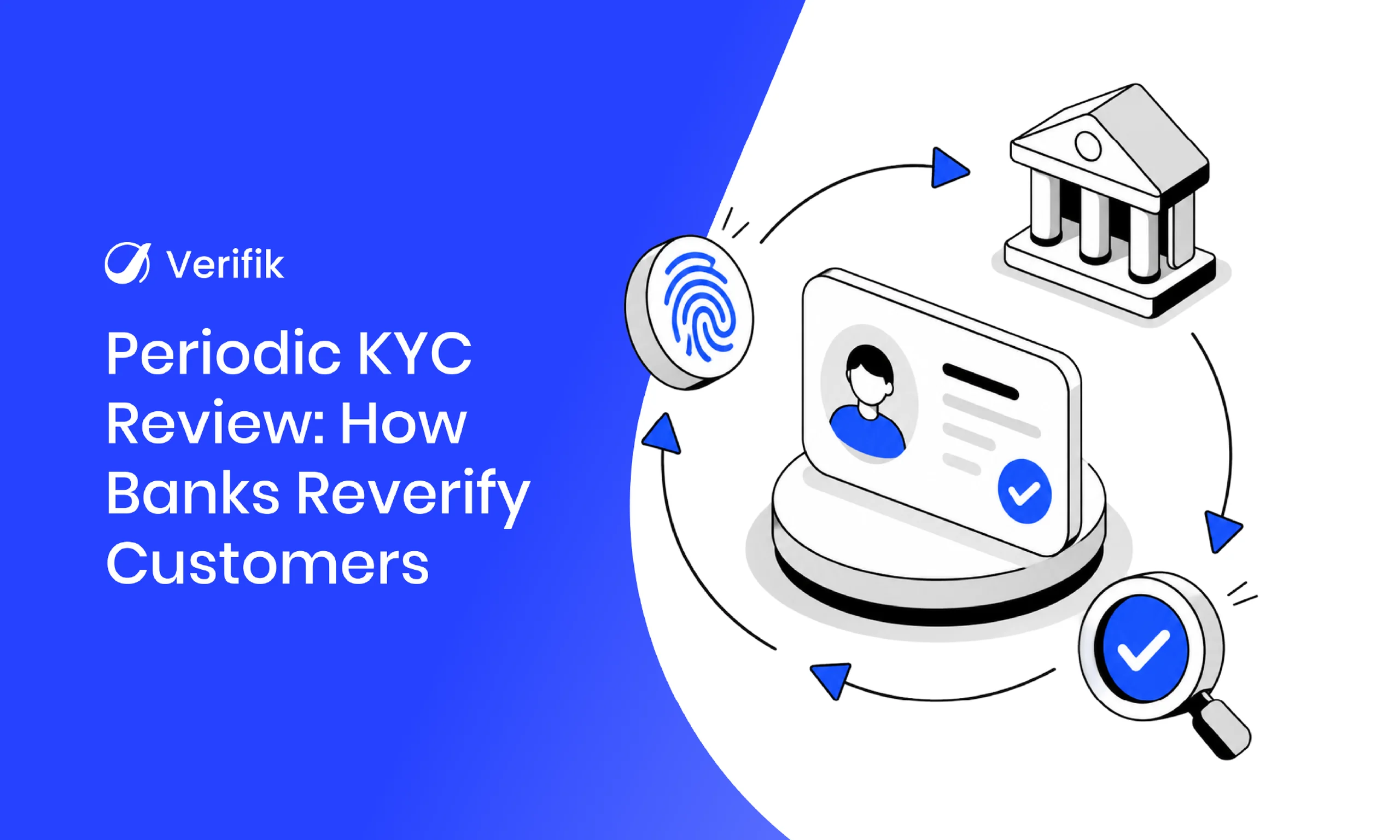
Short answer: A periodic KYC review is the scheduled re-verification of a customer’s data after onboarding: identity, sanctions lists, PEP status and, for companies, the business registry. In Colombia, the Financial Superintendence requires that data to be updated at least every three years and, for higher-risk customers, at least once a year.
A survey by Risk.net and Fenergo of 110 compliance professionals at banks and asset managers in Singapore, Malaysia and Australia found that 54% face periodic KYC review backlogs and 66% still rely heavily on manual processes. Onboarding is only the first check.
A modern KYC solution for banks keeps customer data current for years after the account is opened, because risk does not freeze on day one.
This guide explains how periodic KYC reviews work: what triggers them, what the bank re-checks, how often Colombian rules require it and how review cycles differ by risk level. For the full picture of requirements and benefits, see eKYC for Banks: Requirements, Process & Benefits. The same bank eKYC platform that onboards a customer should be able to reverify them without starting from scratch.
Why banks reverify their customers
A good bank KYC solution treats onboarding as the first check, not the last. A customer who was low risk at onboarding can become high risk years later. Periodic reviews exist to catch that change.
Risk changes after onboarding
People change jobs, start companies, enter politics or show up in adverse media. Companies change fast: new directors, new owners, new lines of business. A one-time check at account opening catches none of this, which is why regulators treat KYC as an ongoing obligation, not a one-off event.
Regulators require current data
In Colombia the rule is specific. The Financial Superintendence’s Circular Básica Jurídica (Part I, Title IV, Chapter IV, section 4.2.2.2.1.6.1) lets each institution set how often it updates customer data based on each customer’s money laundering and terrorist financing risk profile, but that period cannot exceed three years. For customers who expose the institution to higher risk, the update must happen at least once a year. And if a customer is reclassified as high risk and their data is more than a year old, the institution must update it within the following month (read the chapter text, in Spanish; the CBJ was reissued by External Circular 006 of 2025, as this SARLAFT guide summarizes).
The same three-year and annual-for-higher-risk rule applies when shareholders or members holding more than 5% of the capital, or the beneficial owner, change (section 4.2.2.2.1.6.3). For PEPs, the rule also requires continuous, enhanced monitoring of the relationship. When data goes stale, the bank cannot show that its risk ratings are still accurate: supervisors penalize outdated compliance, not just missing compliance. The underlying obligations are covered in eKYC Compliance Requirements for Regulated Businesses.
Mexico is moving the same way. According to LexLatin, the new LFPIORPI anti-money laundering rules, which take effect on November 30, 2026 for businesses carrying out so-called vulnerable activities (not banks, which have their own regime), require customers to be classified as low, medium or high risk, with reviews at least every six months.
Remediation campaigns and backlogs
When a bank discovers that its customer files are out of date, it launches a remediation campaign: thousands of customers are reverified at the same time. These projects can eat a large share of the compliance budget. They are the most expensive way to run periodic reviews, and they happen when routine reviews were skipped for too long.
If the use case is clear, create an account and test the endpoint from your own code.
How a periodic review works
A review follows the same logic as onboarding, condensed: confirm the data is still correct, screen again and decide again. It usually runs in five steps:
- Calendar trigger: a cycle based on the customer’s risk level.
- Event trigger: a PEP listing, adverse media or an ownership change.
- Data refresh: compare fresh data with the customer file.
- Revalidation: query registries such as RUES or SIMIT.
- Decision: automatic closure or escalation with evidence.
Trigger: the calendar or an event
Most reviews are calendar-based. In Colombia, the SFC sets a maximum of three years and, for higher-risk customers, at least once a year; a common practice is to review high risk every year, medium risk every two years and low risk every three, as defined in each institution’s SARLAFT manual. How each customer is assigned to those levels is explained in Bank KYC Tiers Explained: CDD vs EDD vs Simplified.
But events can trigger a review at any time: a new PEP listing, an adverse media hit, a change in beneficial ownership or a sudden shift in transaction patterns. Colombian rules also require updating data within a month when a situation calls for extra information to compare transactions with the customer’s activity (section 4.2.2.2.1.6.2). When your system detects one of these events, the review should not wait for the calendar.
Data refresh and revalidation
The bank pulls fresh data and compares it with the file: is the ID document still valid? Is the address current? Has the customer appeared on any new list?
In Colombia, that means revalidating the cédula against the Registraduría, re-screening UN sanctions lists, OFAC and politically exposed persons (PEP), and querying RUES again when the customer is a company. If you offer vehicle loans or onboard drivers, SIMIT traffic fines also matter. Good bank eKYC software refreshes most of this automatically and only involves the customer when something has actually changed.
The reviewer’s decision and the evidence
If the fresh data matches and no new risk appears, the review closes with a timestamp.
If something changed, the case goes to a reviewer with a before-and-after view: what the file said, what the fresh data shows and which signals fired. The reviewer confirms the risk level, updates the file and the decision is stored with its evidence, because supervisors will ask for it.
What an API re-check looks like
This JavaScript example re-queries a customer’s cédula, PEP, UN, OFAC and, where relevant, RUES records; compares the responses with the ones you stored at the last review; and decides whether to close or escalate. The data is sample data; the endpoints and parameters come from the documentation.
import axios from "axios";

const api = axios.create({
  baseURL: "https://api.verifik.co",
  headers: {
    Accept: "application/json",
    Authorization: `Bearer ${process.env.VERIFIK_TOKEN}`,
  },
});

// A 404 on PEP or other lists usually means "no record": treat it as null
const get = async (path, params) => {
  try {
    return (await api.get(path, { params })).data;
  } catch (err) {
    if (err.response?.status === 404) return null;
    throw err;
  }
};

// file = what you stored at the last review (sample data)
async function periodicReview(file) {
  const id = { documentType: "CC", documentNumber: file.documentNumber };
  const fresh = {
    cedula: await get("/v2/co/cedula", id), // Registraduría (national ID registry)
    pep: await get("/v2/co/politically-exposed-persons", id), // politically exposed persons
    onu: await get("/v2/onu", id),
    ofac: await get("/v2/ofac", id),
  };
  if (file.nit) {
    fresh.rues = await get("/v3/co/rues-complete", {
      documentType: "NIT",
      documentNumber: file.nit,
      category: "RM",
    });
  }

  // Simplified example: in production compare specific fields
  // (name, PEP position, list matches, legal representatives)
  const changes = Object.keys(fresh).filter(
    (k) => JSON.stringify(fresh[k]?.data ?? null) !== JSON.stringify(file.last?.[k]?.data ?? null)
  );
  return changes.length === 0
    ? { decision: "close", reviewedAt: new Date().toISOString(), fresh }
    : { decision: "escalate", changes, fresh }; // to the reviewer, with before and after
}

console.log(await periodicReview({ documentNumber: "1020304050", nit: "900123456", last: {} }));
This is how the PEP lookup responds when records exist (fictitious data, real fields). A 404 usually means no PEP record was found for that ID.
{
  "data": {
    "documentNumber": "1020304050",
    "documentType": "CC",
    "detail": [
      {
        "declarant": "SAMPLE PERSON",
        "entity": "Ministerio de Ejemplo",
        "positionContractor": "Asesor",
        "publicationType": "Declaración de Bienes",
        "declaration": "12345",
        "publicationDate": "15/03/2026",
        "declarationStatus": "Activa"
      }
    ]
  },
  "signature": {
    "dateTime": "November 25, 2026 8:02 AM",
    "message": "Certified by Verifik.co"
  },
  "id": "PEP01"
}
For thousands of customers you don’t need a loop: queue the same lookups with type=queue on the async queue or upload them as a spreadsheet to SmartBatch, which notifies you by webhook or email when it finishes.
curl -sS -H "Authorization: Bearer $VERIFIK_TOKEN" \
  "https://async.verifik.co/v2/co/cedula?documentType=CC&documentNumber=1020304050&type=queue"
The volume problem nobody talks about
Periodic reviews create huge workloads. Take an illustrative mid-sized retail bank with 500,000 customers: the 5% who are high risk are reviewed every year, the 25% medium risk every two years and the 70% low risk every three years, within the SFC maximum.
That works out to about 204,167 reviews a year (25,000 + 62,500 + 116,667), every year, before any remediation campaign. A bank with a million customers faces more than 400,000. That is why backlogs are the rule rather than the exception: the math of calendar reviews outruns manual teams. Automation is not a luxury here; it is the only way to close the cycle.
The trade-off: scheduled reviews vs continuous monitoring
Full scheduled reviews are thorough but overwhelming: every customer is reverified on a fixed cycle, even though most have not changed since last time. Continuous monitoring is efficient but demanding: it needs clean, always-on data sources and precise event rules, or it floods reviewers with false alerts.
The realistic middle ground is risk-based cycles plus event triggers: the calendar sets the floor and the signals your system detects pull risky customers forward. Banks should ask vendors exactly which events their system detects, which sources it re-queries and what the customer experiences when a review fires.
Periodic reviews vs perpetual KYC
Perpetual KYC (pKYC) replaces the calendar with continuous, event-driven monitoring. Here is how the two models compare on trigger, data freshness, customer contact and workload.
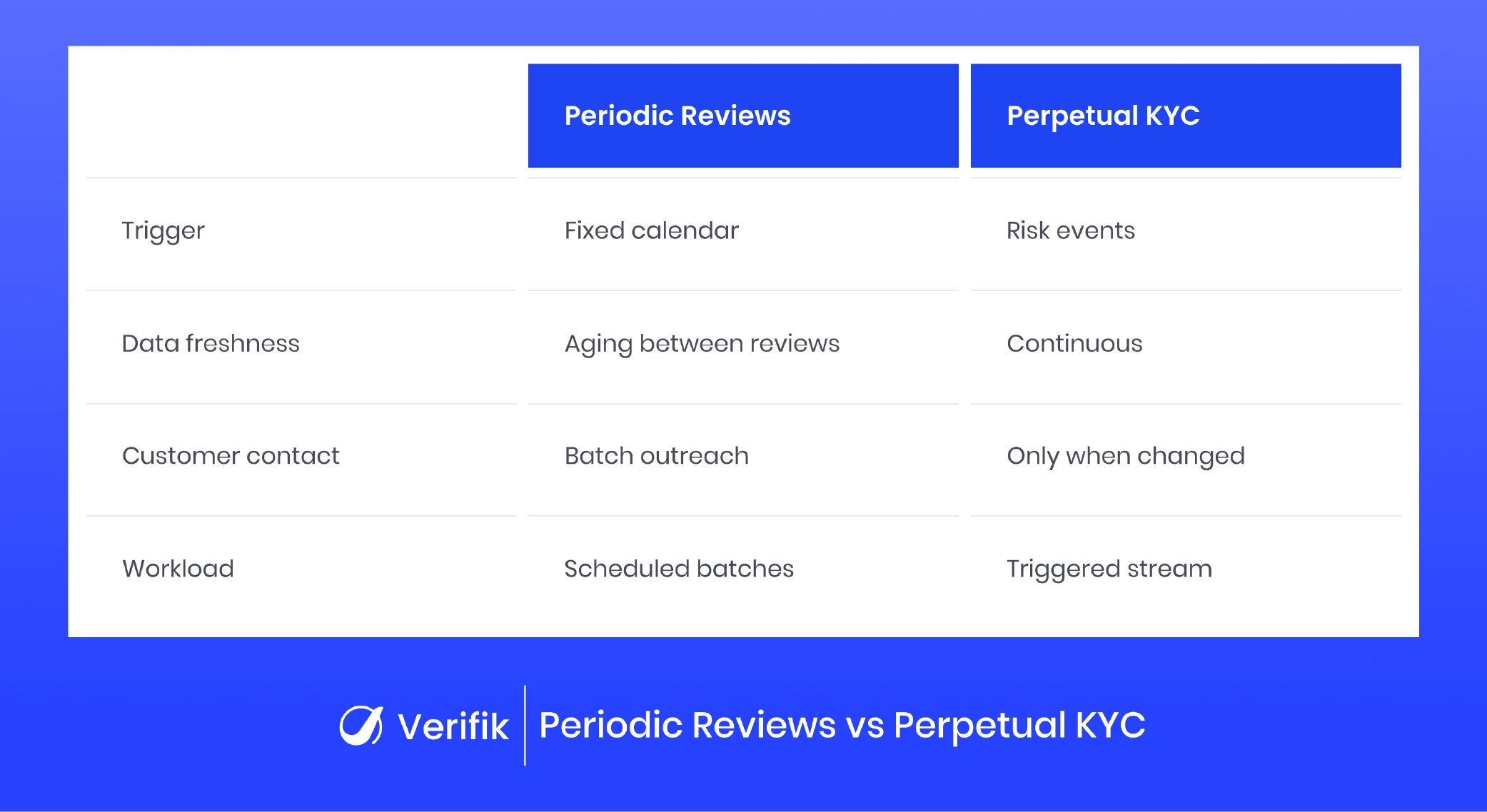
Most banks end up with a hybrid: calendar reviews as the safety net and event monitoring as the early-warning system. In Colombia, the calendar is not optional: the three-year maximum keeps running even if you monitor events. The FATF guidance on digital identity, available in the GAFILAT library, focuses on identification systems being reliable; whichever model you choose, what matters is being able to show the evidence for every review.
How to automate periodic reviews with Verifik
smartENROLL is Verifik’s eKYC solution for banking in Latin America, where keeping customer data current across many registries and ID formats is the real challenge. Together with the lookup APIs and SmartBatch, it covers the pieces of a periodic review; the review calendar lives in your own system (core banking or scheduled jobs), which decides whom to reverify and when.
API re-checks against local registries
When a customer’s date comes up or your system detects an event (a shareholder change, a transaction alert, a reclassification), you trigger the re-check by API right away: cédula against the Registraduría, PEP, UN, OFAC, adverse media and RUES. In Colombia you can add the SIGEP public servant lookup to support PEP identification. All the lookups are in the Colombia KYC API.
Cohort batches with SmartBatch
SmartBatch chains steps from the lookup catalog into a recipe. You upload a spreadsheet (for example, one per risk level or per due month) or queue rows by API, and the batch runs in the background. The batch dashboard shows progress, attempts and cost per row, and the completion notice arrives by webhook or email.
Customer-friendly refresh
Registries are re-queried without bothering the customer. Only when something changed do you send them a new smartENROLL link to update documents, with face recognition and liveness detection, plus email or phone OTP verification. Documents are not requested every cycle, so completion rates stay high.
Reviewer-ready evidence
Every refresh lands in SmartEnroll Admin with its status (pending, in progress, approved, rejected or in review), the documents and the verification results, and your system receives the lifecycle events by webhook. Lookup responses come signed by Verifik; you build the before-and-after view by storing each response in the customer file, as in the code example.
Remediation without chaos
Mass reverification campaigns use the same flow as routine reviews: one SmartBatch batch per customer cohort, with row-by-row progress on the dashboard.
Ready to cut your review backlog? Book a session with our team to look at how to reverify your own customer base, or try the lookups at app.verifik.co.
Conclusion
A periodic KYC review keeps onboarding valid over time. Risk changes, data goes stale and regulators expect the bank to notice: in Colombia, with a three-year maximum and an annual review for higher-risk customers. Calendar cycles set the floor, event triggers catch what the calendar misses, and the combination is what keeps a customer file defensible years after the account was opened. The banks drowning in backlogs are the ones still doing this by hand.
The practical question is whether your platform can reverify customers without starting from scratch every time. smartENROLL and Verifik’s APIs are built for that, with Latin American registry coverage that keeps reviews grounded in local data. Create your account and try a re-check with your own token.