 Identity Card
 National Identity Document
 Citizenship ID
 Unique Identity Document
 Personal Identification Document
 Unique Population Registry Code
 Personal Identity Card
 Civil Identity Card
 Identity and Electoral Card
 Check Plate Colombia
 Check Plate Peru
 Check Plate Mexico
 Check Plate Argentina
 Check Plate Chile
 Check Plate USA
 Check Plate Brazil


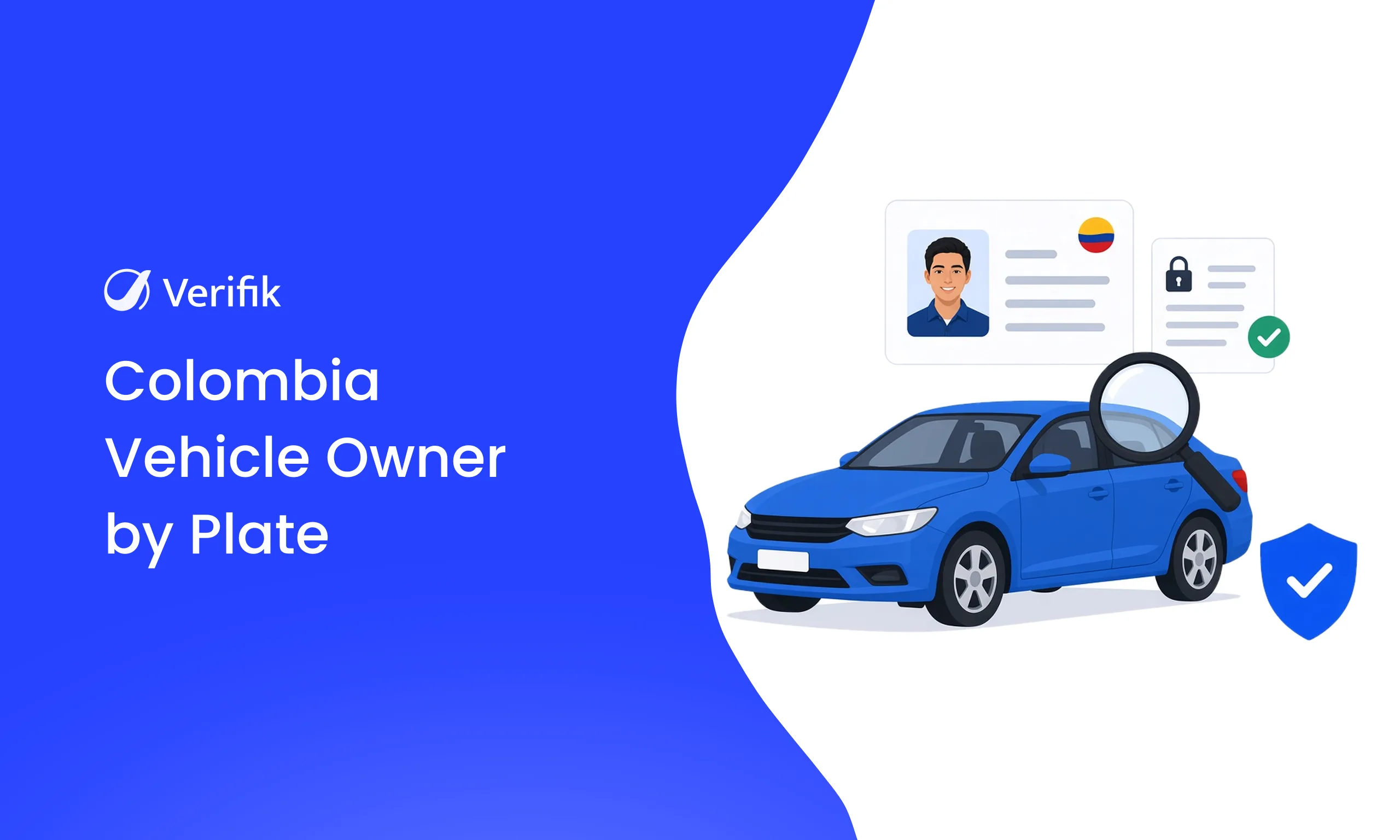
Short answer: To look up a vehicle owner by plate in Colombia with an API, send a GET request to https://api.verifik.co/v2/co/runt/propietarios with the 5–9 character plate. Verifik returns the brand, line, model and the RUNT ownership records with dates, financing and pledge (lien) status. Requests are paid with smartCHECK credits, from $49 per month.
If your company lends against vehicles, insures cars, rents fleets or lists used cars in Colombia, you need to know who is registered as the owner before you approve the deal. With Verifik’s RUNT Vehicle Owners API you get that in 1 request per plate: the GET /v2/co/runt/propietarios endpoint returns the vehicle’s basic data and its ownership records using only the plate. According to the documentation, it is built for ownership verification, vehicle linking and due diligence.
In this guide you will see what the endpoint returns, how to call it with the official example from the docs, which business rules you can automate, what Verifik’s terms say about personal data, and how much it costs.
What the Colombia vehicle owner lookup by plate returns
The response contains a data object with the vehicle’s basic data and an owners array with the ownership records. These are the fields Verifik documents:
- Vehicle:
plate,brand,lineandmodel(model year). - Owner:
fullName,firstName,lastName,documentType(for example CC),documentNumber,documentIssueDateandregistraduriaStatus. - Ownership period:
ownershipStartDate,ownershipEndDateandownershipDuration(years, months and days). - Financing and pledge:
financingType(for example “Prenda”, a pledge),entity(the financial entity),financingTimeandpledge(for example “Prenda levantada”, a released pledge). - Registry:
ownerIdandvehicleRegistryNumber. - Signature: a
signatureobject with date and time and the message “Certified by Verifik.co”, useful as evidence for each lookup.
The documentation points out two details: some owner fields can be null, and owners may contain several historical records, not only the latest one.
To follow this guide with your own integration, open a Verifik account and generate your access token.
Who it is for: fintech, insurers, rental companies, fleets and marketplaces
Colombia’s RUNT (Registro Único Nacional de Tránsito, the national transit registry) includes the National Vehicle Registry, and according to the official RUNT website it had 22,476,551 registered vehicles as of August 1, 2026. Sector rules and deadlines come from the Ministry of Transport. At that scale, an API makes sense when you run many checks every day:
- Fintech and auto-secured lending: confirm that the applicant is registered as the owner and check whether the vehicle shows a pledge before you disburse.
- Insurers: match the policyholder against the registered owner and spot recent ownership changes when you issue or renew a policy.
- Rental and fleet companies: verify that partner or third-party vehicles belong to the person who claims to own them before you onboard them.
- Used-car marketplaces and dealers: show buyers that the seller matches the registered owner and cut fraudulent listings.
When you also need to confirm the owner’s identity, you can add the cédula, biometrics and background checks by following our guide to person-level KYC in Colombia by API.
How to look up a vehicle owner with the Verifik API
You only need your Verifik token and 1 required parameter:
plate: the vehicle plate, 5 to 9 alphanumeric characters (for exampleCRL299).
Here is the Python example from the documentation:
import os
import requests

url = "https://api.verifik.co/v2/co/runt/propietarios"
headers = {
    "Accept": "application/json",
    "Authorization": f"Bearer {os.getenv('VERIFIK_TOKEN')}",
}
response = requests.get(url, headers=headers, params={"plate": "CRL299"})
print(response.json())
And this is the sample 200 response shown in the documentation:
{
  "data": {
    "plate": "CRL299",
    "brand": "CHEVROLET",
    "line": "CRUZE",
    "model": "2012",
    "owners": [
      {
        "documentIssueDate": null,
        "documentNumber": "********",
        "documentType": "CC",
        "entity": "ENTIDAD FINANCIERA",
        "financingTime": 42.03,
        "financingType": "Prenda",
        "firstName": "OWNER",
        "fullName": "OWNER EXAMPLE",
        "lastName": "EXAMPLE",
        "ownerId": 10000001,
        "ownershipDuration": {
          "days": 23,
          "months": 6,
          "years": 8
        },
        "ownershipEndDate": "2020-02-13T05:00:00.000+0000",
        "ownershipStartDate": "2011-07-21T05:00:00.000+0000",
        "pledge": "Prenda levantada",
        "registraduriaStatus": null,
        "vehicleRegistryNumber": "15514772"
      }
    ]
  },
  "signature": {
    "dateTime": "September 8, 2026 11:00 PM",
    "message": "Certified by Verifik.co"
  },
  "id": "ABCDE"
}
If the plate has no record, the API returns a 404 with {"code":"NotFound","message":"Record not found."}. If the plate is missing, it returns a 409 with {"code":"MissingParameter","message":"missing plate"}. In sandbox, use the plate CRL299. The older route GET /v2/co/runt/vehiculo/owners still works as an alias, with the same result and the same charge.
Want to try it with your own plates? Create your free Verifik account and run your first lookup in sandbox.
If you need the vehicle rather than its owner (specs, registration status, SOAT and technical inspection), the Colombia RUNT plate lookup API returns that record from the plate alone.
Business rules you can automate with the response
- Seller = owner match: compare the name and document type in the most recent ownership record (sort by
ownershipStartDate) with the details your customer provides. To confirm a specific ID number, combine this lookup withGET /v2/co/runt/vehiculo, which takes the plate and the holder’s document. - Pledge: check
financingType,entityandpledge. In the documentation example the pledge shows “Prenda levantada” (released); send any other value to manual review before you accept the vehicle as collateral. - Ownership changes: use
ownershipDurationand the number of records inownersto flag vehicles with very recent or frequent transfers. - No record: treat the 404 “Record not found.” as a case for review, not an automatic rejection.
- Evidence: store each response’s
idandsignaturewith the customer file.
For a fuller picture, add other Verifik checks: the full RUNT vehicle history, vehicle data validation by plate, SIMIT traffic fines, vehicle insurance claims and the driver’s license.
Personal data: what Verifik’s terms say
The owner’s name and document are personal data. The smartCHECK terms and conditions state that when you use the services to look up information about a third party, your company acts as the Controller of the personal data and Verifik acts as the Processor. In that case you must:
- Collect, store, use, circulate and delete the personal data in compliance with applicable law.
- Request authorization from each data subject and retain proof of that authorization.
- Inform Verifik of updates, rectifications, revoked authorizations and deletion requests from the data subject.
Verifik reserves the right to terminate the service if these obligations are not met. In Colombia, Law 1581 of 2012 governs personal data protection and, except for the cases the law itself lists, requires the data subject’s prior and informed authorization. This article is not legal advice: review your use case with your legal team.
How much the vehicle owner lookup costs with Verifik
Verifik does not charge a subscription per endpoint: each request is deducted from your smartCHECK plan credits. According to the smartCHECK pricing page:
- Starter: $49 per month, or $490 per year with $588 in credits.
- Basic: $129 per month, or $1,290 per year with $1,548 in credits.
- Plus: $299 per month, or $2,990 per year with $3,588 in credits.
- Business: $649 per month, or $6,490 per year with $7,788 in credits.
Annual plans include 2 free months. Each call to /v2/co/runt/propietarios is deducted from your credits, and you can see its cost in your dashboard once you create your account.
Start looking up vehicle owners in Colombia today
Automating owner lookups by plate saves you manual checks and leaves a signed record of every verification. Read the endpoint documentation and make your first call in sandbox.
Ready to start? Create your free Verifik account or book a demo to see how to add vehicle verification to your lending, insurance or rental flow.