Identity Card
 National Identity Document
 Citizenship ID
 Unique Identity Document
 Personal Identification Document
 Unique Population Registry Code
 Personal Identity Card
 Civil Identity Card
 Identity and Electoral Card
 Check Plate Colombia
 Check Plate Peru
 Check Plate Mexico
 Check Plate Argentina
 Check Plate Chile
 Check Plate USA
 Check Plate Brazil


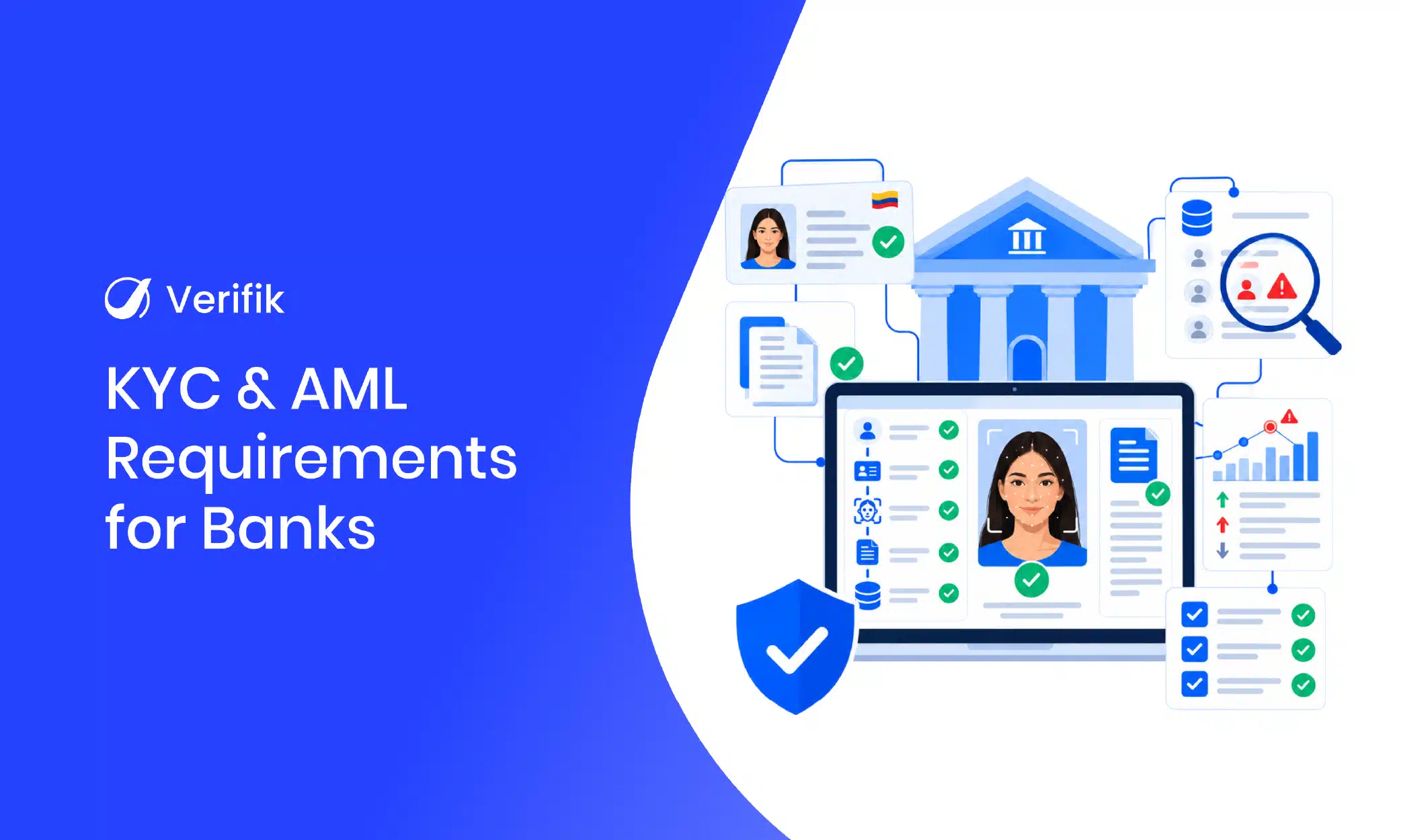
Ask three people at the same bank what the KYC requirements are and you will often get three different answers. The obligations are real and well defined, but they sit across international standards, national rules and the bank’s own risk policy, so no single document spells them out end to end.
The stakes behind them are not small. The UN Office on Drugs and Crime estimates that 2 to 5 percent of global GDP, between 800 billion and 2 trillion US dollars, is laundered every year (UNODC). Banks sit at the point where that money tries to enter the financial system, which is why supervisors examine their customer checks so closely.
In this guide, you will learn where bank KYC and AML rules come from, the core requirements every bank has to meet, how long records must be kept, what ongoing monitoring involves, and where banks most often fall short.
Where Bank KYC and AML Rules Come From
Bank obligations come from three layers that stack on top of each other. The FATF Recommendations set the international standard, national supervisors turn that standard into binding rules, and each bank then decides how deep to go for each customer based on its own risk assessment.
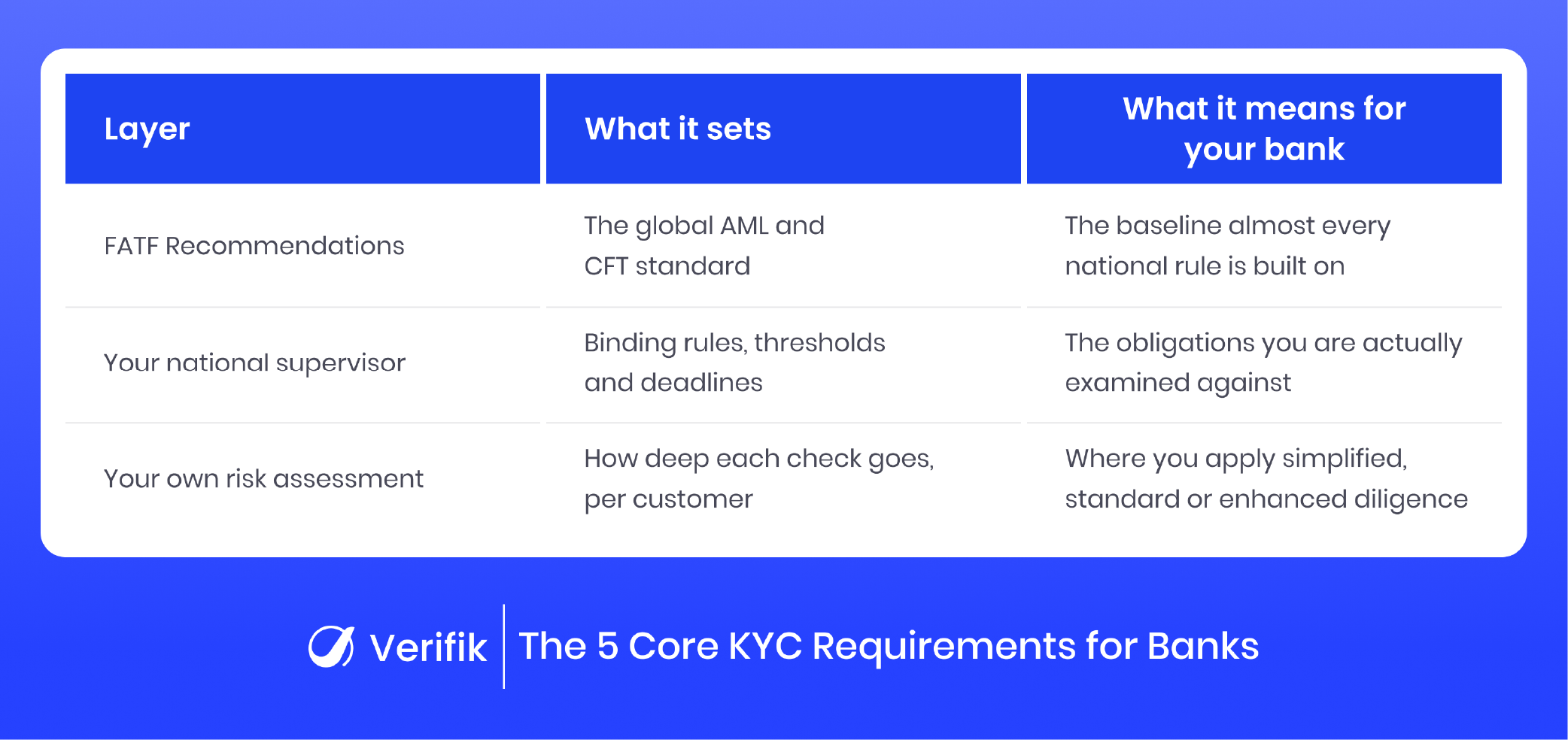
This is why a requirement can look different in two markets while resting on the same principle. The direction comes from the same place, but the thresholds, deadlines and evidence standards are set locally.
If you want to see how this works in your operation, take a look at Database Screening.
The Core KYC Requirements for Banks
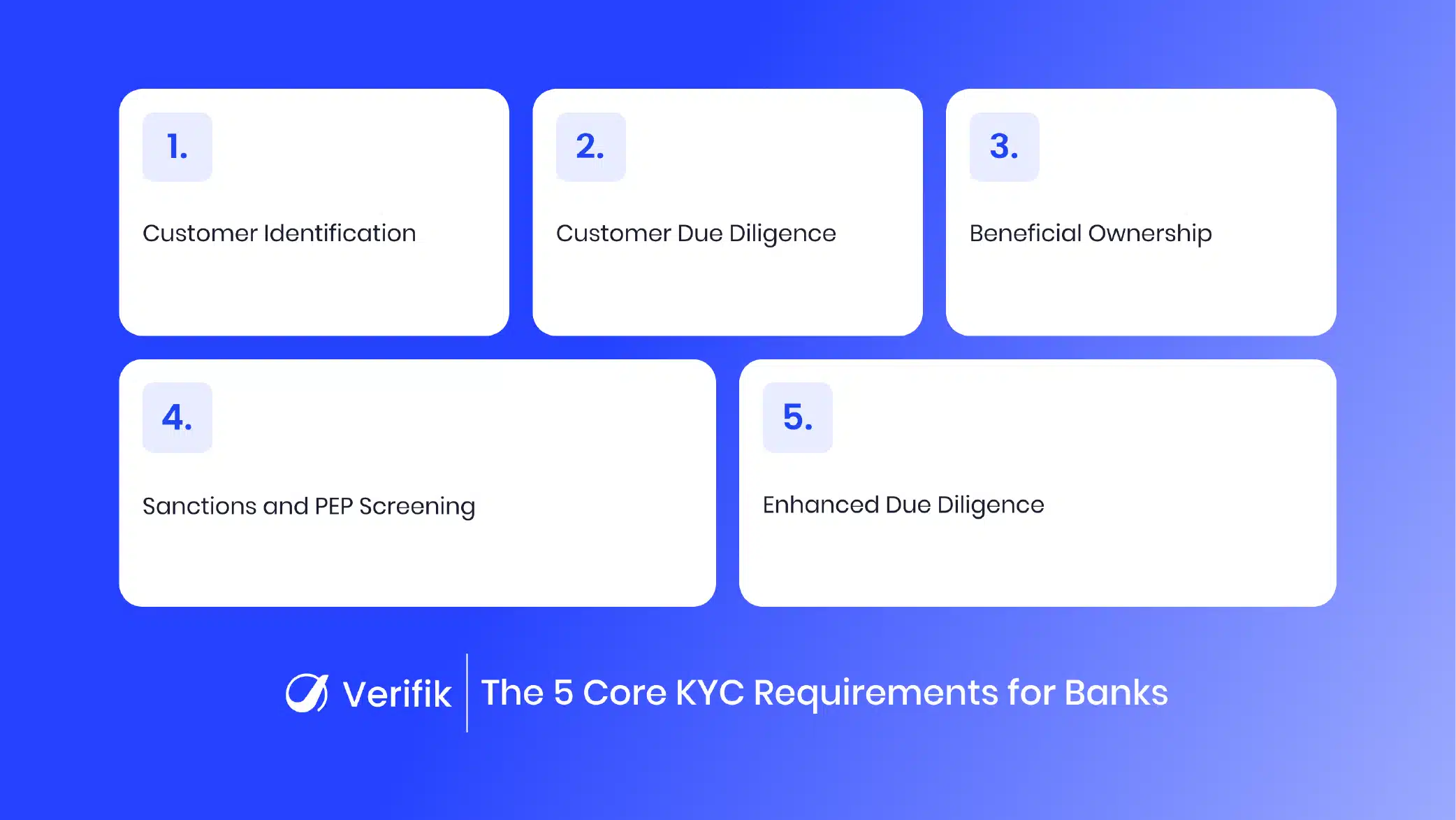
Five obligations show up in almost every regime. The wording changes, the substance does not.
1. Customer Identification
Collect identifying information and verify it against a reliable, independent source before the relationship begins. In a branch that meant an original document and a human check. In a digital channel it means a government-issued document checked for authenticity and matched to the person presenting it.
2. Customer Due Diligence
FATF Recommendation 10 covers customer due diligence. Beyond identifying the customer, a bank has to understand the purpose of the relationship and build a profile it can later measure activity against. Without that profile, monitoring has nothing to compare transactions to.
3. Beneficial Ownership
For corporate customers, identification does not stop at the entity. The bank has to establish who ultimately owns or controls it, and verify those people too. Layered ownership structures are the most common place this requirement breaks down.
4. Sanctions and PEP Screening
Recommendation 12 deals with politically exposed persons. Applicants are screened against sanctions lists, watchlists and PEP data before onboarding, and that screening has to stay current rather than being a one-time gate. Sanctions lists and wider watchlists are not the same thing, and knowing the difference between global watchlists and sanctions lists helps a bank set the right screening rules. In Colombia, PEP checks often start with a SIGEP lookup of public servants.
5. Enhanced Due Diligence
Higher-risk relationships call for more: source of funds, source of wealth, closer scrutiny of activity, and usually senior sign-off before approval. Which customers fall into that tier is a policy decision, and Bank KYC Tiers Explained: CDD vs EDD vs Simplified walks through how banks draw those lines.
KYC Record Keeping Requirements for Banks
Recommendation 11 covers record keeping. Banks have to retain the evidence behind each decision, not just the conclusion, and produce it on request during an examination or investigation.
In practice that means keeping the identity documents collected, the verification results, the screening hits and how they were resolved, the risk rating applied, and who approved the relationship. Most supervisors set a minimum retention period of five years after the relationship ends, and some require longer.
The common failure here is not missing records. It is records spread across systems that cannot be assembled into one coherent file when an examiner asks for it.
Ongoing KYC Monitoring and Periodic Review
KYC does not end at onboarding. Customers move, change names, change behaviour, or appear on a list they were not on last year. Supervisors expect banks to keep customer information current and to monitor activity against the profile built at the start.
That has two parts. Transaction monitoring looks for activity that does not fit the profile. Periodic review refreshes the customer information itself, on a cycle set by risk rating or triggered by a specific event.
Periodic KYC Review: How Banks Reverify Customers covers how banks schedule those reviews and what triggers an out-of-cycle refresh.
Suspicious Activity Reporting Requirements
Recommendation 20 requires regulated institutions to report suspicious transactions to the national financial intelligence unit. Reporting obligations usually carry a deadline, a prescribed format, and a prohibition on telling the customer a report has been filed.
Good KYC makes this workable. Without a documented customer profile, a reviewer has no reliable basis for deciding whether activity is unusual, and reports become either too frequent to be useful or too rare to be credible.
Why a Risk-Based KYC Approach Is the Requirement
A point worth being clear about: regulators do not ask for identical treatment of every customer. The standard itself is risk-based. Applying the heaviest checks to everyone is not over-compliance, it is a misallocation that adds friction for low-risk customers while giving high-risk ones no extra scrutiny.
What supervisors look for is a documented, consistently applied method for sorting customers by risk and matching the depth of diligence to that rating. A banking eKYC platform supports this by making the tier an explicit rule rather than a reviewer’s judgement call.
Where Banks Most Often Fall Short on KYC Compliance
Inconsistent Evidence
Two reviewers accept different evidence for the same requirement. The file passes internally and fails on examination, because nothing documents why each decision was acceptable.
Stale Customer Data
Information verified at onboarding is never refreshed. The record is accurate as of three years ago, which is not what ongoing monitoring means.
Screening That Runs Once
Applicants are screened at onboarding and never rescreened. Lists change constantly, so a clean result at signup says nothing about today.
No Reconstructable Audit Trail
The checks were done, but the evidence sits across separate systems. If a file cannot be assembled on request, in practice it reads as if the work was not done.
How eKYC Supports Bank KYC Requirements
Most of what is listed above is evidence work: collect it, verify it, record it, keep it current, produce it on demand. That is exactly where automation helps, because the record is created as a by-product of the check rather than written up afterwards. eKYC for Banks: Requirements, Process & Benefits sets out how the full onboarding flow fits together. Each of those checks is walked through in our guide to how banking eKYC works. Digital verification also has its own rulebook, covered in our guide to eKYC compliance requirements.
An eKYC platform built for banking runs document verification, biometric checks, liveness, OTP and database validation inside the application, applies the risk tier automatically, and retains a timestamped record of every step. The obligations do not change. What changes is how much of the evidence trail has to be assembled by hand.
Why Banks Choose smartENROLL
smartENROLL brings the checks behind these requirements into one workflow: AI-powered identity verification, OCR, facial recognition, liveness detection, OTP verification, phone and email intelligence, and local and international database validation.
Registration steps and risk rules are configurable, so the tiers your policy defines are the tiers the platform applies. Verification records are retained in one place, which is the difference between having done the work and being able to show it. smartENROLL for banking integrates with existing web and mobile banking applications through flexible APIs.
Want to see how it maps to your compliance process? Book a personalised demo.

Conclusion
The KYC and AML requirements banks face are stable and well documented. What makes them hard is not ambiguity about the rules, it is the volume of evidence they generate and the discipline needed to keep that evidence current and retrievable.
Banks that treat verification as a record-building exercise rather than a gate to clear tend to find examinations straightforward, because the file an examiner asks for already exists.
Frequently Asked Questions (FAQs)
What are the KYC requirements for banks?
Banks must identify and verify each customer against a reliable independent source, understand the purpose of the relationship, establish beneficial ownership for corporate customers, screen against sanctions and PEP lists, apply enhanced diligence to higher-risk customers, keep records of every step, and monitor the relationship on an ongoing basis.
What is the difference between KYC and AML?
AML is the whole framework a bank operates to prevent money laundering, covering governance, monitoring, reporting and training. KYC is the part of that framework concerned with knowing who the customer is. KYC is a component of AML, not a separate obligation.
How long must banks keep KYC records?
Most supervisors require records to be retained for at least five years after the relationship ends, and some set longer periods. What matters as much as the duration is whether the records can be assembled into a single coherent file when an examiner asks for one.
What triggers enhanced due diligence?
Common triggers include politically exposed persons, customers in higher-risk jurisdictions, complex or opaque ownership structures, and unusual transaction patterns. smartENROLL lets these triggers be configured as explicit rules so the right tier is applied consistently rather than case by case.
What makes smartENROLL the best eKYC solution for bank KYC and AML compliance?
smartENROLL runs identity verification, screening and database validation in one workflow and retains a timestamped record of each check, so the audit trail is built as the work happens. For banks in Latin America the local registry coverage is the real differentiator, and risk tiers stay configurable to your own policy.