 Identity Card
 National Identity Document
 Citizenship ID
 Unique Identity Document
 Personal Identification Document
 Unique Population Registry Code
 Personal Identity Card
 Civil Identity Card
 Identity and Electoral Card
 Check Plate Colombia
 Check Plate Peru
 Check Plate Mexico
 Check Plate Argentina
 Check Plate Chile
 Check Plate USA
 Check Plate Brazil


Updated November 2026
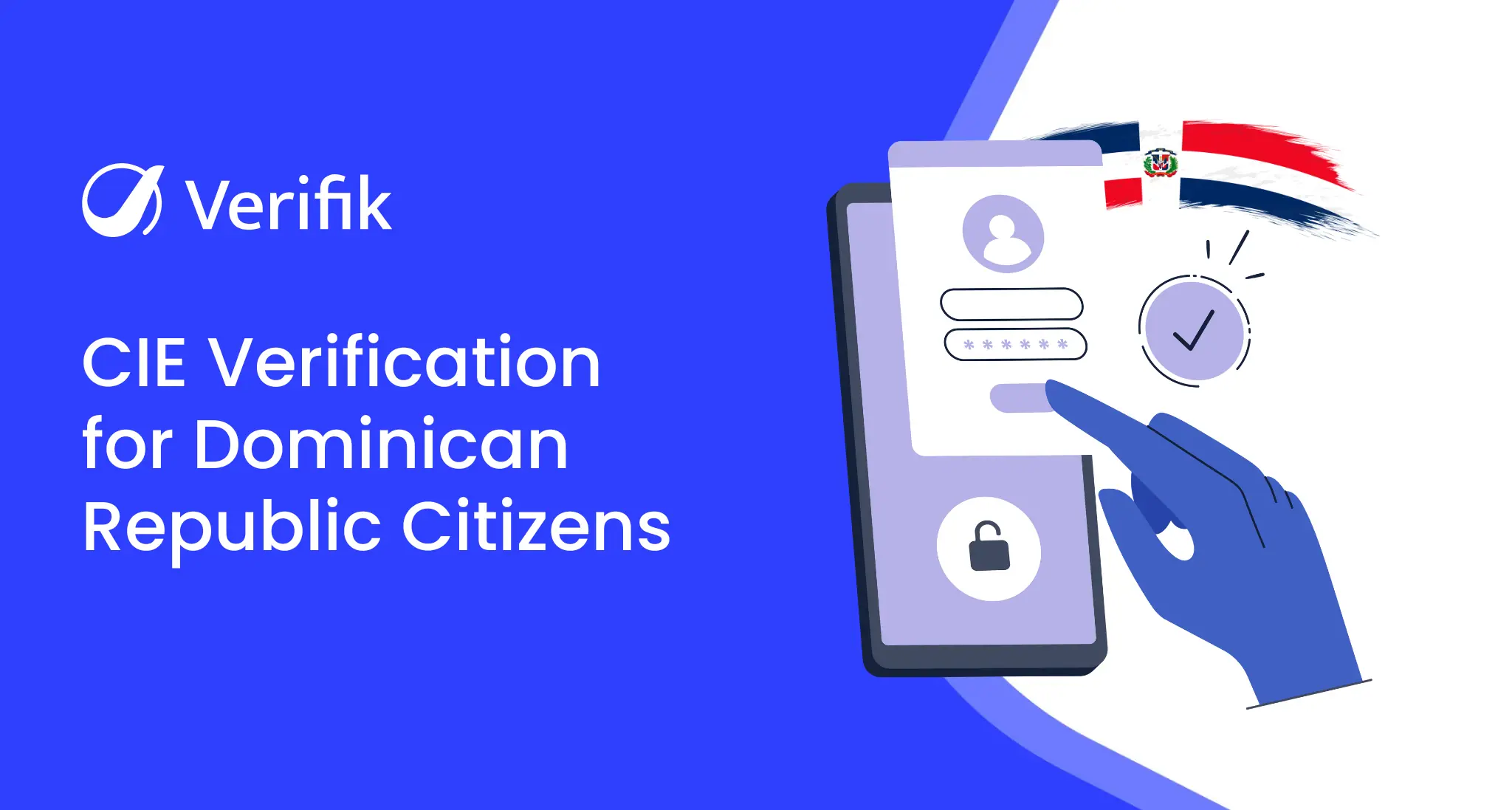
This guide shows how to verify a cédula in Dominican Republic with Verifik’s API: the endpoint, its parameters, a request you can paste into a terminal, the documented response and errors, and what to watch for when you put it in production. Everything below comes from the official endpoint documentation.
About the cédula in Dominican Republic
The Cédula de Identidad y Electoral is issued by the Junta Central Electoral (JCE). It works both as national ID and voter card, and its 11-digit number (printed as 000-0000000-0) is required to open bank accounts, sign phone contracts and receive remittances.
Verifik’s endpoint uses the document type CIE and returns the registered name split into first name, last name and name parts.
If the use case is clear, create an account and test the endpoint from your own code.
How to call the Dominican Republic cédula API
Endpoint: GET https://api.verifik.co/v2/do/cedula. Send your token in the Authorization: Bearer header. Parameters, as documented:
| Parameter | Required | Description |
|---|---|---|
documentType | Yes | Document type. Allowed value: CIE. |
documentNumber | Yes | Document number. |
Request example with placeholder values (replace them with your user’s data):
curl --location --request GET 'https://api.verifik.co/v2/do/cedula?documentType=CIE&documentNumber=00112345678' \
--header 'Accept: application/json' \
--header 'Authorization: Bearer <token>'
200 response from the docs (personal data masked):
{
  "data": {
    "arrayName": [
      "M****",
      "V******"
    ],
    "documentNumber": "12**********76",
    "documentType": "CIE",
    "firstName": "M****",
    "fullName": "M**** V******",
    "lastName": "V******"
  },
  "signature": {
    "dateTime": "July 3, 2024 3:24 PM",
    "message": "Certified by Verifik.co"
  },
  "id": "YOESE"
}
A successful call returns HTTP 200 with a data object containing: arrayName, documentNumber, documentType, firstName, fullName, lastName. Every response also carries a signature (timestamp and “Certified by Verifik.co”) and a unique id you can store as evidence of the check.
Documented errors for /v2/do/cedula
- 401
UNAUTHORIZED(“Authentication required”): the token is missing or invalid; check the Authorization header. - 404
NotFound(“Record not found”): no record was found; do not treat it as a match and route the case to review or ask for another document. - 409
MissingParameter(“missing documentType missing documentNumber”): a required parameter is missing or has an invalid value; fix the request instead of retrying it as is. - 500
InternalServerError(“Server error”): a server or source error; retry with backoff and log the request id.
Integration tips
- Remove the hyphens users copy from the card before sending the number.
documentTypemust beCIE; any other value is rejected.- A 404 means the number is not in the registry; a 409 lists the missing parameters.
- Remittance and lending apps typically compare
fullNamewith the name on the account to flag third-party use.
Personal data and terms of use
Identity lookups process personal data. Use the API only for a lawful purpose you can document, such as onboarding, fraud prevention or contract checks, collect consent where the local law requires it, and keep only the fields you need. Usage is governed by the smartCHECK terms and conditions.
Pricing
Each successful request consumes credits from your Verifik plan. Current plans and per-endpoint costs are on the smartCHECK pricing page.
Related guides and documentation
- Panama cédula verification API
- Costa Rica cédula verification API
- Endpoint documentation (English)
- Documentation in Spanish
Start testing
Create a Verifik account to get your API token, or book a meeting if you want to review coverage and volumes with the team.