Identity Card
 National Identity Document
 Citizenship ID
 Unique Identity Document
 Personal Identification Document
 Unique Population Registry Code
 Personal Identity Card
 Civil Identity Card
 Identity and Electoral Card
 Check Plate Colombia
 Check Plate Peru
 Check Plate Mexico
 Check Plate Argentina
 Check Plate Chile
 Check Plate USA
 Check Plate Brazil


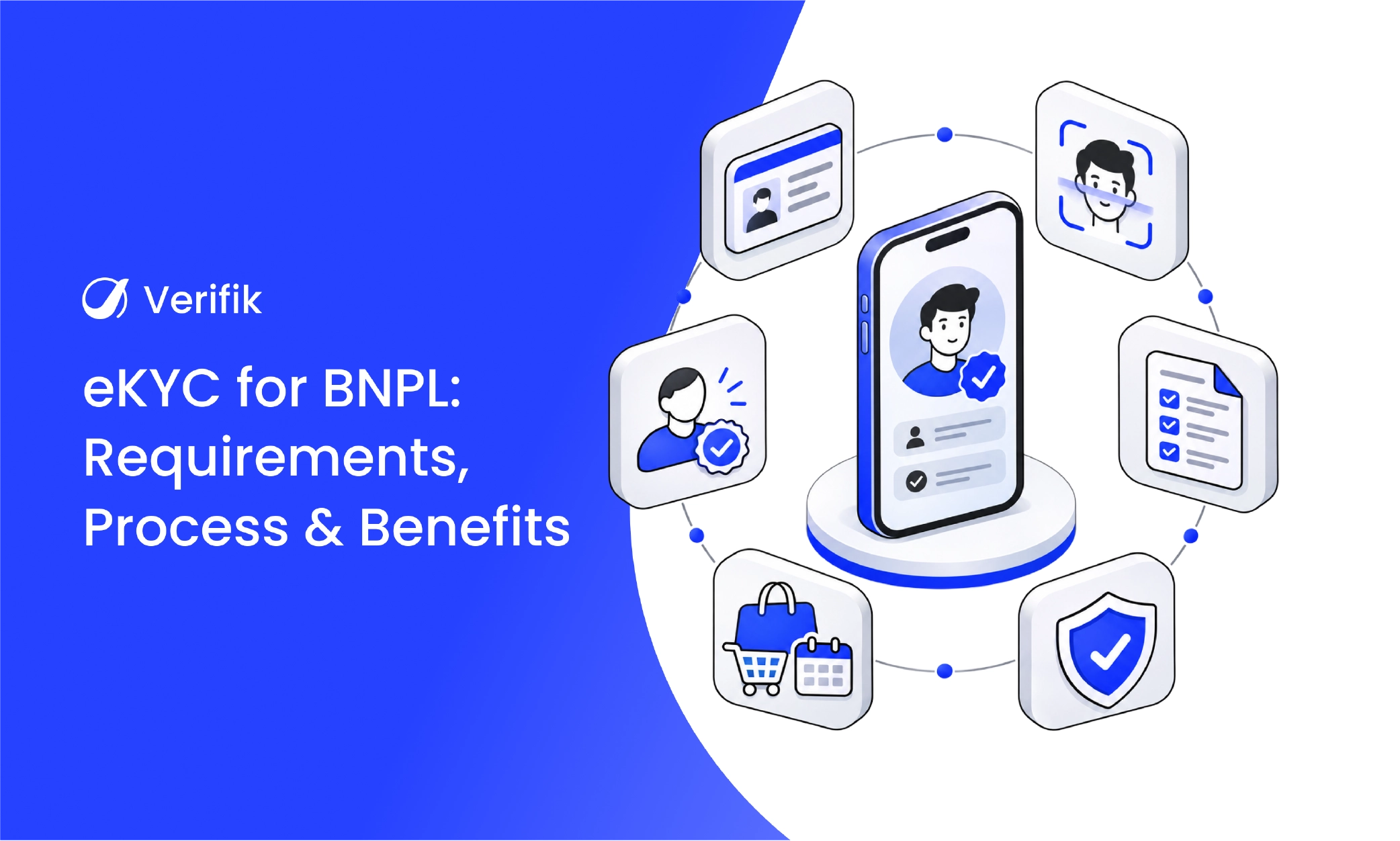
BNPL fraud runs at 3 to 4 percent of transactions, according to BNPL statistics compiled by Chargebacks911.
A modern BNPL eKYC platform must stop that fraud in the few seconds between a shopper clicking “split into 4 payments” and the order confirmation, while regulators on three continents rewrite the rules underneath it.
This guide covers the KYC requirements BNPL lenders face, the eKYC process that meets them, and the benefits of getting it right. It is the hub of our BNPL series.
If you are comparing vendors, an eKYC software for BNPL must handle checkout-speed decisions, age and eligibility checks, and real affordability screening in one connected flow.
Why BNPL Is a Fraud Magnet
BNPL combines three traits that attract fraud: instant approval, small individual loans, and a customer base that often has thin credit files. Fraudsters noticed.
Fraud Losses at Scale
With a typical fraud rate of 3 to 4 percent of transactions, even a low single-digit rate means heavy losses at BNPL’s scale. The economics that make BNPL attractive to merchants, fast approval and broad acceptance, are exactly what make it attractive to fraudsters.
First-Payment Default and Loan Stacking
First-payment default is not the only risk: loan stacking is the wider one, because many borrowers hold several BNPL plans at once. When many of those loans do not show up in the reports other lenders check, a stretched borrower can stack several plans across providers without any single provider seeing the full picture.
Synthetic Identities Target Instant Approval
Synthetic identity fraud, built from a mix of real and fabricated personal data, is a growing threat to instant credit.
BNPL is a natural target: approvals happen in seconds, early checks are light, and the first payment often only covers a quarter of the purchase. A synthetic identity that would fail a mortgage application can breeze through a checkout.
If the use case is clear, create an account and test the endpoint from your own code.
The Regulatory Squeeze
For years BNPL sat outside consumer credit regulation in most markets. That era is ending, and the new rules all point in one direction: verify the borrower properly before you extend credit.
United Kingdom: FCA Regulation From July 2026
From 15 July 2026, UK BNPL (legally “Deferred Payment Credit”) sits under Financial Conduct Authority regulation. Lenders must run proportionate affordability checks before offering credit, follow the Consumer Duty, give borrowers access to the Financial Ombudsman Service, and hold FCA authorisation.
The FCA notes the UK BNPL market has grown sharply in recent years, which is why it moved to regulate. See the FCA announcement.
The practical effect is that every UK BNPL checkout now needs real creditworthiness assessment, not a soft check and a hope.
United States: Federal Retreat, State Advance
In May 2024 the CFPB issued an interpretive rule treating BNPL providers as credit card issuers under the Truth in Lending Act. In May 2025 the agency rescinded it and confirmed it will not issue a revised rule.
But the pressure moved to the states: New York’s BNPL Consumer Protection Act, signed in May 2025, requires NYDFS licensing, and seven state attorneys general opened investigations into major BNPL providers in December 2025.
Lenders now face a patchwork where state licensing and UDAP obligations still demand solid verification.
European Union: CCD II Narrows the Exemption
The EU’s revised Consumer Credit Directive (Directive 2023/2225) removes the old BNPL exemption almost entirely. Since it began to apply on 20 November 2026, only supplier-direct deferred payment of up to 50 days (14 days for large online sellers) escapes the rules.
Third-party BNPL becomes regulated consumer credit with mandatory creditworthiness assessments. CMS Law has a detailed analysis of the impact on BNPL providers. If you operate in Europe, your checkout flow must now assess repayment capacity by law.
The clause-by-clause detail for all three regimes is covered in our guide to KYC and AML requirements for BNPL lenders. The headline is simple: regulators everywhere are converging on one demand, know your borrower before you lend.
What BNPL KYC Must Check
A BNPL credit decision is small and fast, but the questions behind it are the same ones behind any loan. Four checks cover nearly all of the risk.
Identity: Is This Person Real?
Document verification plus a biometric face match with liveness detection answers this question. Stolen and synthetic identities are the primary attack on BNPL, so this check cannot be a light form fill. Any eKYC software for BNPL must validate the identity data against official sources, not just check it for correct formatting.
Age and Eligibility: Can They Legally Borrow?
BNPL requires a borrower old enough to enter a credit agreement, 18 in most markets, plus residency and a valid repayment method. Underage applicants are a real risk because BNPL checkout feels like a payment button, not a loan application.
Affordability: Can They Repay?
This is where regulation is moving fastest. UK lenders must now run proportionate affordability checks, and EU lenders must assess creditworthiness. With many borrowers stacking multiple BNPL loans, affordability means seeing beyond the single transaction: income signals, existing obligations, and repayment behavior across providers.
Watchlists: Are They Prohibited?
Sanctions, PEP, and adverse media screening apply to BNPL lenders just like any other credit provider. Lists change daily, so screening must run on fresh data at onboarding and be repeated in your periodic KYC reviews. A checkout flow that skips watchlist screening to save two seconds is taking on compliance risk it cannot defend later.
The BNPL eKYC Process, Step by Step
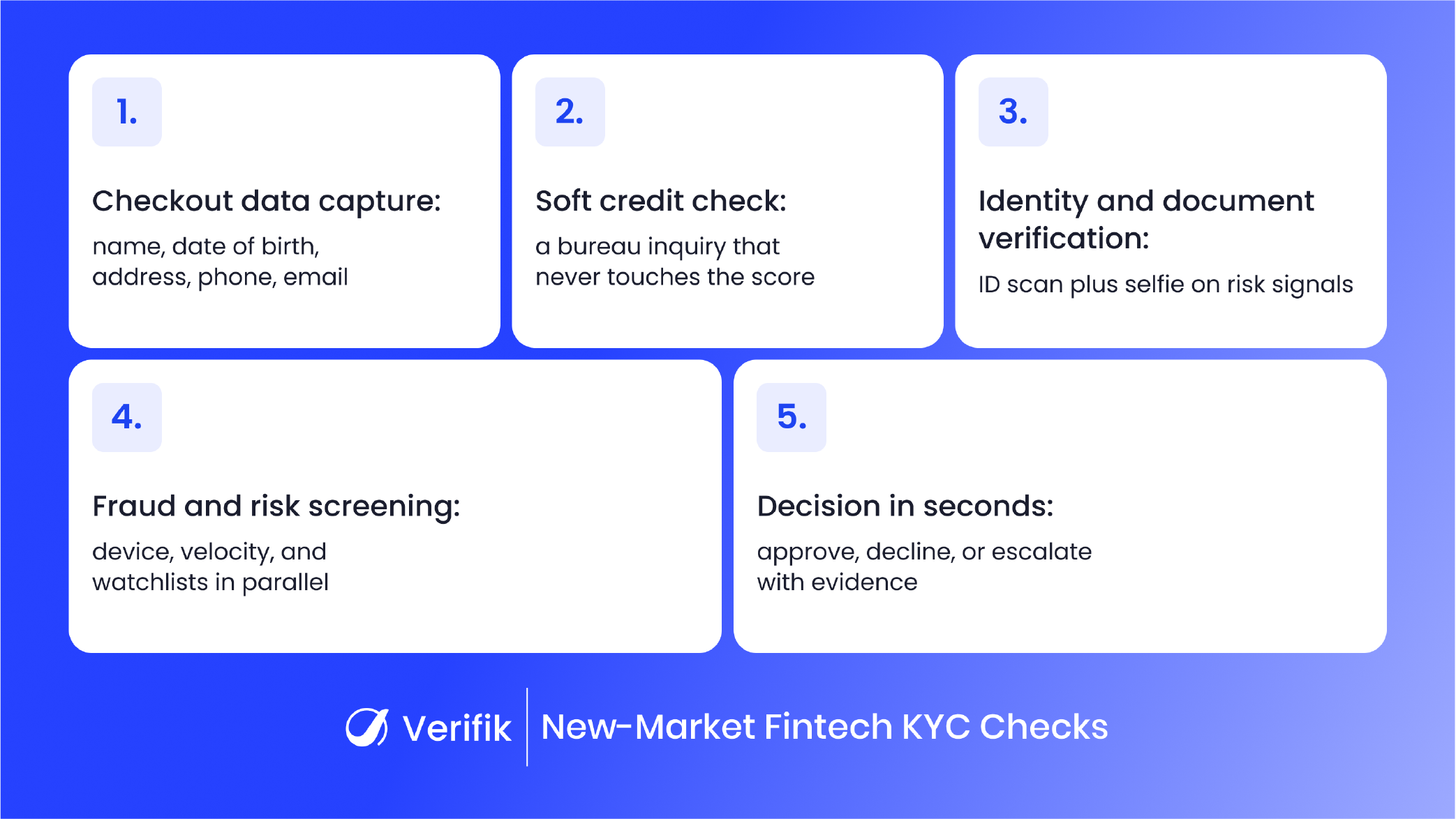
BNPL eKYC compresses a full credit decision into the checkout flow. Five steps, usually completed in seconds.
1. Checkout Data Capture
The shopper enters basic details at checkout: name, date of birth, address, phone, and email. Good flows pre-fill what the merchant already knows and ask for nothing twice. Every extra field is a chance to lose the sale, so capture is designed for thumbs on a phone screen.
2. Soft Credit Check
The lender runs a soft inquiry with its own credit bureau to gauge repayment capacity. Soft checks do not affect the applicant’s credit score, which keeps the experience light. But thin files are common in BNPL’s young customer base, so the soft check is only one signal among several.
3. Identity and Document Verification
For higher-risk applications, the flow escalates: the applicant scans a government ID and takes a selfie, which is matched biometrically with liveness detection, or follows an alternative path where the law requires one, as in Colombia under Law 2573 of 2026. Document authenticity analysis catches forgeries before they enter the system. This is the step that stops stolen and synthetic identities.
4. Fraud and Risk Screening
Device signals, velocity checks, watchlist screening, and behavioral analysis run in parallel. Is this device linked to ten applications today? Does the email look freshly created? Do sanctions lists flag the name? These checks cost milliseconds and catch the attacks that documents alone miss. Device and velocity signals usually come from your own anti-fraud stack; Verifik contributes pieces such as phone line holder lookup, IP geolocation, OTP codes, and watchlist screening.
5. Decision in Seconds
All signals combine into approve, decline, or escalate. Clear cases are decided automatically with an evidence record attached. Unclear cases route to human reviewers with everything already collected. Each step is broken down in detail in our walkthrough of the BNPL eKYC process.
What the Silent Step Looks Like via API
This Node.js example, with sample data, runs three invisible checks in parallel for a shopper in Colombia: the cédula against the official registry, the holder of the mobile line, and the country of the connection. If everything matches, identity passes; if something fails, the flow escalates to smartENROLL or to a non-biometric alternative.
import axios from "axios";

const api = axios.create({
  baseURL: "https://api.verifik.co",
  headers: { Accept: "application/json", Authorization: `Bearer ${process.env.VERIFIK_TOKEN}` },
});
const get = async (path, params) => (await api.get(path, { params })).data;

// Sample data captured at checkout
async function verifyBnplShopper({ cedula, name, mobile, ip }) {
  const [registry, phone, network] = await Promise.all([
    get("/v2/co/cedula", { documentType: "CC", documentNumber: cedula }), // official cédula registry
    get("/v2/look-ups/phone", { countryCode: "57", phone: mobile }),       // line holder
    get("/v2/ip-lookup", { ip }),                                          // connection country and ISP
  ]);

  const signals = {
    nameMatches: registry.data.fullName?.toUpperCase().includes(name.toUpperCase()),
    phoneMatches: phone.data?.name?.toUpperCase().includes(name.split(" ")[0].toUpperCase()),
    ipInColombia: network.data?.countryCode === "CO",
  };

  const lowRisk = Object.values(signals).every(Boolean);
  return lowRisk
    ? { decision: "identity_approved", signals }  // continue with your credit bureau check
    : { decision: "escalate", signals, nextStep: "smartENROLL (document + selfie) or a non-biometric alternative" };
}
The credit decision (affordability) is still yours: this step only resolves identity.
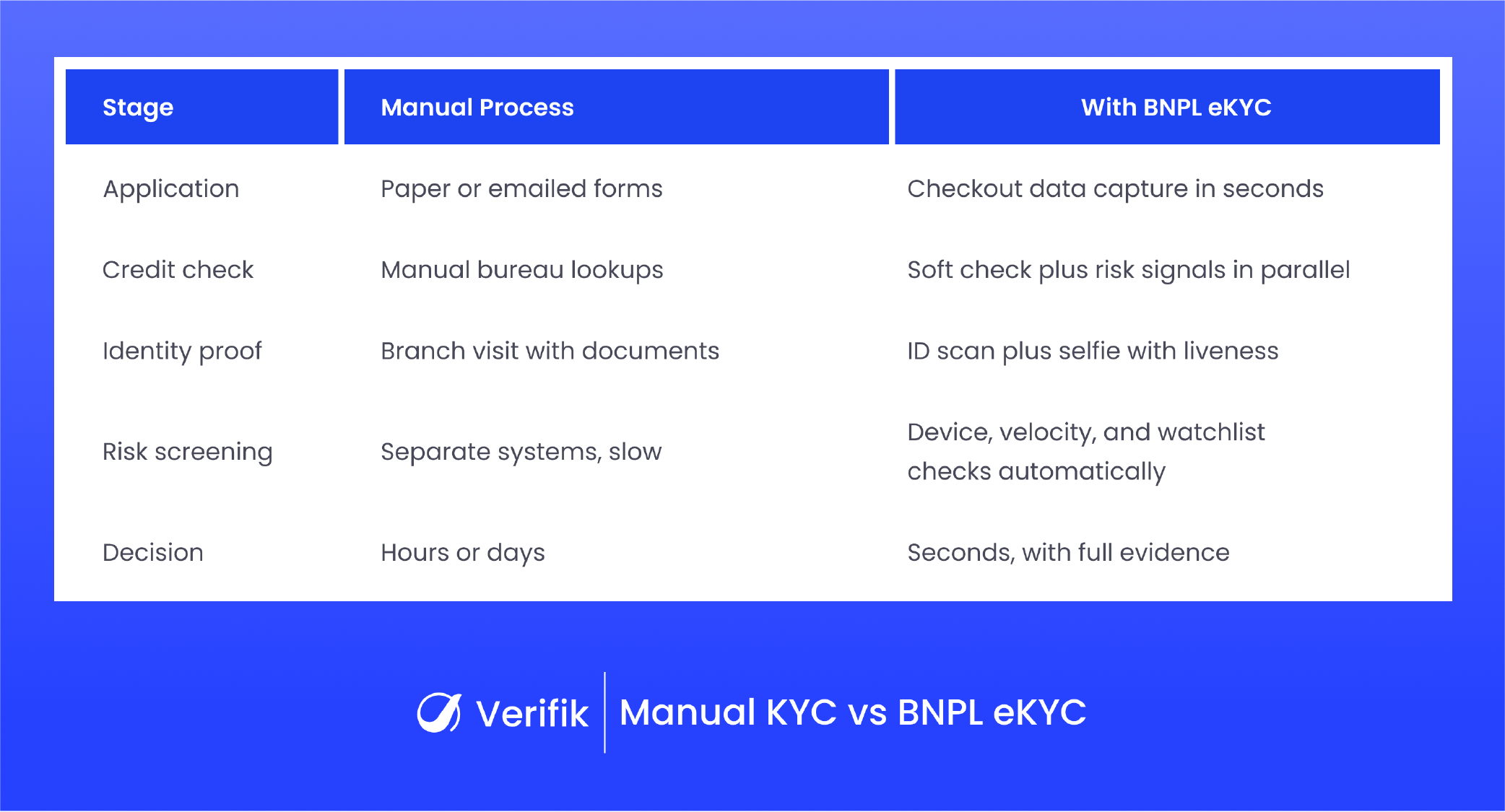
Manual process versus BNPL eKYC at a glance:
The Trade-Off: Speed Against Safety
Here is the honest tension at the heart of BNPL eKYC. Every check you add makes fraud harder and checkout slower. Every extra step is a chance for the shopper to abandon the cart, and long, complicated checkouts are a cause of abandonment you can actually fix.
A BNPL flow that asks for an ID scan, a selfie, and a utility bill will stop fraud and lose most legitimate customers too.
The way out is risk-based layering, not fewer checks. Run cheap, invisible checks on everyone: device signals, velocity, bureau data, watchlists. Reserve visible friction, the ID scan and selfie, for the applications that look risky.
Low-risk shoppers sail through in seconds; high-risk ones face real verification. This is also the economics argument: catching a fraudster at checkout costs cents, while a defaulted loan and a chargeback cost the full basket plus fees.
Spend the friction where the risk is.
What to Demand From a BNPL eKYC Solution
Not every identity platform is built for checkout speed. These are the capabilities that matter most for BNPL.
Decisions in Seconds, Not Minutes
The entire verification must fit inside the checkout flow without a page that says “we will email you.” Ask vendors for their median decision time on real traffic, not lab demos.
Database Depth Beyond Documents
Document checks catch forgeries, but database validation catches lies: does this person exist, at this address, with this ID number? In Latin America that means coverage of each country’s national ID system and official registries. Ask every vendor which sources it covers in your markets.
Risk Rules Your Team Can Tune
Fraud patterns change weekly. Your risk team needs to adjust thresholds, add rules, and reorder checks without filing engineering tickets. A platform that needs a developer for every rule change will always be one attack behind.
Evidence for Audits and Disputes
Every decision should store what was checked, what passed, what failed, and when. Regulators and payment disputes both demand this record. A decision without evidence is a liability.
BNPL eKYC in Latin America
BNPL is growing strongly in Latin America, where installment buying is embedded in the culture through “parcelado” and “meses sin intereses” traditions. The market includes specialist BNPL platforms, consumer lenders, banks, and marketplaces.
The region brings specific verification demands. National IDs differ by country: Colombia’s cédula, Mexico’s INE, Peru’s DNI, Brazil’s CPF. Regulators like Colombia’s Superintendencia Financiera expect real customer identification. We cover Colombia’s sources in our Colombia KYC API guide.
And validation against official sources matters: Colombia’s cédula registry, Mexico’s CURP and INE voter card, or Peru’s DNI let you confirm that an identity exists and matches what the shopper declares. RUES, Colombia’s official business registry, serves a different purpose: verifying partner merchants (KYB) before you activate them, not shoppers.
Colombia adds a new rule. Law 2573 of 2026 has been in force since November 19, 2026: according to Portafolio, a selfie can no longer be an automatic requirement to apply for credit, although lenders must still verify the applicant’s identity. For a BNPL flow, that means offering a non-biometric path, for example validating the cédula against the official registry, an OTP code to the mobile phone, and an assisted review, and asking for explicit consent when biometrics are used, since they are sensitive data under Law 1581 of 2012. Confirm with your legal counsel which combination applies to your product.
A KYC solution for BNPL lenders that cannot reach these registries is guessing. Conditions differ by country, so confirm the details with your own supervisor.
How to Handle BNPL eKYC With smartENROLL
smartENROLL is Verifik’s eKYC onboarding solution. For BNPL in Latin America, where installment culture is strong, ID formats vary by country, and access to official registries separates real verification from theater, these are the pieces it brings.
Checkout-Speed Decisions
Layered checks run in parallel and return decisions in seconds, so verification fits inside the checkout flow instead of interrupting it.
Document Verification for Regional IDs
Reads (OCR) and verifies Latin American national IDs, such as Colombia’s cédula, Mexico’s INE voter card, and Peru’s DNI.
Biometrics With Passive Liveness
Matches the shopper’s face to the ID photo and confirms from a single image that a live person is present, helping stop photo, video, and mask attacks without awkward head movements.
Validation Against Official Registries
Validates the shopper’s identity against each country’s official ID registry (cédula, CURP, DNI, and others) and, when you need to verify a partner merchant, against RUES and other business registries. Verifik’s public catalog covers 409 APIs across 51 countries: see coverage by country and per-call pricing.
Watchlist Screening Built In
Sanctions (OFAC and UN) and PEP screening run at onboarding, and you can repeat them via API or in batches during your periodic reviews, without manual list management.
Configurable Flows and Thresholds
You configure flow steps, biometric thresholds, and blocklists per project, and doubtful cases go to review in the admin panel, with webhook notifications to your system.
Ready to see checkout-speed verification on your own flow? Book a session and watch a verification decision land in seconds.
Conclusion
BNPL eKYC has to do two jobs at once: stop fraud that runs at around 3 to 4 percent of transactions and keep checkout fast enough that legitimate shoppers finish. Regulators in the UK, the EU, and US states all demand the same checks: verify identity, check age and eligibility, assess affordability, and screen watchlists before you lend. In Colombia, Law 2573 also requires a verification path that does not depend on a selfie alone.
The fastest way to judge any platform is to run your own applicants through it and watch where good shoppers stall and fraudsters slip through. smartENROLL is built for that test, with document reading and validation against official Latin American registries.