 Identity Card
 National Identity Document
 Citizenship ID
 Unique Identity Document
 Personal Identification Document
 Unique Population Registry Code
 Personal Identity Card
 Civil Identity Card
 Identity and Electoral Card
 Check Plate Colombia
 Check Plate Peru
 Check Plate Mexico
 Check Plate Argentina
 Check Plate Chile
 Check Plate USA
 Check Plate Brazil


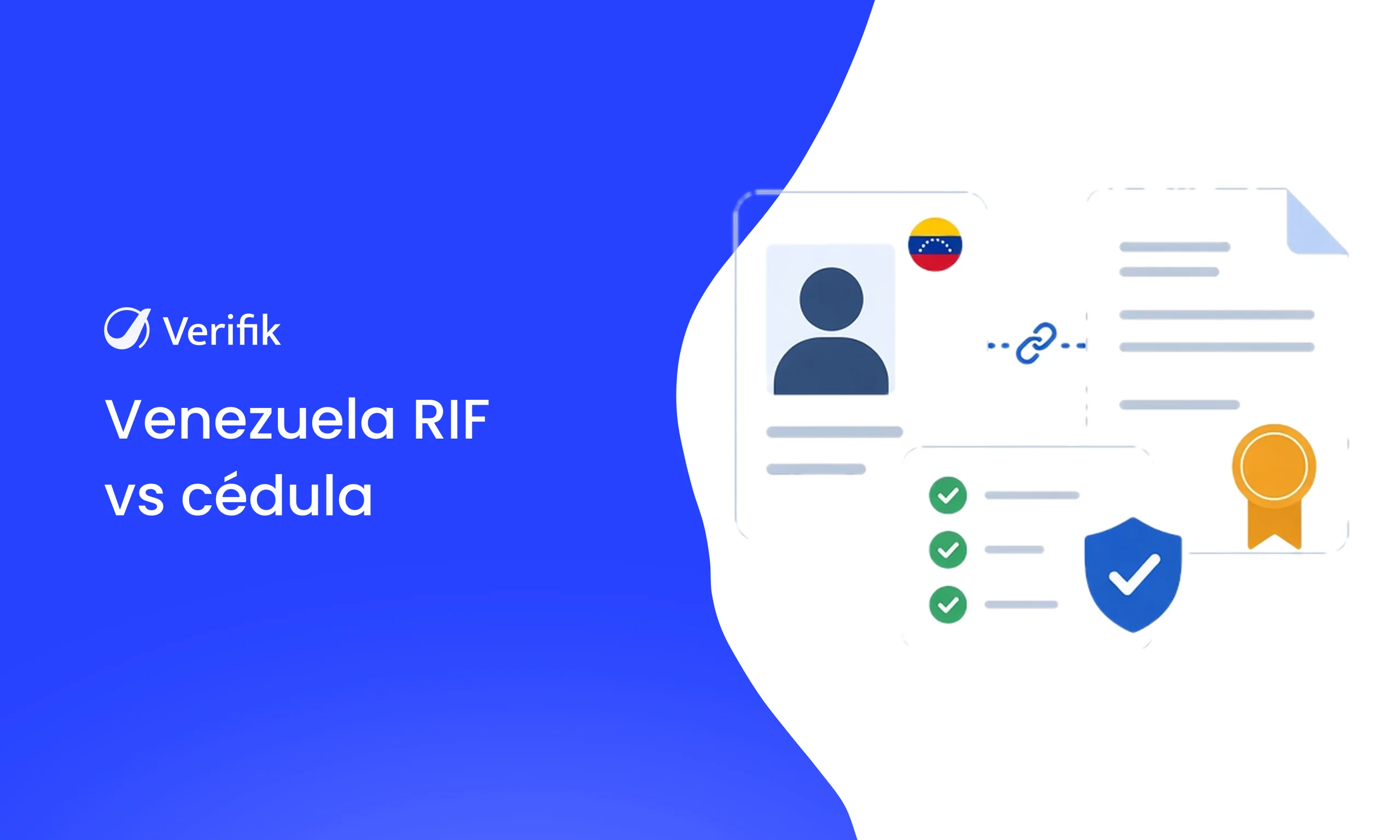
Short answer: In Venezuela, the cédula is the identity card issued by SAIME and proves who a person is; the RIF is the tax ID assigned by SENIAT. For individuals, the RIF carries a V or E prefix and, according to specialist sources, the cédula number plus a check digit. Verifik verifies cédulas by API; RIFs are checked with SENIAT.
If your company works with Venezuelan customers, suppliers or couriers, you will see two similar numbers on your forms: the cédula and the RIF. They get mixed up because, for an individual, they share almost every digit. But they answer different questions: the cédula says who the person is and the RIF says how they are registered for tax purposes. This guide explains what each one is, how they relate and what you can verify by API.
What the Venezuelan cédula is and who issues it
The cédula de identidad is the identity document for people in Venezuela. It is issued by the Administrative Service for Identification, Migration and Foreigners (SAIME), the agency in charge of citizen identification, migration and the control of foreign nationals in the country.
Two variants matter in a verification flow: the cédula of Venezuelan nationals and that of foreign residents. Verifik’s documentation calls them CCVE (Venezuelan identity card) and CEVE (foreigner identity card), and each one has its own endpoint.
If the use case is clear, create an account and test the endpoint from your own code.
What the RIF is and how SENIAT uses it
The RIF (Registro Único de Información Fiscal, or Single Tax Information Registry) is the tax ID assigned by Venezuela’s tax and customs authority, SENIAT. Individuals, companies and public bodies have one, and it is used in tax filings, invoices and dealings with the public administration.
According to a Bloomberg Línea guide, a RIF has 10 characters: a letter for the taxpayer type, eight digits and a final check digit. The most common letters are:
| Letter | Taxpayer type |
|---|---|
| V | Venezuelan individual |
| E | Foreign resident individual |
| J | Legal entity (company) |
| P | Person registered with a passport |
| G | Government body |
Venezuela RIF vs cédula: how the two numbers relate
For an individual, the eight RIF digits are their cédula number, according to the same Bloomberg Línea guide. SENIAT’s official RIF lookup form shows the format with the example V123456789, asks you to pad with leading zeros if the number has fewer than nine digits, and lets you search for a RIF by cédula or passport number.
| Cédula | RIF | |
|---|---|---|
| Issued by | SAIME | SENIAT |
| What it proves | The person’s identity | The person’s or company’s tax registration |
| Format for individuals | Cédula number (CCVE or CEVE) | V or E + cédula number padded to 8 digits + check digit |
| Companies | Not applicable | Letter J + assigned number + check digit |
| Where to verify it | By API with Verifik | On SENIAT’s portal |
Two practical warnings. First, being able to “build” a RIF from a cédula does not mean the person is registered: the number only exists at SENIAT once they have applied for it. Second, the check digit catches typos but does not prove the RIF belongs to whoever presents it. SAIME itself asks for an updated RIF for both cédula serials in procedures such as duplicate cédula cases, a sign that the two registries cross-reference each other but remain separate.
When your business needs the cédula and when it needs the RIF
- Cédula: customer onboarding, account opening, onboarding couriers or drivers, hiring and any KYC process where you must know the person exists and is who they say they are.
- RIF: invoicing, tax withholding, supplier onboarding and contracts with people or companies that invoice in Venezuela.
- Both: when an individual is both a customer and a supplier (for example, a merchant selling on your marketplace). Verify the cédula first, then ask for the RIF for the tax side.
How to verify a Venezuelan cédula by API with Verifik
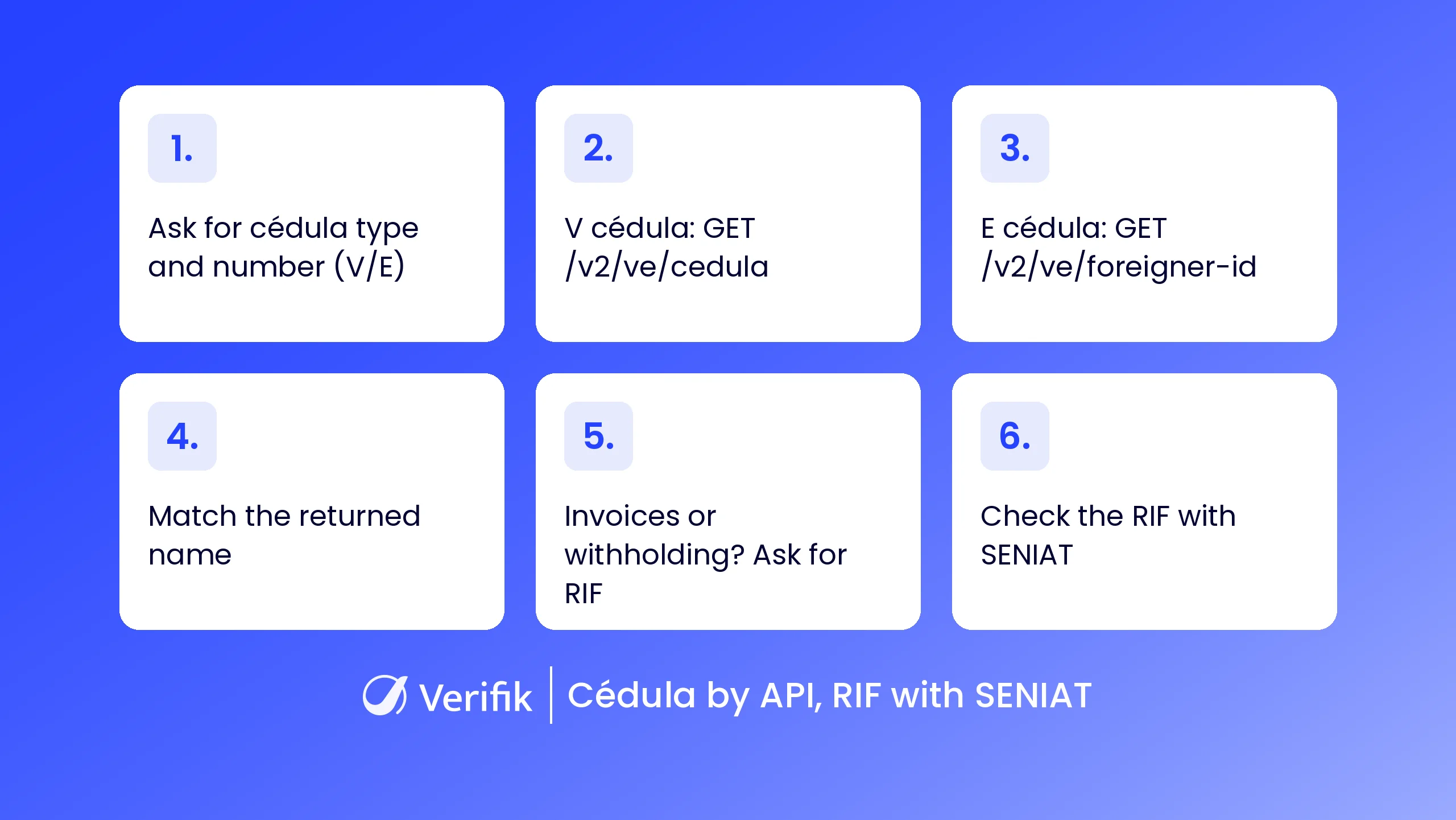
Verifik verifies Venezuelan nationals’ cédulas with GET /v2/ve/cedula and foreign residents’ with GET /v2/ve/foreigner-id. In both cases you send only documentNumber (the API strips dots and spaces) and your Bearer token; the response returns the full name, given names and surnames and, when available, date of birth and gender.
This is the Venezuelan cédula (CCVE) example, following the structure in the official documentation:
curl -G "https://api.verifik.co/v2/ve/cedula" \
  -H "Accept: application/json" \
  -H "Authorization: Bearer $VERIFIK_TOKEN" \
  --data-urlencode "documentNumber=10000001"
{
"data": {
"arrayName": [
"ANA",
"LUCIA",
"PEREZ",
"MARTINEZ"
],
"documentNumber": "10000001",
"documentType": "CCVE",
"firstName": "ANA LUCIA",
"fullName": "ANA LUCIA PEREZ MARTINEZ",
"lastName": "PEREZ MARTINEZ"
},
"signature": {
"dateTime": "November 14, 2026 9:30 AM",
"message": "Certified by Verifik.co"
},
"id": "VE01A"
}For a foreigner ID (CEVE), change the route; the response comes back with documentType: "CEVE" (CEVE documentation):
curl -G "https://api.verifik.co/v2/ve/foreigner-id" \
  -H "Accept: application/json" \
  -H "Authorization: Bearer $VERIFIK_TOKEN" \
  --data-urlencode "documentNumber=10000001"
The documentation lists 401 and 403 (token), 404 (no record), 409 (missing parameter or source out of service) and 500 responses. A 404 or a 409 Endpoint_out_of_service should not reject anyone automatically. You will find the fields, test numbers and business rules in our Venezuela cédula lookup API guide.
What Verifik does not do: there is no RIF endpoint
Verifik does not currently offer a RIF lookup by API. If your process needs the RIF, ask the user for it and confirm it through SENIAT’s channels. What you can automate is the identity side: the cédula (CCVE or CEVE) and, to know the person signing up is the holder, a selfie with liveness detection and a face match inside an eKYC solution.
If you serve Venezuelan migrants in Colombia, the Temporary Protection Permit (PPT) is verified with a different endpoint, covered on our Colombia ID verification page, and the full flow is in our Colombia KYC API guide.
Ready to try it? Create your free Verifik account and verify your first Venezuelan cédula from your code.